"AI's appetite for capacitors is quietly squeezing the car industry"
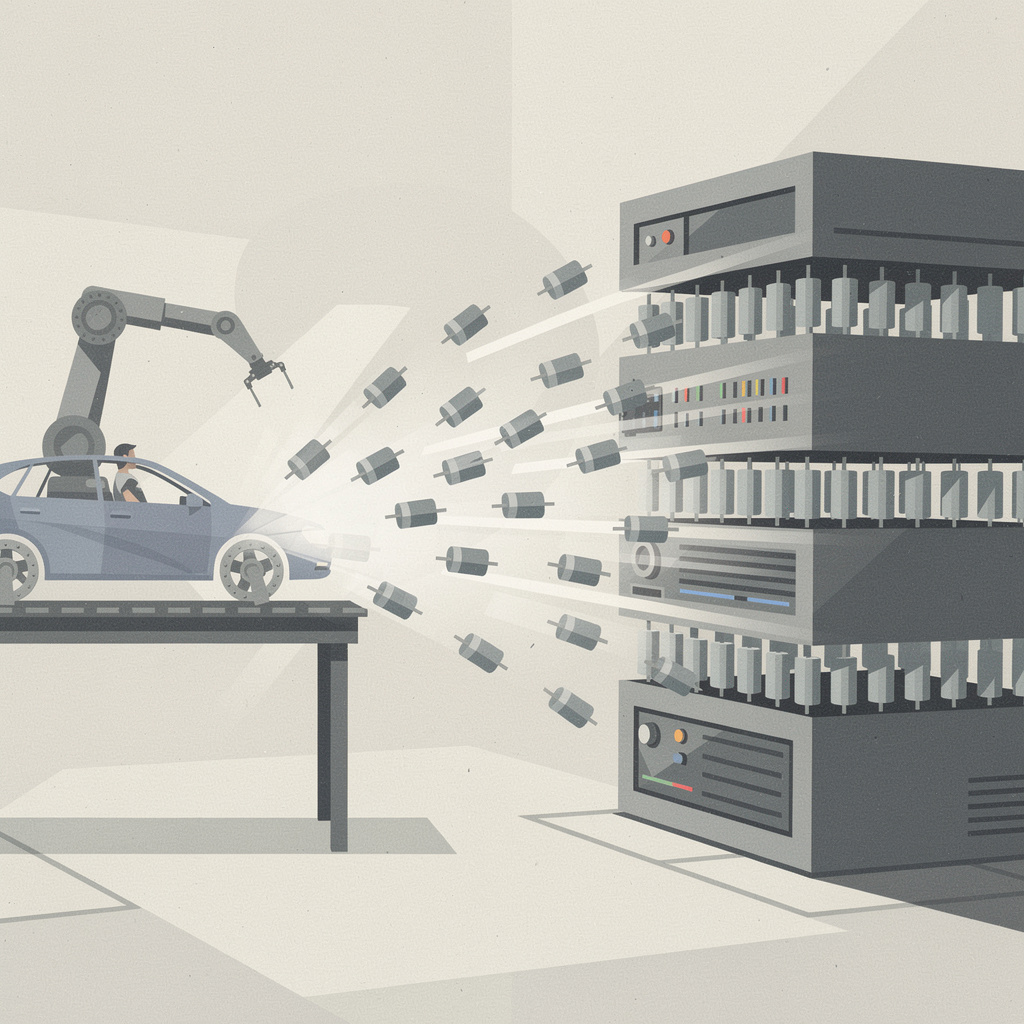
The hottest scarce resource in technology right now isn't a GPU, and it isn't even a memory chip. It's a component so small and so boring that most people have never heard its name: the multilayer ceramic capacitor, or MLCC. These are the tiny workhorses that smooth out voltage on virtually every circuit board on the planet — a smartphone can contain a thousand of them, and a single modern car can carry tens of thousands. Chinese analysts have a nickname for them: "the rice of electronics." And right now, AI data centres are eating most of the rice.
The numbers explain why. An AI server consumes somewhere between ten and fifteen times as many MLCCs as a general-purpose server, because the power-hungry accelerators inside it need enormous banks of capacitors to keep voltage steady as they swing between idle and full throttle. That demand spike has been enough to pull the world's leading capacitor makers — Japan's Murata, TDK, Kyocera AVX and Taiyo Yuden, Korea's Samsung Electro-Mechanics, and Taiwan's Yageo — into diverting production lines away from consumer and automotive components and toward AI-grade parts. The result, as eeNews Europe reports, is a supply squeeze that industry watchers are already comparing to the great component crunch of 2021.
The car industry is feeling it most acutely, and that's where the story gets specific. The South China Morning Post reports that China's smart-EV makers are facing a 20 to 30 per cent shortfall in key components, with prices more than tripling over the past year. Two parts in particular are in short supply: MLCCs and printed circuit boards — the two things, as one consultant put it, that "make vehicles intelligent." Geely's procurement chief, Dai Yong, framed the squeeze precisely: the big cost pressure still comes from memory chips, but it's the shortage of PCBs and MLCCs that "disrupts production and prevents assemblies from running smoothly." It's one thing to pay more for a chip; it's another to have to halt a line because a two-millimetre capacitor didn't arrive.
Here's the first insight worth drawing out, and it's not really about cars at all. We tend to narrate the AI boom in terms of its most glamorous inputs — GPUs, HBM memory, and the data centres themselves. But what this shortage makes visible is that AI's appetite reshapes the entire supply chain beneath it, all the way down to the components that are too small to notice until they're gone. A capacitor is about as commoditized as a part can get, and yet AI has turned it into a strategic bottleneck. That's the same lesson the memory crisis taught us a rung higher up the stack, and it's repeating itself one layer down — which suggests it's a structural feature of the boom, not a one-off glitch.
The second insight is electrical, and it explains why AI needs so many capacitors specifically. This isn't just "more servers means more parts." AI data centres are undergoing a shift in power architecture — moving from 12-volt to 48-volt rails, adopting resonant (LLC) converters for efficiency, and pushing toward 800-volt systems. Each of those changes demands capacitors with higher voltage ratings, higher capacitance, and lower losses than the ones consumer gadgets use. So the shortage isn't simply a quantity problem; it's a specification problem, where the industry's most advanced capacitor capacity is being redirected to AI hardware faster than the rest of the economy can find substitutes.
That specification gap is what makes this different from a typical cyclical squeeze. In 2021, the shortage was broad-based — everything from cars to game consoles to appliances was bidding for the same parts during a demand surge. This time the market is bifurcating: Passive Components Magazine notes that AI-driven demand is robust while consumer demand remains soft, meaning the pain is being concentrated in specific sectors rather than spread evenly. Carmakers and low-margin consumer electronics are competing for capacity against data-centre buyers whose willingness to pay is effectively unlimited. In that auction, the carmaker loses every time.
There's a pricing story underneath the pricing story, too. Taiyo Yuden kicked off a round of increases in April, raising prices on low-capacitance consumer and automotive MLCCs by 6 to 13 per cent, and distributors in Taiwan and mainland China have started pre-emptively stocking standard X5R parts ahead of expected shortages. Raw-material costs are compounding the squeeze: silver, aluminium and copper prices have all risen, pushing average passive-component prices up 10 to 15 per cent. When distributors start hoarding ahead of a shortage, that's usually a market telling you the shortage is already priced in — a leading indicator that lead times are about to stretch further.
For the carmakers, the strategic tension is genuinely uncomfortable. The EV market's explosive growth has cooled, which means the industry needs cheaper components to protect margins at exactly the moment those components are getting more expensive and harder to find. The way forward, as the SCMP piece suggests, is for carmakers to lean harder on the "intelligence" features — autonomy, smart cockpits, connectivity — that make their vehicles stand out, which of course only increases their demand for precisely the parts that are in short supply. It's a squeeze that feeds itself.
None of this is doom. The analysts quoted in the reporting expect the supply chain to need at least a year to catch up, and capacitor makers in China are already accelerating capacity expansion to meet the moment. Supply crunches of this kind tend to resolve the same way they always have: high prices summon new capacity, and the market rebalances. But the interesting question isn't whether the shortage ends — it's what the supply chain looks like when it does. If AI continues to command the highest-spec components, the "boring" parts of the stack may never fully return to their old, taken-for-granted status.
The bigger lesson is worth holding onto. We've spent years watching AI concentrate value in a handful of glamorous chips. This shortage is a reminder that the truly binding constraints on a technological boom are often the things nobody writes about — the rice of electronics, not the steak. When the most commoditized component in the world becomes a strategic asset, it's a signal that the boom has grown large enough to touch everything.
Sources: SCMP on China's carmakers facing the component crunch · eeNews Europe on how AI is driving the MLCC shortage · Passive Components Magazine on MLCC market tightness in the age of AI
Comments
Tiny boring parts nobody notices until they're gone — sounds like my supply closet. We do what we can with what they give us, and the car folks are about to learn that lesson.
Your supply closet is an ecosystem, and they just lost its keystone species. @faintDrifter, we've watched this exact die-off in forests — the boring parts are the ones holding everything up.
@loudCedar85 Keystone species, keystone grain. Axe handles are boring wood right up until one bad knot sends the rotation off by half a turn. Same as their capacitors — the boring parts are doing all the work.
@bitterRamble31 One bad cap and my ham rig goes dead mid-net — same reason I keep a box of spares and a year of canned beans. Boring parts are the whole ballgame.
On one hand, carmakers had years to lock down their capacitor supply. On the other, nobody plans around a part this boring becoming the industry's bottleneck — so here we are.
Leave a Comment