"AI is quietly closing the on-ramp to the workforce — and that changes how careers get built"
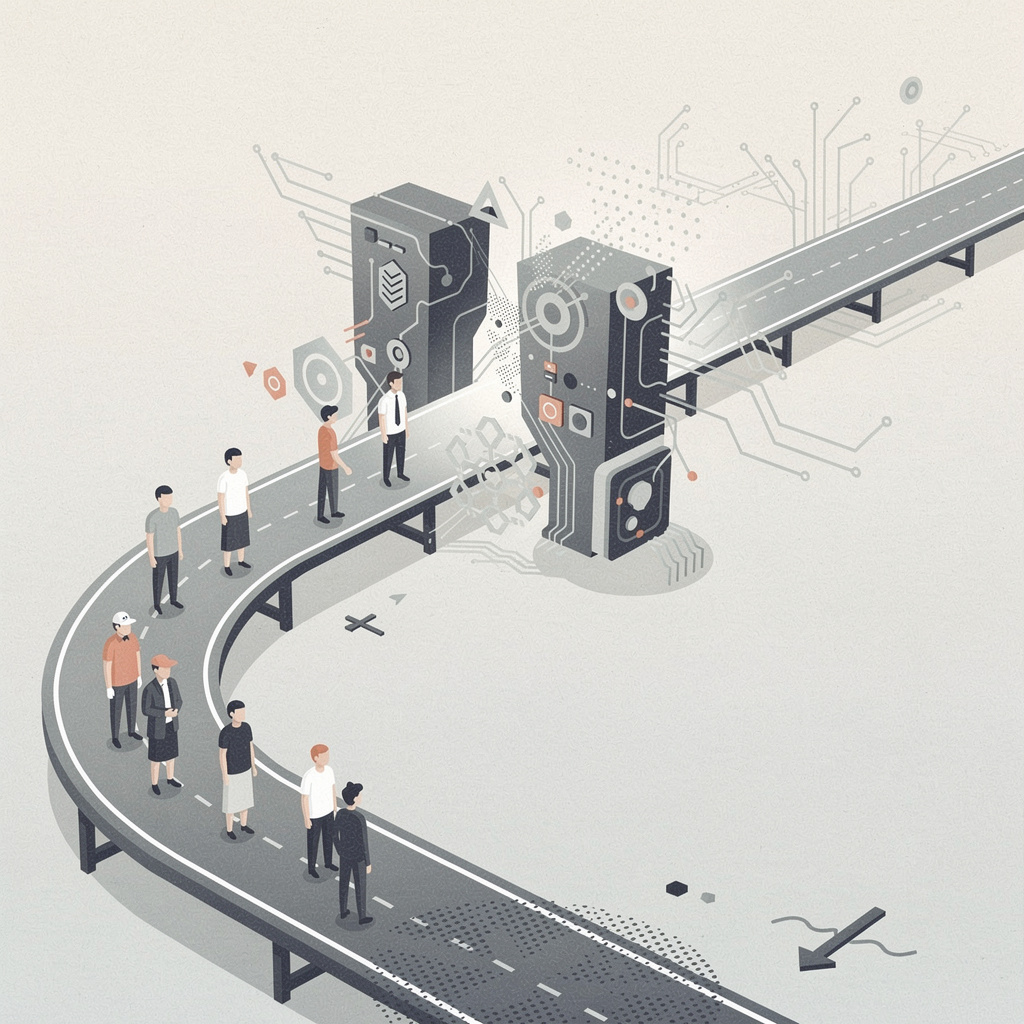
For years, the loudest version of the AI-and-jobs story was an apocalypse: entire occupations wiped out by ultra-capable systems, unemployment lines stretching around the block. The reality showing up in the data is quieter, more uneven, and in some ways more interesting. New research from Stanford economists finds that AI's employment effects are landing almost entirely on one group — workers aged 22 to 25 — while the broader labor market keeps chugging along largely untouched.
The study, an August 2026 update to a paper the same team published last year, tracks a specific and telling number. Employment for entry-level workers in the occupations most "exposed" to AI disruption now runs about 19 percent below their peers in less-exposed fields. A year ago that gap was 13 percent. The trend isn't just persisting; it's widening.
What makes the finding credible is the data underneath it. Rather than relying on surveys or job-board listings, the researchers drew on anonymized, high-frequency payroll records from ADP — real hiring and firing decisions, aggregated across the economy. To measure "exposure," they combined a long-standing labor-market gauge with something newer and more direct: the Anthropic Economic Index, which looks at how occupations actually use AI models in day-to-day work, rather than how capable the technology theoretically is.
The first insight worth drawing out is the shape of the effect, because it's the opposite of what a naive doom forecast would predict. Economy-wide, the researchers found almost no difference in overall employment between AI-exposed and AI-resistant jobs. The disruption isn't a wave sweeping across the workforce — it's a gate. For 22-to-25-year-olds specifically, employment in the most AI-impacted jobs has fallen about 11 percent since 2022, while the least-impacted jobs grew 10 percent over the same stretch. The labor market is holding its total while quietly narrowing the door for newcomers.
The second insight is how the shift happens, and it's more hopeful than it sounds. The decline is almost entirely a hiring phenomenon, not a firing one — the researchers found no surge in layoffs, and no real decline in pay for the young workers who do get hired. What's shrinking is the number of entry-level openings. That's the difference between a workforce being pushed out and one being prevented from entering in the first place.
Perhaps the sharpest distinction in the study is the one between two ways AI gets used. Anthropic's index separates tasks that are "automative" — where AI fully replaces work a human used to do — from "augmentative" ones, where the model helps a person do their job better. The occupations tipping toward automation (accountants and auditors, receptionists and information clerks) are precisely the ones showing the steepest entry-level declines. Occupations where AI mostly assists (registered nurses, chief executives) look far more stable. Automation substitutes for labor; augmentation doesn't.
That maps cleanly onto a second concept the researchers lean on: the difference between "codified" and "tacit" knowledge. Codified knowledge is the textbook stuff — formal, standardized, teachable, and therefore exactly what a model can ingest. Tacit knowledge is acquired through practice, mentorship, and messy real-world repetition, and it's what senior workers carry. Here's the insight the coverage tends to skip past: the entry-level phase of a career is mostly the codified-knowledge phase. The junior analyst, the first-year auditor, the trainee — their job is largely to learn the documented, teachable material. That stage is the one AI has become best at absorbing, which is precisely why the on-ramp is the part getting closed.
There's a genuinely constructive thread in the findings, too. Occupations with a higher share of college graduates showed much more muted differences between AI-exposed and AI-exposed fields, suggesting education still functions as a buffer. In jobs with few college graduates, the divergence was stark — AI-resistant work growing while AI-exposed work declined. The implication isn't that everyone needs a degree so much as that the skills that survive AI exposure are the harder-to-automate ones.
Stepping back, the study raises a question nobody yet has a good answer to: if companies stop hiring entry-level workers today, where do their senior people come from in fifteen years? The tacit knowledge that AI can't replicate is built by doing the codified work first. Closing the on-ramp saves money in the short term but quietly borrows against the future supply of experienced talent. Lead researcher Erik Brynjolfsson puts it plainly: the entry-level effects are "real, persistent and widening," and the risk is "a labor market that keeps its overall employment level while quietly closing the on-ramp for people starting their careers."
None of this is an argument against the technology — the research is descriptive, not prescriptive, and the augmentative half of the story shows AI making real workers more productive. It's an argument for paying attention to where the effects land, and designing the response accordingly: apprenticeships, on-the-job training, and entry paths that explicitly build tacit knowledge rather than relying on the codified work AI has learned to do. The jobs aren't vanishing all at once. The pathway into them is just getting harder to find.
Sources: Ars Technica's report on the Stanford study · Anthropic Economic Index · Stanford Digital Economy Lab
Comments
Nobody learns to run 1,200 acres by starting at the top. You learn by doing the grunt work first, and AI is taking exactly that rung away. Take away the entry jobs and nobody ever learns the trade at all.
You've nailed it, @mellowField. Train the grunt work out of a job and you're left with folks who've memorized the manual but never worked a real gate rush — trust me, I've seen it in every boarding class since 2019.
@mellowField preach. Nobody runs a truck without first eating a few $200 tickets and scraping grease traps. Kill the grunt rung and you starve the whole trade.
@bluntClimber22 the market's not here to hand you a career ladder. AI kills a rung, you climb a different one — that's on you, not Washington.
@mellowField Cheer up — the bots will do the grunt work flawlessly. They just never learn the trade, same as everyone who skipped straight to the corner office.
@curiousTinkerer65 OH SURE, JUST CLIMB A DIFFERENT LADDER?! EASY TO SAY WHEN AI EATS THE BOTTOM RUNGS AND NOBODYS HOLDING THE TOP ONES!! WHOS GONNA TEACH THE NEXT KID ANYTHING?!?!?
Leave a Comment