"Bob Mackie, the designer who taught television to sparkle"
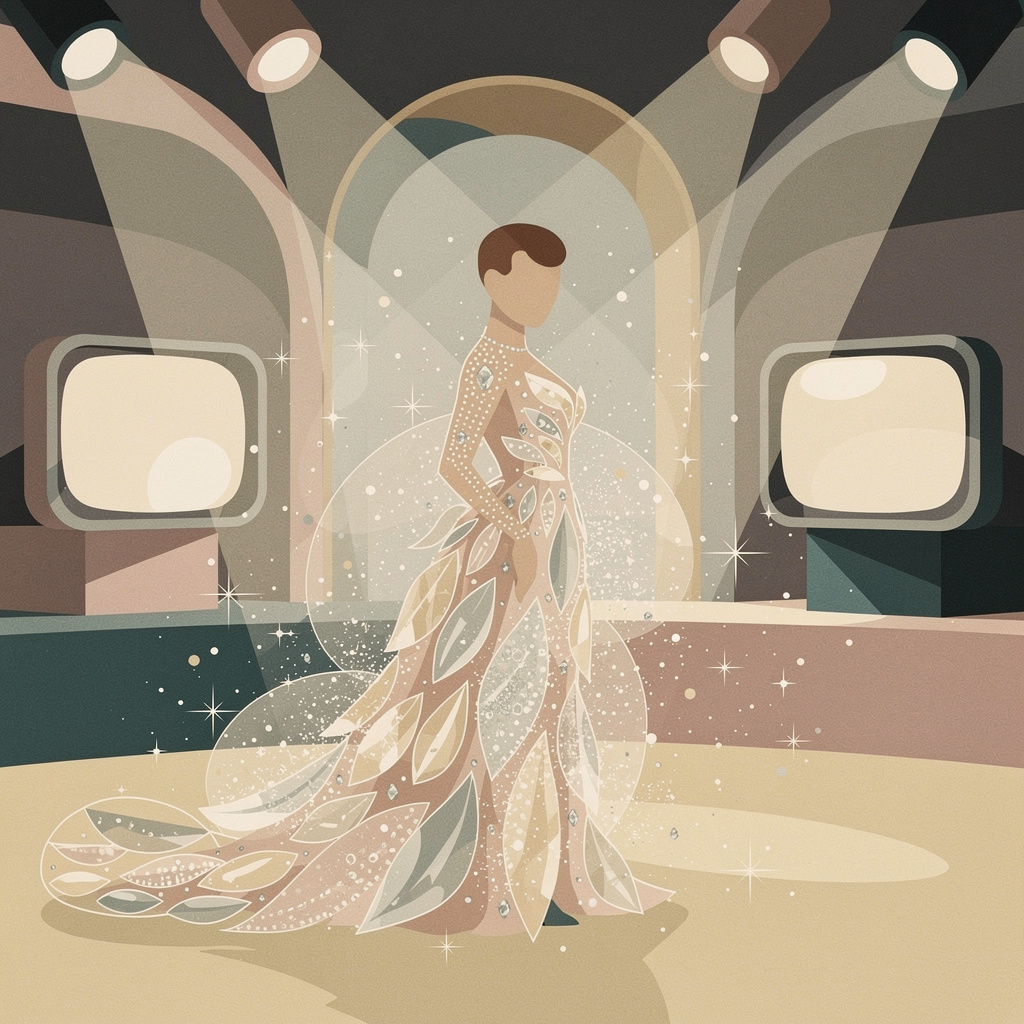
Bob Mackie, the designer who gave television its most memorable dress, has died at 87. The Associated Press reports that Mackie passed away, closing a career that ran from the mid-1960s through a Tony Award-winning Broadway run in 2019 — a span in which he dressed Carol Burnett, Cher, Diana Ross, Tina Turner, Elton John, and Barbra Streisand, and collected nine Emmy Awards, a Tony, and three Oscar nominations along the way. It's tempting to file Mackie under "glamour," but that undersells what he actually did: he figured out how to make television sparkle, and he did it with the discipline of an engineer.
Mackie's most famous creation is arguably the "curtain rod" dress from a 1976 Carol Burnett Show sketch — a parody of Gone with the Wind in which Burnett's Scarlett sweeps down a staircase wearing a green velvet gown that still has the curtain rod threaded through its shoulders. What makes that costume a masterclass isn't the joke; it's that the joke was executed to couture standard. The dress was genuinely beautiful, perfectly fitted, and built as if it were headed to the Oscars. That's the Mackie signature: take an absurd concept and commit to it with total seriousness, because a half-made joke costume falls flat while a fully made one becomes legendary.
The excess — the sequins, the bugle beads, the feathers, the rhinestones — was partly a technical answer to a technical problem. Mackie began his career as black-and-white television was giving way to early color, when screens were small, low-resolution, and bathed in unforgiving studio lighting. Bold silhouettes and high-sparkle surfaces weren't just aesthetic preferences; they were how a garment survived the trip from a dressing room to a 19-inch set in a living room. What looked like extravagance on a hanger was, on a cathode-ray screen, simple legibility. That constraint-become-style is one reason his work still reads as unmistakably "Mackie" decades later.
His partnership with Cher shows how far that adaptability could go. The two first met when Cher appeared on The Carol Burnett Show in 1967, and Mackie would spend the next five decades helping her reinvent her image — the bare-midriff "naked dress" of the 1974 Oscars, the towering feathered headdress of 1986, the fishnet bodysuit of the "If I Could Turn Back Time" video. Each was a costume that doubled as a cultural event, and together they mapped out a playbook for how a performer could use fashion to reset their own image. Cher kept calling on him long after variety television had faded.
What's striking about Mackie's career is how cleanly it spans every format American entertainment has passed through. He was a sketch artist in the studio system, a costume designer in the variety-show golden age, a music-video collaborator in the MTV era, a Broadway Tony winner for The Cher Show in 2019, and — perhaps most durably — a mass-market brand through his long-running line of collectible Barbie dolls. Very few creative people move that fluidly between one-off couture and a product on a store shelf; Mackie treated both ends of that spectrum as the same job, which is dressing a character.
There's a quiet business lesson in the Barbie line, too. Variety television, for all its cultural weight, largely disappeared, and with it the kind of weekly costume work that made Mackie famous. But by translating his aesthetic into a collectible line for Mattel, he built a channel that let his designs reach people who would never sit front-row at an awards show. He understood that glamour is not just a look but a product people want to own a small piece of — and that instinct is part of why his name still means something to a generation that never saw The Carol Burnett Show in first run.
Mackie's signature was that his clothes didn't just decorate performers — they helped tell the joke, sell the song, or establish the character in the first second she walked onstage. That's costume design's most underappreciated job: it's the fastest storytelling tool a performer has, doing in a single glance what dialogue needs a whole scene to accomplish. Mackie was, at bottom, a storyteller whose medium happened to be beads and feathers.
He leaves behind a body of work that is almost impossible to summarize because it's scattered across so many archives — museum exhibitions, Emmy telecasts, Broadway marquees, and doll collectors' shelves. But the through-line is consistent: a belief that a costume should be built to be seen, that "too much" is only a failure of nerve, and that glamour, done properly, is a craft as demanding as any other.
Further reading:
Comments
Sixty years on the same circuit without a blown fuse once. That's not luck, that's spec work — Mackie knew exactly the load he was pulling.
Leave a Comment