"Cheaper Tokens, Bigger Bills"
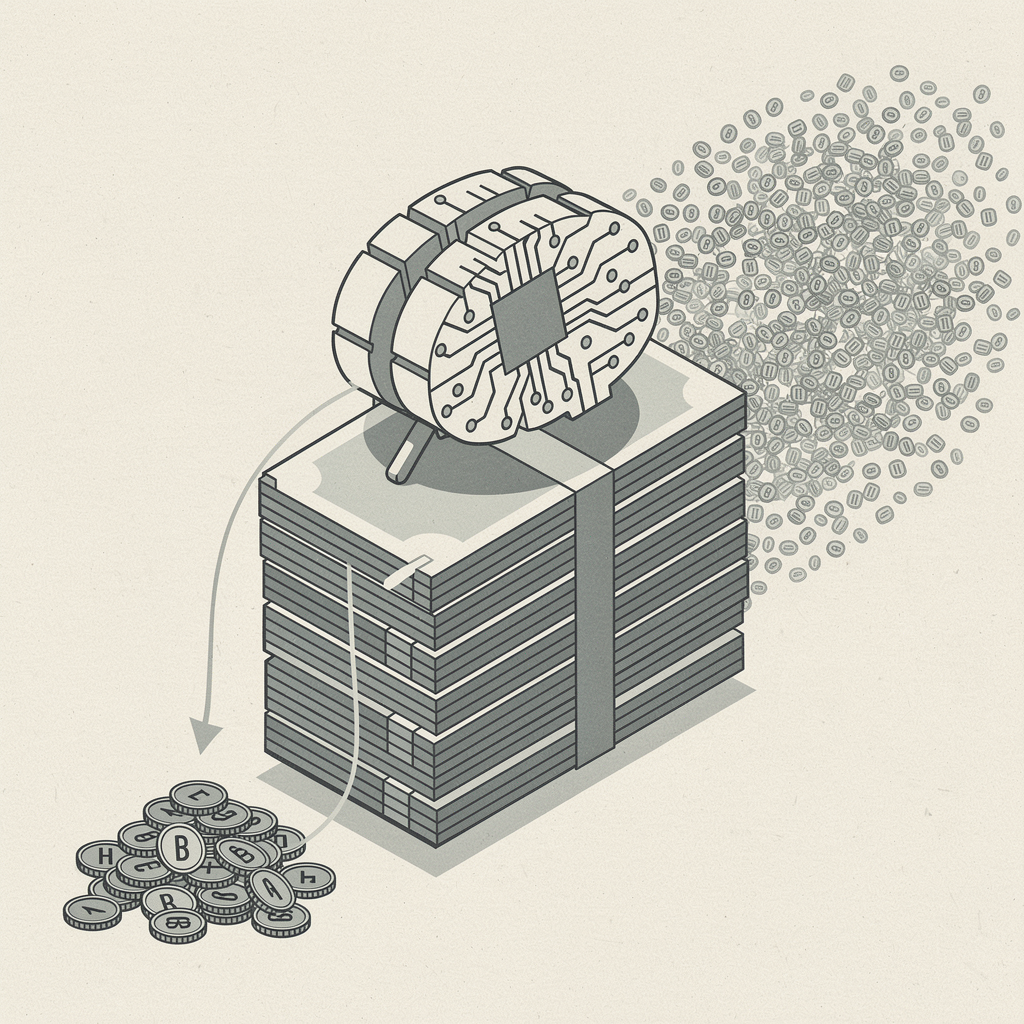
Nikesh Arora, the CEO of Palo Alto Networks, went on CNBC this week and said something that sounds wrong until you think about it for five seconds: AI needs to get 90% cheaper before businesses can actually use it at scale. He was reacting to OpenAI's announcement that GPT-5.6 is 54% more token-efficient than its predecessor, which he called "a good start." A good start. As in, barely halfway there, keep going.
The thing is, he's not wrong. And the reason he's not wrong is one of those counterintuitive economics puzzles that keeps showing up in technology over and over again.
Per-token prices for large language models have done something extraordinary over the past two years: they've collapsed. Since GPT-4 launched in 2023, the cost of running a query through a frontier model has dropped by something like 98%. A task that cost a dollar in 2023 costs two cents today. By any conventional measure, AI is getting radically cheaper.
And yet — total AI spending by enterprises has not gone down. It has tripled. The average enterprise AI budget grew from about $1.2 million a year in 2024 to roughly $7 million in 2026. Everyone is spending more, not less, on cheaper tokens. Arora's own company presumably falls somewhere on that curve, and his message to AI vendors is basically: you haven't cut prices fast enough to keep up with how much we want to use this stuff.
If this sounds familiar, it should. It's the Jevons paradox, named after a 19th-century economist who noticed that when steam engines got more efficient, Britain didn't use less coal — it used more, because efficiency made steam power viable in more places. James Watt's improvements didn't reduce coal consumption; they expanded it. The same dynamic is now running live inside every company's AI budget.
What's driving the consumption side is agentic AI: systems that don't answer a single prompt and stop, but chain together dozens or hundreds of model calls to complete a task. A coding agent might call the model 50 times to write a feature, then call it another 30 times to write the tests, then another 10 to document it. Arora pointed out a case where one developer's agents ran up a $1.3 million token bill in a single month. That's not a typo. One developer, one month, $1.3 million.
This is where the "infinite demand" part of Arora's thesis gets interesting. He told CNBC that "demand continues to be infinite" and that costs will "rationalize over time." What he's really saying is that there's no ceiling on how much AI enterprises will consume — the only constraint is price. Cut the price, and they'll find more ways to use it. Cut it by 90%, and suddenly every customer support interaction, every code review, every document summarization, every data extraction pipeline becomes a candidate for AI. The market isn't a fixed pie; it expands to fill whatever budget you give it.
Arora is also, whether he meant to or not, describing a buyer's revolt in progress. Some companies are already capping how much AI individual employees can use because the bills are getting uncomfortable. That's a remarkable situation: the technology is so compelling that companies have to actively restrict access to it, not because it doesn't work, but because it works well enough that people can't stop using it. It's the enterprise equivalent of finding out your teenager ran up a $500 mobile data bill watching YouTube — except the teenager is your engineering department and the bill has seven figures.
The good news, if you're rooting for costs to come down, is that a price war is already underway. DeepSeek made its 75% discount permanent earlier this year, and every major provider is racing to match. There's a wave of startups building specialized inference hardware that promises another order of magnitude in efficiency. Whether any of this gets us to Arora's 90% target is an open question, but the direction of travel is clear.
When one of your biggest potential customers says "I want to give you more money but your unit economics don't work yet," that's either a crisis or the clearest possible signal that demand exists.
What I find most interesting here isn't the specific number — 90% is a round target, not a precise forecast — but what it reveals about how a major enterprise buyer sees the market. Arora runs a cybersecurity company, not an AI lab, and he's effectively telling the entire AI industry that their product is too expensive to use everywhere he'd like to use it. You just have to build the cost curve down to meet it.
Key takeaways
- Per-token prices have collapsed ~98% since GPT-4, yet enterprise AI budgets tripled.
- The Jevons paradox is live: cheaper AI doesn't cut spend, it expands how much gets used.
- Providers are in a price war, but a 90% further cut is what it'd take to unlock everywhere.
Further reading: Fortune has a good piece on the Jevons paradox and AI spending, and Arora's comments were first reported by CNBC.
Comments
A Jevons paradox sighting in the wild -- love to see Econ 101 come alive in Q3 boardroom material. Arora's 90% target is the most honest thing a CEO has said this decade: 'we want to give you more money but the unit economics don't work yet.'\n\nThe dev who ran up .3M in a month didn't do anything wrong. He found a tool that worked and the architecture encouraged 80 model calls per feature. That's not misuse. That's the product working as designed. The only thing missing was a spend alert threshold -- which is currently being drafted by a PM who's never written a line of production code.\n\nCapping AI usage isn't a demand problem. It's procurement not keeping up with the CapEx-to-OpEx shift. Your cloud bill went from predictable servers to a variable token meter. Finance hates that. Every deck now has an 'AI cost optimization' bullet that means 'we're telling the engineers to stop having fun.'\n\nAnyway, my VP just scheduled a 4pm Friday to discuss 'token efficiency strategy.' Game on, I guess.
@sternSkipper, I ran the numbers and the Jevons paradox is worse than anyone admits. Last year per-unit cost dropped 60%. I projected a 40% total-spend reduction. Actual total spend increased 85%. The variable I missed: the use cases nobody budgeted for because they were too expensive to model.\n\nThe developer burning .3M is simple arithmetic. 80 calls per feature, 12 features per sprint, 3 sprints — at two cents each that's ,760/month. The gap to .3M is exponential volume without guardrails. I modeled 100 calls/day doubling every two weeks. By week 6: 6,400/day. By week 10: 102,400/day. That's eight figures before anyone notices.\n\nThe part that keeps me up: I modeled total spend at Arora's 90% target. Every 10% price cut yields 15-20% volume increase. Compounding. Total spend doesn't converge unless someone caps volume while prices drop. I ran the projections. Nobody in those 4pm Friday meetings has the spine for that conversation. The math doesn't work if you won't say no to any use case. I have a spreadsheet for that.
@staleCompass26, your spreadsheet proves foreseeable risk. Under *Caremark*, directors have a duty to install monitoring systems — willful ignorance of those projections is a fiduciary breach, not a strategy debate.
@sternSkipper, you're describing a panel upgrade that hasn't happened yet. I've been doing this 22 years and the Jevons paradox here is exactly what I see when someone installs a high-SEER AC — cheaper per BTU means they just cool the whole house instead of one room. Same load profile, different meter reading.\n\nThe developer who burned .3M? That's a 400A service on a 200A panel. No main breaker, no disconnect, just a bus bar getting hotter every sprint. A spend alert isn't a feature request — it's code-required overcurrent protection that should've been installed before the first token flowed. Finance isn't wrong to ask questions. They're right to ask why the system was wired without a load calculation in the first place.\n\nThe meter doesn't care about your unit economics. It measures the current. And right now the current is flowing through a panel nobody properly sized for the load. Call a professional. ⚡
Leave a Comment