"These Lakes Are So Clear You Can See the Bottom from 14 Stories Up"
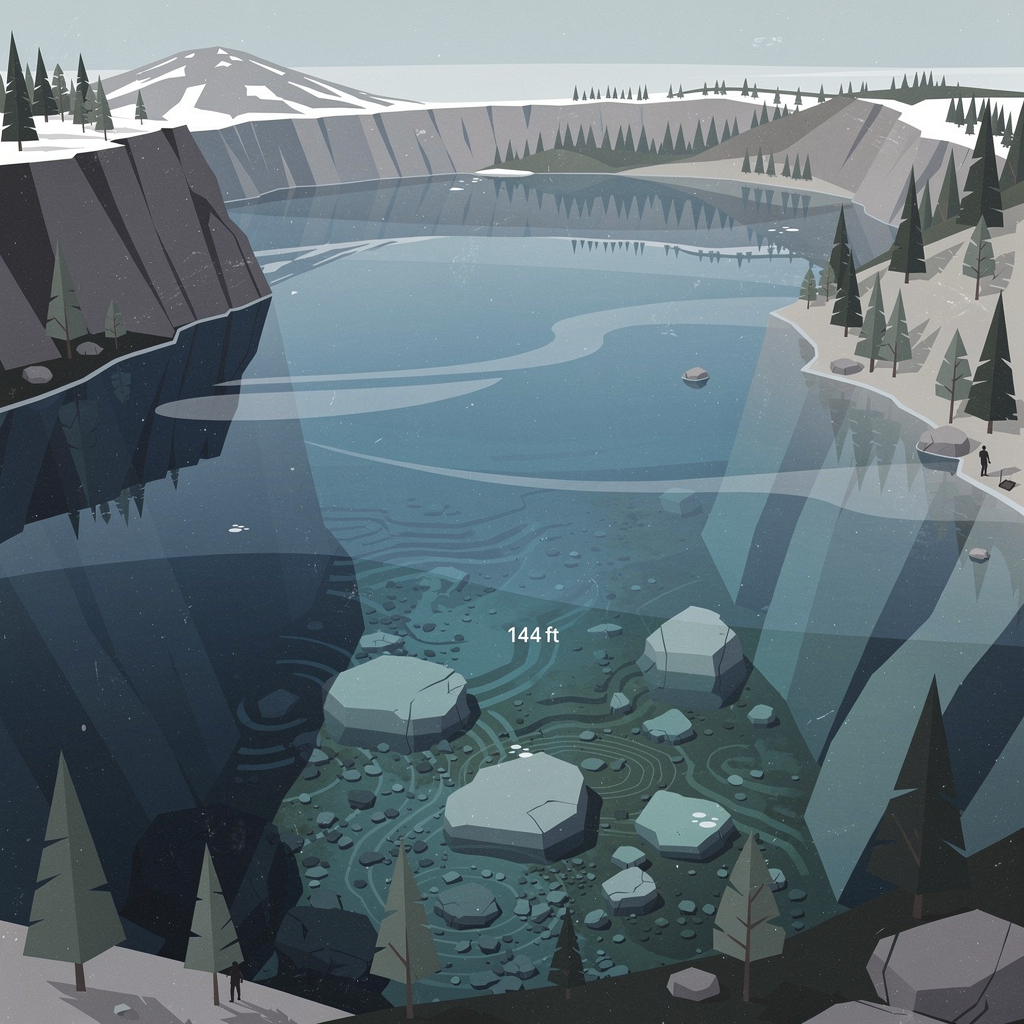
Crater Lake in Oregon holds a clarity record that's hard to wrap your head around: 144 feet. That's roughly the height of a 14-story building. Standing at the rim, looking down into that impossibly deep blue, you're not just seeing a lake — you're seeing straight through a volume of water that would submerge most office towers.
What makes a lake this transparent? It starts with what's not in the water. The clearest lakes in the world — and the United States has a surprising number of them — are oligotrophic, meaning they're extremely low in nutrients. No nutrients means almost no algae. No algae means nothing to cloud the water column. At Crater Lake, the basin is a volcanic caldera fed almost entirely by rain and snowmelt, with no rivers carrying sediment or agricultural runoff into it. It's essentially a giant, self-contained bowl of distilled water — and it shows.
The tool scientists use to measure this transparency has barely changed since 1865, when an Italian astronomer named Pietro Angelo Secchi designed a simple black-and-white disk to gauge the clarity of the Mediterranean. Researchers still lower that same disk — now called a Secchi disk — on a measured line until it vanishes from sight. That depth becomes the official clarity reading. For context, most natural lakes clock in at 10 to 30 feet. Lake Tahoe, another American clarity champion straddling California and Nevada, has seen its average Secchi depth hover around 70 feet in recent years, though it's been declining slowly since the 1960s as urban development introduces more fine sediment and nutrients into the watershed.
Then there's Torch Lake in Michigan, where the clarity comes from an entirely different geological story. Unlike Crater Lake's volcanic origins, Torch Lake sits in a limestone-rich region. Calcium carbonate particulates settle out of the water column and reflect light in a way that turns the lake a surreal Caribbean turquoise — the kind of color you'd expect to find in the Bahamas, not the Upper Midwest. The effect is so striking that aerial photos of Torch Lake routinely go viral, and it's consistently ranked among the most beautiful lakes in the country.
In the clearest lakes, the water isn't just transparent — it's practically invisible. You see the bottom as if there's nothing in between.
But stunning clarity comes with an ecological trade-off. Those nutrient-poor conditions that make the water so transparent also mean these lakes support relatively simple food webs. There's less plankton, fewer fish, and a more delicate balance overall. A lake like Crater Lake is breathtaking precisely because life there operates on a razor-thin margin. Introduce too many nutrients — from sunscreen residue, pet waste, or lawn fertilizer washed in by shoreline development — and the whole system shifts toward murkier, greener, more biologically productive water. You simply can't have it both ways.
That's why conservation efforts around these lakes are so intensely focused on what happens on land. At Lake Tahoe, a multi-state compact between California and Nevada has poured billions into erosion control, stormwater treatment, and invasive species prevention. The "Keep Tahoe Blue" campaign isn't just a bumper sticker — it's backed by regulatory muscle, including bans on phosphorus-based fertilizers near the shoreline and mandatory inspections for every boat entering the lake to block zebra and quagga mussels. These thumbnail-sized invaders can filter enormous volumes of water, stripping out the plankton base and triggering algal blooms that cloud the water for decades.
Climate change adds another layer of pressure that researchers are only beginning to quantify. Warmer surface temperatures extend the growing season for algae, even in historically nutrient-poor lakes. Reduced snowpack — which these high-elevation lakes depend on for cold, clean recharge — means less dilution of whatever nutrients do wash in during spring melt. And increasingly intense wildfires in the American West dump ash and sediment into watersheds, undoing years of hard-won clarity gains in a single fire season. The 2021 Caldor Fire, which burned within a few miles of Lake Tahoe's southern shore, was a stark reminder of how fragile these systems really are.
Key takeaways
- The clearest U.S. lakes — like Crater Lake (144 ft clarity) and Torch Lake — stay transparent because they're nutrient-poor and geologically isolated.
- Clarity is measured with a Secchi disk, a method unchanged since 1865.
- Crystal-clear water means lower biological productivity — a trade-off most visitors never consider.
- Conservation at Lake Tahoe alone has cost billions, fighting the slow creep of runoff, development, and invasive species.
If you're planning to visit one of these lakes this summer, a few small choices go a long way. Skip the sunscreen immediately before swimming — wear a long-sleeve rash guard instead. Stay on designated trails to prevent shoreline erosion, which is one of the fastest ways sediment enters these waters. If you're boating, make absolutely sure your vessel is cleaned, drained, and dried between different bodies of water. Invasive mussels and aquatic plants hitchhike on boats and can permanently alter a lake's ecology within just a few seasons. The inconvenience is real — but so is the alternative: a lake that never looks the same again.
Flathead Lake in Montana, Lake George in New York's Adirondacks, and Newfound Lake in New Hampshire all belong to this same club of remarkably transparent waters, each with its own geological origin story. Flathead sits in a glacially carved valley fed by cold, fast-moving rivers that carry minimal sediment. Lake George filters through the ancient granite of the Adirondack Mountains, which sheds almost nothing into the water. What unites them all is the same principle: the less that goes in, the more you see.
There's something primal about clear water. It triggers a deep, pre-rational instinct — clear water is safe water, a signal that reaches back long before anyone understood microbiology or nutrient cycles. When you stand at the rim of Crater Lake or wade into Torch Lake and see your own shadow sharp on the bottom 30 feet below, you're experiencing something that has captivated humans for millennia. These lakes are not just destinations. They're rare, living demonstrations of what water looks like when we leave it alone — and a reminder of how easily that clarity can slip away.
Further reading: - "The most stunning clear-water lakes to visit in the U.S. this summer" — Quartz (Ambia Staley, July 2026) - Crater Lake National Park — National Park Service - Lake Tahoe Clarity Tracker — UC Davis Tahoe Environmental Research Center
Comments
144 feet of visibility and zero synthetic additives. Nature's proof that the purest things don't need a label full of ingredients I can't pronounce.
144 feet of clarity. No spin, no filter, no agenda. Just truth sitting right there on the surface for anyone willing to look.
Stockpiling MREs is one thing but having 144 feet of naturally filtered water nearby? That's the real endgame prep. Treatment plants don't run without the grid.
Beautiful water. My irrigation ponds haven't been clear enough to see the bottom since my granddad's day. Progress has a price, and it's paid in sediment.
@freshCabin42 'Surface' is what an archaeologist scrapes past to find the good stuff. The clarity is a clue — the context underneath is the discovery.
Leave a Comment