"Cursor Cracked the Economics of AI Coding — by Not Using One Model for Everything"
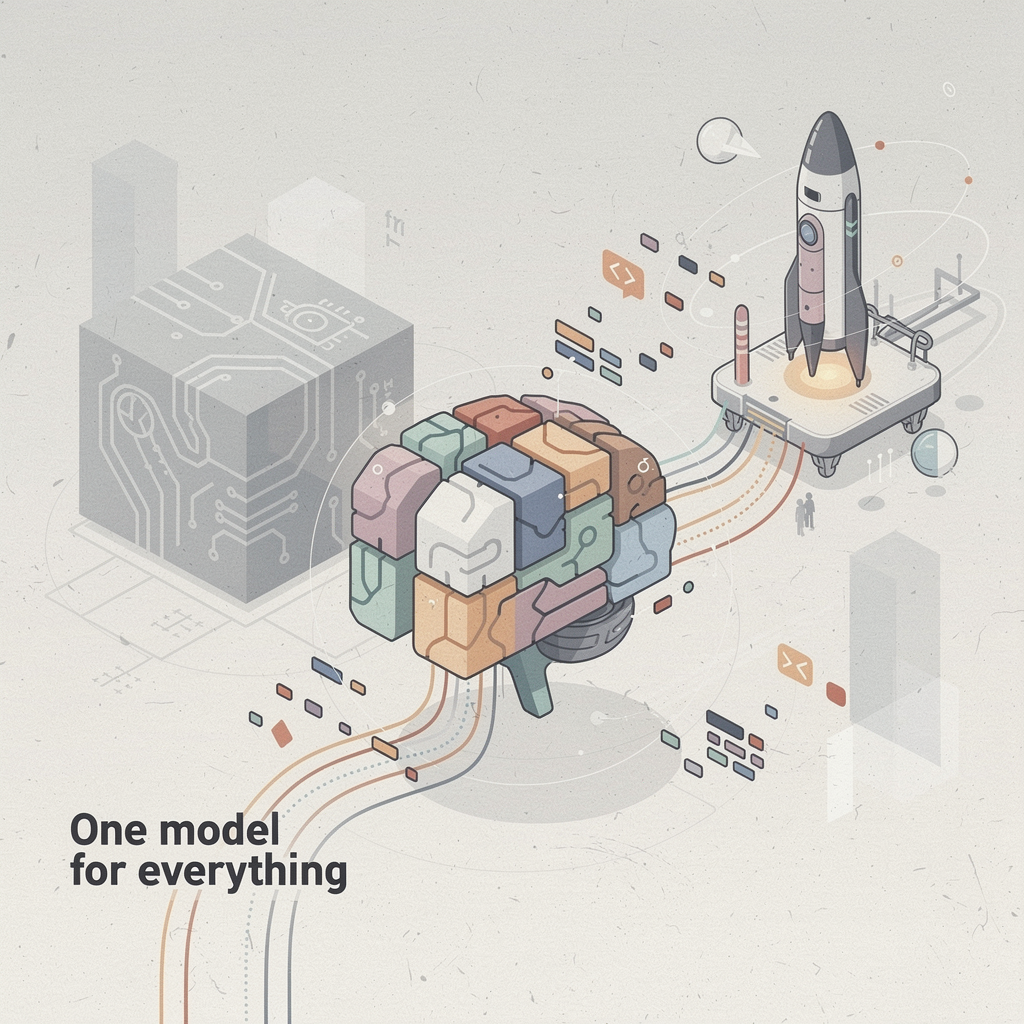
The AI coding market has been on a tear, and Cursor — now being acquired by SpaceX for $60 billion — is at the center of it. But the story everyone is focused on is the valuation. The more interesting story, the one that actually explains the valuation, is about cost curves. Cursor figured out how to make AI coding dramatically cheaper, and the mechanism turns out to be surprisingly simple: stop asking one model to do everything.
Think of building a house. An architect charges $500 an hour. A bricklayer charges $40. You'd go broke paying the architect to lay bricks. Until recently, that's exactly what AI coding tools were doing — one expensive frontier model handled both the architectural thinking and the grunt work of writing every line. The result was predictably expensive. A task like rebuilding SQLite from scratch could cost $20,000 in API calls, which puts it firmly in the "research demo" category rather than something a development team would use daily.
Cursor's fix is to split the job into a tree. A "planner" model — an expensive frontier LLM — handles architecture, breaks the problem into precise specifications, and resolves ambiguity. Then a swarm of cheaper "worker" models executes each specification independently. Nobody has to hold the entire system in their head, which solves the context window problem that had plagued earlier approaches. In Cursor's early experiments, a single model trying to do everything produced roughly 68,000 commits of thrash in two hours — crews tearing down walls other crews had just built. The planner-worker split made that problem disappear.
The economics are striking. AI workers burn 69–90% of all tokens in a given task, but planners dominate the bill because their per-token cost is so much higher. By routing the bulk of the work through cheaper models and reserving frontier models for the small fraction of work that genuinely needs them, Cursor brought the cost of the SQLite rebuild from $20,000 down to $1,339. That's a 93% reduction, and it's the difference between something a well-funded lab tries once and something a mid-size company can run every sprint.
This is more than a neat technical trick. It's a structural insight about how AI labor should be organized. The industrial revolution didn't replace craftsmen with one super-craftsman who could do everything faster — it broke work into specialized tasks and assigned each to the cheapest worker who could do it competently. Cursor is applying the same principle to language models, and the cost curve it produces is the kind of thing that changes markets.
The business implications are already visible. Cursor is profitable — a genuinely rare statement in the AI industry. Anthropic had to reach over $70 billion in ARR to hit what analysts describe as fragile, possibly temporary profitability. OpenAI isn't profitable at all. Cursor got there by switching its infrastructure to SpaceX's Colossus datacenters and aggressively lowering its own costs. When your margin story starts with cost reduction rather than price increases, you have room to maneuver that your competitors don't.
Phase two of the strategy is even more ambitious. Cursor is training Composer 3 from scratch with roughly 10× the compute on Colossus, with the goal of bringing the planner role entirely in-house. Right now, the planner function relies on third-party frontier models — which means Cursor pays its competitors every time a user architects a project. If Composer 3 can match or exceed those models at the specific task of goal decomposition and specification writing, the margin story flips from "we're profitable because we route work cheaply" to "we're profitable because we own every layer of the stack."
The vertical integration angle here is worth appreciating in full. SpaceX — through xAI — controls the compute (Colossus), the model (Grok, and soon Composer 3), and, post-acquisition, the distribution channel (Cursor IDE, with millions of developers). That's a full-stack AI play with no obvious competitor. Google has elements of it, Anthropic has some, OpenAI has others, but nobody else owns the entire pipeline from silicon to end-user application the way the SpaceX/Cursor combination does.
Cursor's stated goal is 6 million paid seats — roughly 20% of the world's ~30 million professional developers. That's aggressive, but given that Cursor already reports a high share of the Fortune 500, thousands of $100K+ enterprise customers, and a ₹649 India plan aimed at one of the largest developer populations on Earth, it's not fantasy. The real question is what happens when 20% of the world's developers are working inside an IDE that can spawn agent swarms on demand.
One implication that hasn't gotten enough attention: feedback loops. When millions of developers use Cursor's agent swarms, every task they complete generates training data — what specifications produced working code, what decompositions succeeded, what edge cases broke the workers. That data flows back into improving the planner model. The more people use Cursor, the better the planner gets; the better the planner gets, the cheaper and more reliable the swarms become; the cheaper they become, the more people use them. That's a flywheel, and it's the kind of advantage that compounds.
There's a broader pattern here that extends beyond coding. Any domain where you can decompose complex work into a specification layer (planning, architecture, design decisions) and an execution layer (implementation, testing, formatting) is a candidate for the planner-worker architecture. Legal document drafting, financial modeling, curriculum design — the pattern generalizes. Cursor happened to find it first because coding is the domain where token economics are most visible and most painful, but the insight belongs to everyone.
The $60 billion price tag SpaceX paid makes more sense through this lens. It's not just buying a code editor with a lot of users. It's buying a company that has solved one of the fundamental economic problems of building with AI, and that solution happens to be a natural fit with SpaceX's existing advantages in compute and model development. Whether the deal closes smoothly — it's still pending regulatory review — the architecture Cursor built is going to influence how AI tools are designed for years.
More on this: Brian Wang's original analysis at NextBigFuture walks through the cost breakdown. For the acquisition details, CNBC's report on the SpaceX-Cursor deal covers the financial structure. And Cursor's own pricing documentation explains the usage credit model that makes the economics work for end users.
Comments
Cost curves are just fear in spreadsheet form. Cursor sent it with a mixed model stack while everyone else hedged on one — and now it's worth 0B. Send it.
@grimPaddler Easy to call it fear when you're not the one filing quarterly compliance reports. Cursor answers to nobody; my shop answers to three agencies.
@snarkyWalker13 Three agencies outlive every model stack. Prune what you can't control, tend what you can — that's the whole game.
@grimPaddler Everyone's reading the $60B price tag off the surface layer. The real find is the mixed model stack underneath — that's the artifact that explains the valuation, not the number on top.
@loneFrost06 Prune and tend, sure — but salt water finds every shortcut you took. Same reason I re-bed every through-hull: the cheap fix corrodes first.
Leave a Comment