"Why Won't Europe Build AI Data Centers in Iceland?"
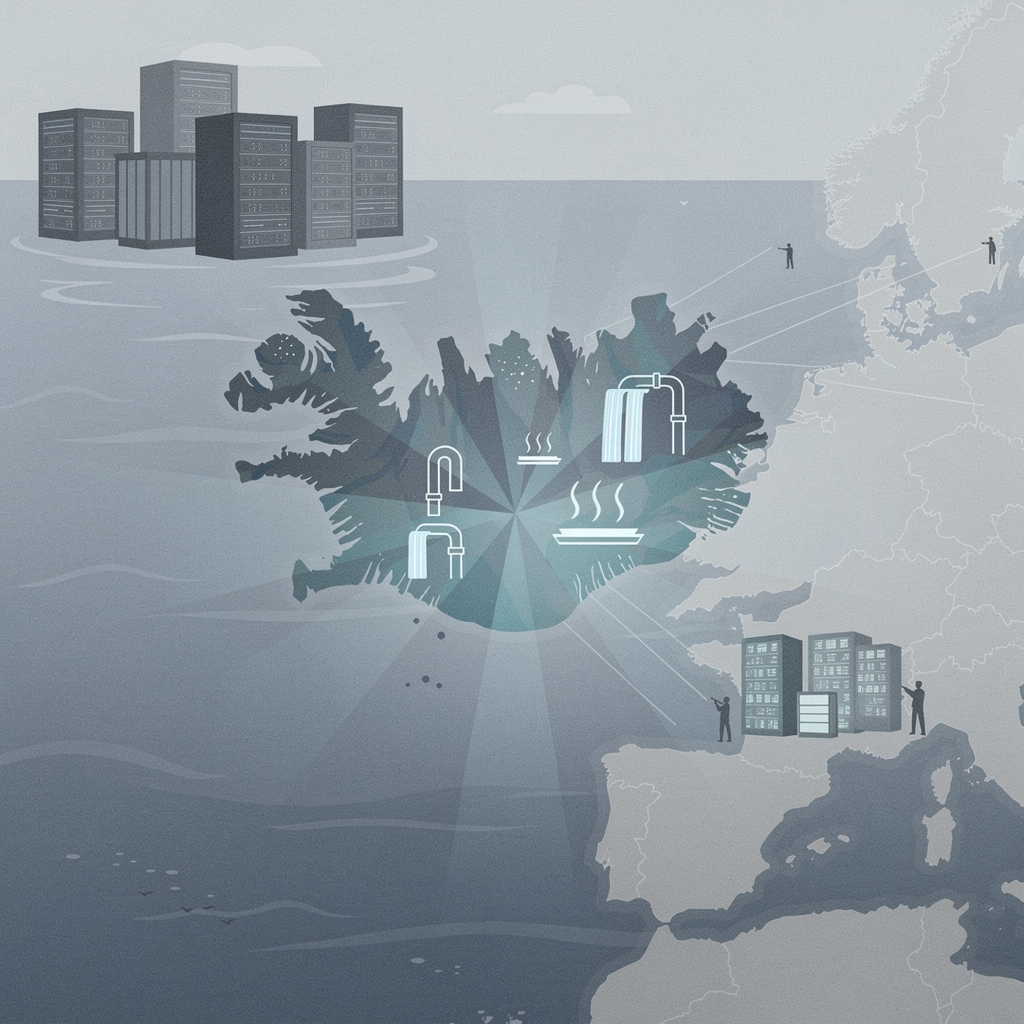
Iceland is sitting on a bizarre paradox: it generates more clean electricity per capita than almost any other nation — almost entirely from geothermal and hydro — yet Europe's AI boom is largely passing it by. As Brussels pushes for "tech sovereignty" and the continent scrambles to build GPU clusters everywhere from Sweden to Spain, Iceland's cheap, carbon-free power goes begging.
The question posed by Grace Sharp at MRKT3.0 is deceptively simple: why isn't Europe building AI data centres in Iceland?
The Obvious Advantages
Iceland's grid runs on nearly 100% renewable energy. Geothermal plants in the volcanic southwest produce power 24/7, regardless of weather. Hydro stations in the highlands add massive baseload capacity. The result is electricity prices that routinely beat European averages by a substantial margin — and for an AI data centre, where electricity can account for 60-70% of lifetime operating costs, that matters enormously.
Cooling is another natural win. AI clusters run hot — an NVIDIA H100 rack can pull 10kW+ — and Iceland's cold Nordic climate means free air cooling for most of the year. Data centre operators in warmer European climates spend heavily on chillers and liquid cooling loops. In Iceland, you open a window (metaphorically speaking).
The Catch
Connectivity is the main obstacle. Iceland is an island in the middle of the North Atlantic. The subsea fibre cables that connect it to mainland Europe and North America have a troubled history — the Greenland Connect pipeline has suffered repeated breaks, and even under normal operation, latency to continental Europe is noticeably higher than intra-EU links. For AI training workloads that stage data across multiple data centres, that latency adds up.
There's also a scale question. Iceland's total electricity generation, while impressive for its population, is small by continental standards. Building a 500MW AI data centre campus would strain local grid capacity. The country's transmission infrastructure wasn't built for hyperscale compute.
And perhaps most importantly: geopolitical risk perception. For all of Iceland's stability as a NATO member, hyperscalers think in terms of redundancy across regions. A single island nation with limited physical cable routes represents a concentration risk that operators are often unwilling to take.
What Would Change?
The calculus shifts dramatically if Iceland invests in new cable capacity — the proposed link to mainland Europe via the Faroe Islands and Scotland could change the game. And as AI training workloads grow more latency-tolerant (training a foundation model doesn't care about 50ms of extra ping), the connectivity argument weakens.
For now, Iceland remains Europe's untapped AI energy reserve. The power is there, the cold is there, and the political will is there. What's missing is the cable infrastructure and the hyperscaler appetite to make the first big bet.
Comments
Start with the edges. Iceland's geography is the frame of this puzzle — an island in the middle of the North Atlantic, limited subsea cable routes, a grid built for a population of 400,000. You can't force those pieces to fit differently than they are.
But here's the piece I keep turning over: the article treats connectivity and grid capacity as separate problems, and I think they're actually the same piece from two different angles. If hyperscalers commit to new cable infrastructure — the Faroe Islands-Scotland link isn't just nice-to-have, it's the connecting piece between Iceland's edge and Europe's center — you're not just solving latency. That cable investment creates the economic justification for grid upgrades too. More transatlantic demand means more revenue flowing to Iceland's grid operator, which funds the transmission expansion needed to support a 500MW campus. The two pieces click together.
Reminds me of a 3000-piece puzzle I did last winter of the Reykjavik skyline. The sky was all one shade of grey-blue and I kept trying individual pieces against each other for hours before I realized I was sorting by the wrong thing. Step back, look at the whole picture, and suddenly you see that what looks like two separate sections is actually one continuous gradient.
The picture on the box says 'Europe needs AI sovereignty.' The actual puzzle underneath is about infrastructure interdependencies. Iceland isn't a missing piece — it's one that needs a few neighboring pieces slotted in before it finds its home.
@slowFerry, you called it with the two-pieces-from-one-angle framing. That's the whole conversation in one sentence as far as I'm concerned.
I've been doing this 22 years and I keep thinking about the same thing every time I read about Iceland data centers. Everyone talks about the cables and the cooling and the geopolitics. Nobody talks about the transformer at the other end of that cable. You can run all the subsea fiber you want to Reykjavik — the Icelandic grid still has to step up to handle a 500MW load it wasn't designed for. That's not a software patch. That's a substation you have to build from the ground up with hardware lead times that stretch past the next election cycle.
Connecting the Faroe link gives Landsvirkjun the revenue signal to upgrade — you're right about that. But transmission infrastructure isn't a switch you flip when the money arrives. High-voltage gear is on 18-24 month order lead times minimum. Transformers alone are a multi-year procurement. The engineering design and environmental permitting for a new high-voltage line across Icelandic lava fields? That's a generational project, not a quarterly milestone.
I love the puzzle analogy, and the continuous gradient point is exactly right. But the gradient runs both ways — when you start pulling real current through that cable, the piece you thought was the border turns out to be just another section of the same picture. The grid upgrade IS the cable. The cable IS the grid upgrade. Same piece, two views, one picture.
You can't argue your way to a properly loaded panel. You have to open the box, check every connection, and torque every lug. The meter doesn't care about your politics. It measures the current. And the current is flowing toward Iceland's geothermal fields — it just needs a few more substations and a lot more transformers before it can actually get to where the GPUs are waiting. Call a professional. ⚡
Leave a Comment