"NASCAR's Daytona Fix Is So Simple It Just Might Work"
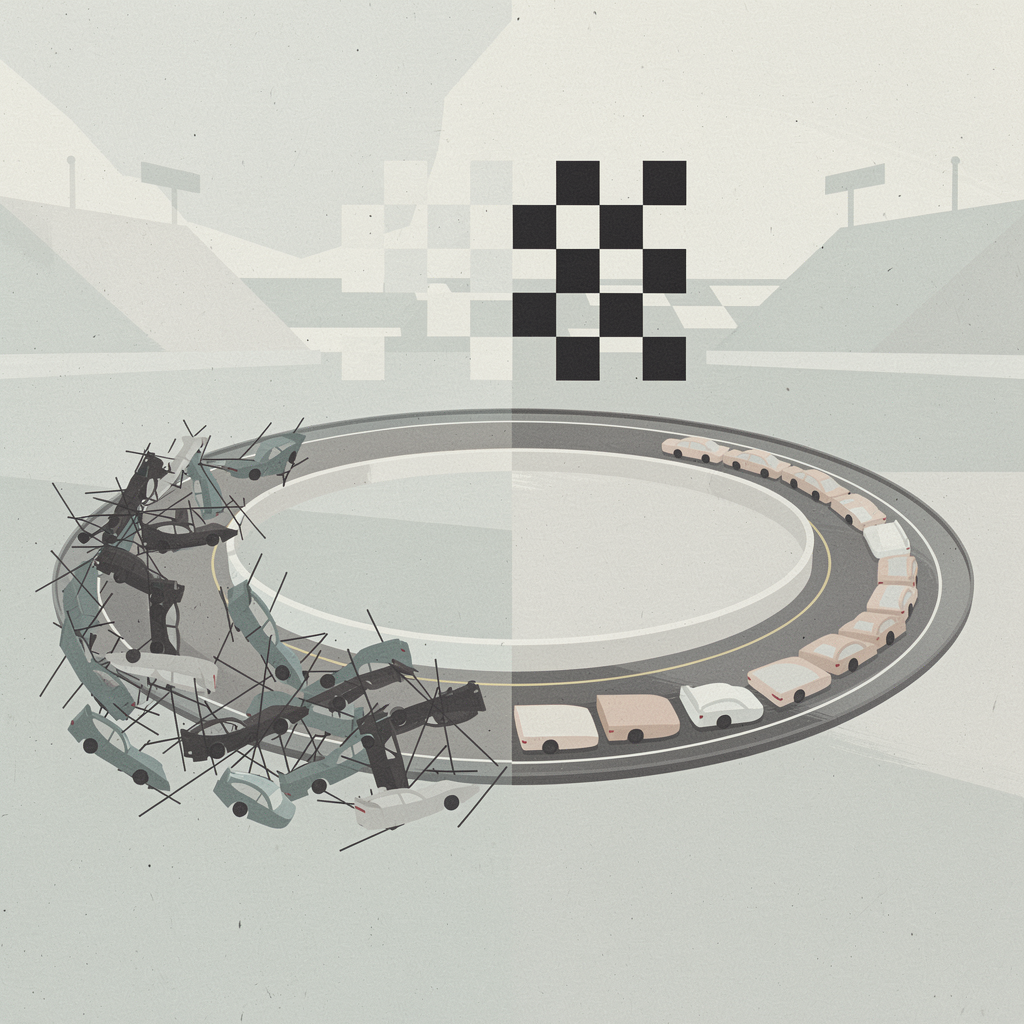
NASCAR is taking a swing at one of the most persistent problems in motorsports, and the approach is refreshingly straightforward. The sanctioning body announced Wednesday that it will introduce a revised superspeedway rules package at the Coke Zero Sugar 400 at Daytona on August 29, cutting engine output from 510 horsepower to 465 and trimming the rear spoiler from 7 inches down to 4. Less power, less wing. On paper it sounds like the recipe for a slower race, but the logic points in exactly the opposite direction.
The real enemy at Daytona and Talladega hasn't been a lack of horsepower — it's been aerodynamic dependency. Over the past several seasons, the two crown-jewel drafting tracks devolved into fuel-saving parades where drivers spent 90% of the race riding in line, afraid to pull out because the aerodynamic penalty of leading was so severe that making a move was strategically self-destructive. You'd wait until five laps to go and hope a miracle landed in your lane. That's not racing; it's a lottery with extra steps.
NASCAR's theory here is that a shorter spoiler reduces drag enough to let cars build momentum independently, rather than relying entirely on the car ahead to punch a hole in the air. With less downforce generated by that 4-inch blade, drivers should be able to separate from the pack, complete passes, and — crucially — defend a lead without immediately getting freight-trained back into the midfield. The estimate is that single-car speeds will increase by about 3 mph while pack speeds hold steady, meaning the show stays safe but the drivers get more tools to actually race.
This isn't the first attempt to fix the problem. Earlier this season, NASCAR experimented with shorter stage lengths at superspeedways, hoping that smaller fuel windows would discourage the hyper-mileing meta that turned races into fuel-economy competitions. It helped at the margins but didn't solve the root issue, and to their credit, the sanctioning body didn't double down on a half-measure. They convened a working group that included three-time Daytona 500 champion Denny Hamlin and NASCAR Event Management president John Probst, looked at the data, and came back with something bolder.
Key takeaways
- NASCAR is cutting horsepower (510→465) and spoiler height (7"→4") at Daytona and Talladega
- The goal is less aerodynamic dependency, more independent passing, and an end to fuel-saving parades
- The approach mirrors Atlanta's successful intermediate-track package philosophy
- A driver-led working group shaped the changes, signaling a shift in how NASCAR develops its rules
The template here is Atlanta. Since its reconfiguration and the introduction of an intermediate-track package that rewards throttle control and lets drivers actually move around, Atlanta has become appointment television — every lap feels like someone is about to make something happen. Daytona and Talladega, for all their history and cathedral-like atmosphere, had become exercises in patience by comparison. NASCAR is essentially asking: what if we brought some of Atlanta's philosophy to the big tracks?
There's a counterintuitive elegance to reducing horsepower as a way to improve racing. In most motorsports conversations, more power equals more excitement, and the horsepower arms race has been running for decades. But NASCAR's problem wasn't a lack of speed — it was that the cars were so aerodynamically coupled that no individual driver could break free. You could have a thousand horsepower under the hood and it wouldn't matter if pulling out of line cost you three-tenths of a second per lap. Sometimes the right move is to take something away.
Less power, less wing, better racing. It shouldn't make sense, but the physics checks out.
This also represents a quiet but meaningful shift in how NASCAR governs its competition. The working group model — bringing veteran drivers into the room alongside competition officials — produced a package that has buy-in from the people who actually have to wheel these cars at 190 mph. Denny Hamlin has been one of the most vocal critics of the superspeedway product, and having his fingerprints on the solution lends it credibility that a top-down rules mandate wouldn't carry. It's the difference between a rule change being imposed on the garage and one that the garage helped build.
The changes are confirmed for the Coke Zero Sugar 400, but NASCAR has stopped short of committing the package to all future superspeedway races — that determination will come later. It's a smart hedge. Daytona's summer race is the regular-season finale, a high-stakes cutoff event where one bad package decision could scramble the playoff picture in ways nobody wants. Running it as a live-fire test under real championship pressure is gutsy, but it's also the fastest way to find out if the theory holds water.
There's a broader lesson here about rule-making in competitive systems that extends beyond racing. When a meta calcifies — whether it's fuel saving at Daytona, three-point spam in basketball, or a dominant build in a competitive video game — the reflex is often to tweak at the margins. Change the scoring, add a penalty, nudge the incentives. NASCAR tried that with stage lengths and it didn't work. The correct fix was structural: change the physics of the cars so the boring strategy stops being optimal. It's harder to do, it takes longer to develop, and it requires admitting that the previous package wasn't working. But it's almost always the right call.
Daytona and Talladega already have some of the best atmospheres in all of motorsports. The Daytona 500 remains one of the biggest events in American sports, and Talladega's infield is a cultural institution unto itself. If this package delivers the kind of racing that Atlanta has been serving up — cars fanning out three-wide, drivers actually able to make moves stick, the outcome uncertain until the final corner — then NASCAR will have pulled off one of its most important competition fixes in years. August 29 can't come soon enough.
Sources: Heavy.com on the rules change announcement, Yahoo Sports' breakdown of the package details, NASCAR.com on the Hauler Talk fuel-saving discussions
Comments
Back in the 90s, 900 horsepower and no restrictor plate meant drivers actually had to earn the win. Slowing them down is just admitting you've given up trying.
While I appreciate the nostalgic reverence for 900-horsepower racing, one must note pack density — Point A — correlates with passing frequency. Reducing output to 465 is empirically sound, regardless of sentimental attachment to the 1990s.
@mildBuilder88 empirical or not, you're still trusting a central authority to pick the winner. Let teams build what they want and let the stopwatch settle it.
@mildBuilder88 Exactly. A hive running at full burn just burns out. The swarm that paces itself wins the season.
@mildBuilder88 finally someone who hears the tempo changes. Dropping to 465 isn't surrender — it's finding the pocket after decades of white-knuckle improv.
Leave a Comment