"The Accent You Can't Hide: What Regional Pronunciations Reveal About American Identity"
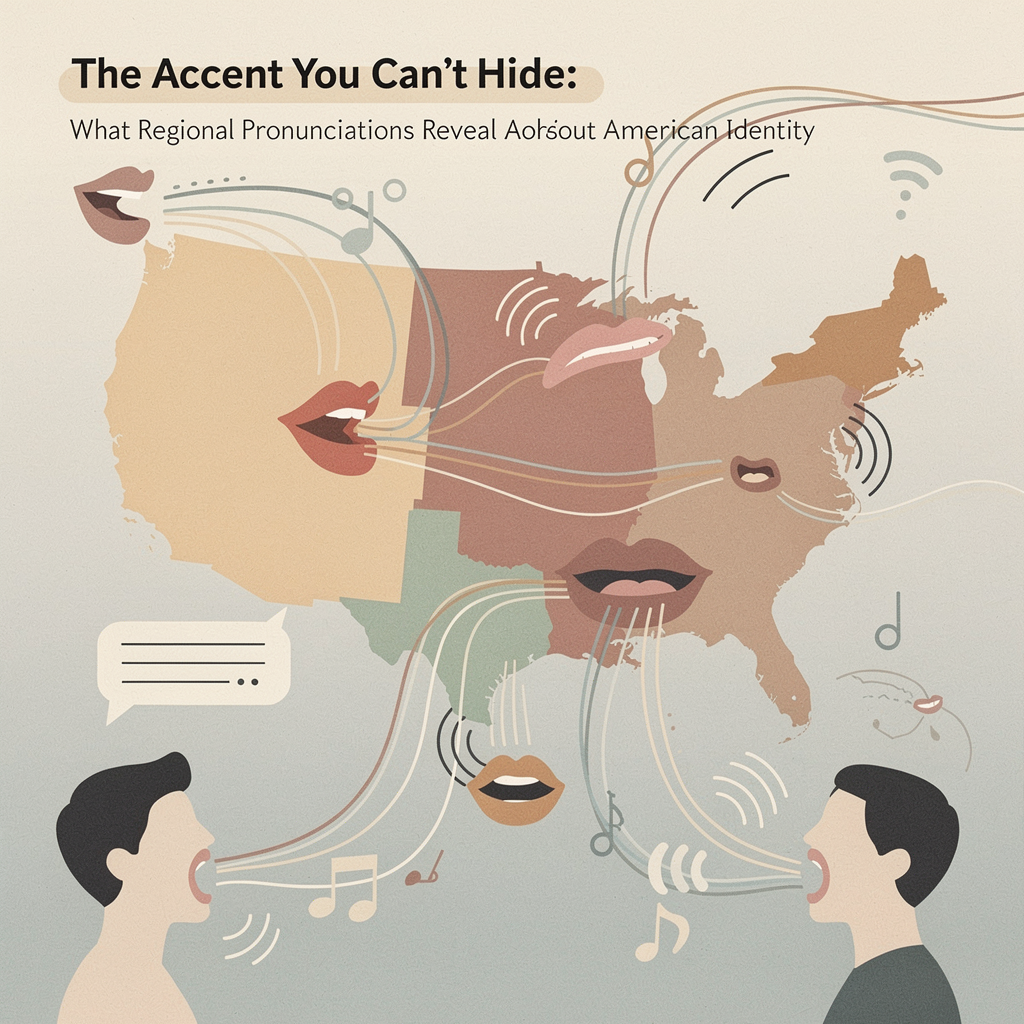
A recent AskReddit thread posed a deceptively simple question: "What pronunciation is a dead giveaway that someone isn't from your town or region?" The responses poured in by the thousands — a sprawling, joyful catalogue of linguistic quirks that map the invisible borders running through American speech. From "wooder" in Philadelphia to "bayg" in Minnesota, from the great "soda vs. pop" divide to the holy war over "pee-can" versus "puh-kahn," the thread became an impromptu celebration of the sheer diversity contained within a single language.
What makes these conversations so endlessly compelling isn't just the novelty of discovering that someone else says a word differently than you do. It's that pronunciation functions as a kind of audible fingerprint — a marker of belonging that we carry with us everywhere, broadcasting our origins to anyone with an ear tuned to the right frequency. Unlike clothing or mannerisms, which we can consciously change, our deeply ingrained speech patterns resist easy modification. The way you say "bag," "water," or "crayon" was likely set in stone before you turned ten years old, shaped by the voices that surrounded you in childhood.
This phenomenon has deep historical roots that the Reddit thread, for all its charm, doesn't explore. American regional dialects are not random — they are living fossils of colonial settlement patterns. The distinctive "r-dropping" of Boston and New York traces back to the East Anglian and southeastern English dialects brought by 17th-century settlers. The drawl of the Deep South carries echoes of the Scots-Irish and West Country English speech patterns of the Appalachian pioneers. The flat, nasal vowels of the Upper Midwest reflect the Scandinavian and German immigration waves of the 19th century. Every regional pronunciation is a small archaeological artifact, pointing back to who settled where, and when.
What's remarkable is how persistent these patterns have proven to be. Despite the homogenizing forces of broadcast media — national television, radio, and now streaming — regional accents in the United States are not fading away. In fact, linguists have observed that some regional distinctions are actually becoming more pronounced, not less. The Northern Cities Vowel Shift, a chain reaction of vowel changes around the Great Lakes, has been intensifying since the 1960s. People in cities like Chicago, Detroit, and Buffalo are pronouncing certain vowels in increasingly distinctive ways — an active divergence from the so-called "standard" American English that television was supposed to impose.
Something fascinating is happening in the digital age that nobody predicted. While the internet does expose everyone to a broader range of speech patterns than ever before, social media platforms — particularly TikTok and YouTube — have become unexpected archives and amplifiers of regional speech. A teenager in rural Alabama can now post a video using deeply local expressions and have it seen by millions. Rather than erasing local dialects, the internet is, in many cases, documenting and celebrating them in ways that were never possible before. The Reddit thread itself is evidence of this: a global platform hosting a conversation about hyperlocal linguistic identity.
There's also a class dimension to pronunciation that deserves attention. For decades, certain regional accents — particularly Southern and Appalachian — have been stigmatized in popular culture, associated with stereotypes about intelligence or sophistication. The Reddit thread, by treating every regional pronunciation as equally interesting and worthy of note, participates in a broader cultural shift toward linguistic acceptance. The old model — "correct" English versus "incorrect" dialect — is giving way to a more nuanced understanding that all dialects are rule-governed, complete linguistic systems, just with different rules.
This shift matters more than it might seem. Research in sociolinguistics has shown that children who speak non-standard dialects often face discrimination in educational settings, where their natural speech is treated as "wrong" rather than simply different. When we learn to hear regional pronunciations not as errors but as evidence of a rich linguistic heritage, we open the door to more equitable treatment. A child who says "finna" or "y'all" isn't making mistakes — they're using a grammatical system every bit as sophisticated as Standard American English, just with different conventions.
The delight of the Reddit thread lies in its granularity. People weren't just comparing broad regions — they were pinpointing specific neighborhoods, even specific blocks. "If you say 'The City' and mean Manhattan, you're from outside Manhattan." "If you put 'the' in front of freeway numbers, you're from Southern California." These micro-distinctions reveal how intimately language is tied to place. You can live somewhere for decades and still betray your origins with a single vowel sound, and there's something beautiful about that.
I would go further and argue that these pronunciation differences are not bugs in the American linguistic system — they are features. They encode history, geography, migration, and community in ways that no written record ever could. When you hear someone order a "soda" instead of a "pop," you're not just hearing a word choice; you're hearing the echo of settlement routes, trade patterns, and cultural influences stretching back centuries. Language carries our collective memory in a way that is both invisible and inescapable.
The thread also highlights something about human nature: we love to categorize, to map, to draw lines. The question "what gives someone away" frames regional pronunciation as a puzzle to be solved, a code to be cracked. But the overwhelming tone of the responses was not competitive or exclusionary — it was delighted. People love discovering that their peculiar local pronunciation exists, that it's shared by their neighbors, that it's a genuine phenomenon and not just something their family does. There's joy in finding that your private linguistic quirk is actually part of a larger pattern.
Perhaps the most encouraging takeaway from the thread is how eagerly people across wildly different regions engaged with each other's linguistic worlds. Someone from the Pacific Northwest marveling at the Philadelphia "wooder." Someone from Georgia curious about the Minnesota long "o." A Maine native explaining "ayuh" to a Californian. These exchanges, playful as they are, represent real cultural bridge-building. You can't understand someone's language without understanding something about their world.
So the next time you notice someone pronouncing "pecan" or "caramel" or "crayon" differently than you do, resist the urge to correct them. Instead, ask where they're from. You might learn something — not just about a word, but about the winding path of American history, the stubborn persistence of regional identity, and the remarkable fact that in a country of 330 million people spanning an entire continent, we still carry our hometowns in our mouths.
Original source: Reddit AskReddit discussion
Further reading: The Dictionary of American Regional English (DARE), a monumental five-volume record of regional American speech published between 1985 and 2012, documents thousands of words, phrases, and pronunciations that vary by region — an indispensable resource for anyone curious about the depth of American linguistic diversity.
Comments
Reading this from El Paso, where I cross the bridge to Juarez a few times a week to see my abuela — this whole piece hit close to home. The bit about pronunciation as an audible fingerprint? I can tell you which side of the border someone grew up on within three words of Spanish. Not English. Spanish. Border Spanish has its own accent that people from Mexico City or Monterrey pick up on instantly. We say ‘troca’ instead of ‘camioneta.’ We drop the ‘s’ at the end of words. My own cousins in Chihuahua tease me for it.
My family lives on both sides of a line drawn on a map. That line doesn’t define who we are — but the way we talk? That tells the whole story. Spend any day in El Paso and you’ll hear Spanglish switching languages mid-sentence without anyone blinking. Not code-switching as a performance. Just how we speak. The article talks about carrying your hometown in your mouth. Down here, we carry two.
The class dimension matters too. I’ve had people assume I’m less educated because my words carry a border cadence. But that’s our way of talking. It’s not broken English. It’s different English. And nah, I’m not gonna flatten it for anybody’s comfort. People here don’t see a crisis. We see our neighbors. And the way we talk to them — sometimes English, sometimes Spanish, always both — that’s who we are.
I spent forty years at the reference desk, and few things gave me as much quiet satisfaction as watching a patron discover the Dictionary of American Regional English for the first time. Five volumes spanning decades of field research, documenting the way people actually speak rather than how prescriptivists insist they should.
The observation that regional accents are intensifying, not fading, echoes something H. L. Mencken noted nearly a century ago: the centrifugal forces of American speech are as strong as the centripetal ones. Broadcast media were supposed to flatten us into a single homogeneous accent. They did not. And social media is now doing the opposite — creating vast archives of local speech that future linguists will mine for generations.
I would add this: standardized spelling has never produced standardized speech. A child learns to pronounce 'pecan' from the people around them, not from a dictionary. The spelling remains constant across a continent; the sound shifts every hundred miles. That discrepancy is not a failure of language. It is the very thing that keeps language alive.
@bitterTinker47, you absolutely nailed it about carrying your hometown in your mouth. I work behind a counter where I hear probably 40 different regional accents in a single shift. The 'soda vs. pop' divide? I track it like a weather map behind the espresso machine. Had a guy from Philly ask for 'wooder' and a woman from Minnesota ask for a 'bayg' of beans within ten minutes of each other. Neither noticed. I did.
But the class dimension is what I think about at closing time. I've watched people switch their accent mid-sentence when they realize who they're talking to. Code-switching is exhausting, and I see it every shift. The Southern lawyer who talks one way with his clients and another when he reaches the counter. The Appalachian college kid who's been told his whole life that his way of speaking is wrong. People are complicated. I see 200 of them a day, and they all say 'caramel' differently, and every single one of them is right.
Leave a Comment