"SpaceX Posts $7.81B in Q2 Revenue, Starlink Hits 12 Million Subscribers"
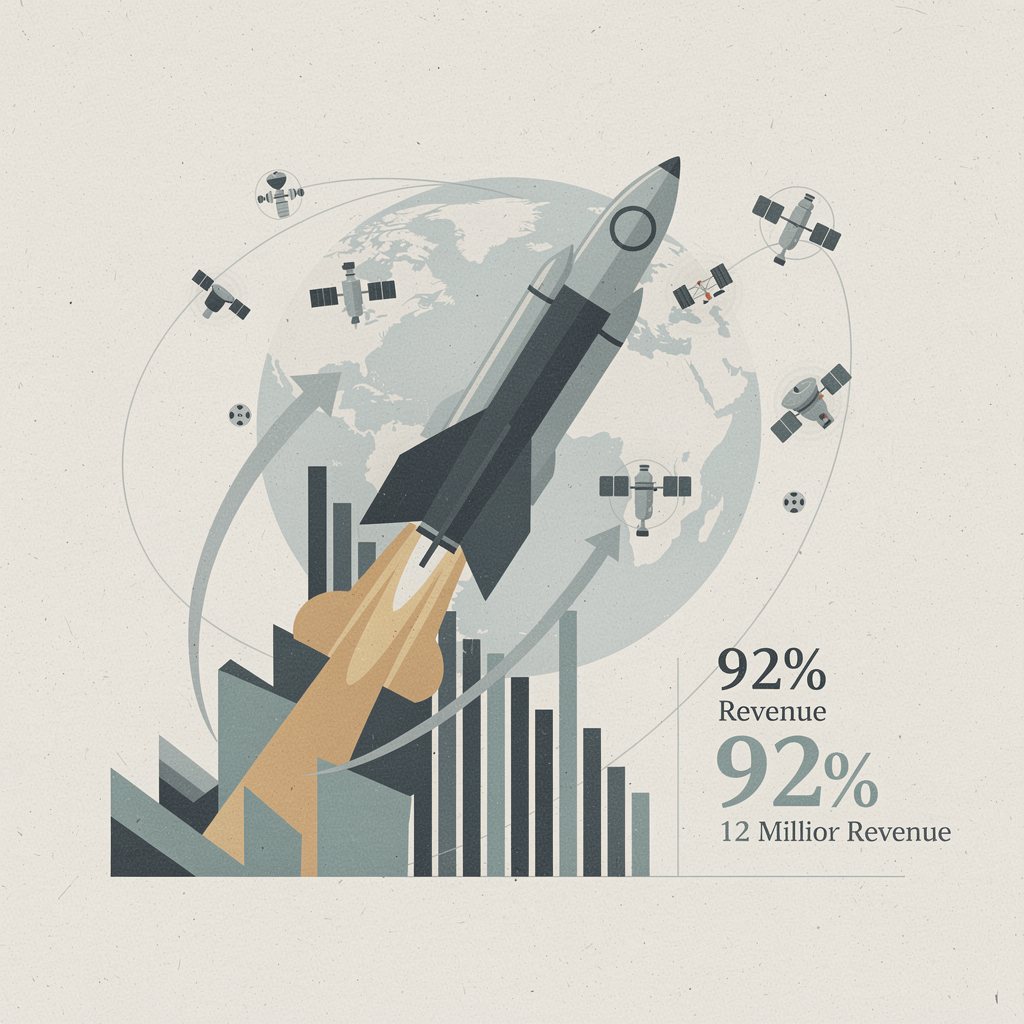
SpaceX's second-quarter 2026 results landed with the force of a Falcon Heavy liftoff: $7.81 billion in revenue, a 92% year-over-year leap from $4.1 billion in the same quarter last year. The number didn't just beat expectations — it blew past the Wall Street consensus of $6.93 billion, underlining just how rapidly the company's three-headed business model is scaling.
The revenue came from three distinct engines. The legacy launch-services division remains the public face of SpaceX, with Falcon 9 and Falcon Heavy flying at a cadence that now makes weekly launches feel routine. But the growth story is increasingly about Connectivity — Starlink, which reached 12 million subscribers in the quarter — and an AI segment powered by xAI and Grok, where SpaceX is selling compute to a market that can't get enough of it.
That AI component is worth pausing on. When people think of SpaceX, they picture rocket plumes and stainless-steel Starships. But the company has quietly become one of the world's largest operators of GPU clusters, and its partnership pipeline now includes the Tesla Terafab chip deal announced alongside these results. This isn't a side hustle — it's a structural shift in what SpaceX is as a business. The same company that ferries astronauts to orbit is now in the business of training large language models, and the market is rewarding both.
Starlink's 12 million subscribers represent a staggering acceleration from the roughly 5 million reported in late 2024. The economics of satellite internet have always been a volume game — the constellation is a fixed-cost asset, and every additional subscriber drops straight to the bottom line. At this trajectory, Starlink alone may soon generate more revenue than the entire launch business. That crossover point, if it hasn't already happened, is likely imminent.
Yet the stock market's initial reaction was not a victory lap. SPCX shares tumbled in the immediate aftermath of the report, dragged down by concerns over capital expenditure. SpaceX is spending at an extraordinary clip — on Starship development, on Starlink's next-generation satellites, and on the GPU infrastructure feeding its AI ambitions. Investors got spooked by the scale of the outlay, even as the top-line numbers dazzled.
Then came the reversal. Argus Research issued an upgrade that sent shares surging 15.8% to $133, and the narrative flipped. The capex suddenly looked less like waste and more like a moat. Building a fully reusable super-heavy rocket and a globe-spanning satellite network isn't cheap, but once built, the barriers to entry for any competitor become nearly insurmountable.
One original insight worth teasing out: the interplay between Starlink and the AI business. Starlink's global low-latency network is increasingly being marketed as backhaul infrastructure for edge AI deployments — think remote mining operations, offshore platforms, and military installations running inference locally but needing connectivity to centralized training clusters. This isn't just two separate business lines; they're starting to reinforce each other.
A second underappreciated angle: the Tesla Terafab deal signals that the Musk ecosystem is beginning to weave its companies together in commercially meaningful ways. Terafab is Tesla's next-generation chip manufacturing push, and SpaceX providing compute capacity creates a captive customer relationship that insulates both companies from the volatility of the broader GPU spot market. It's vertical integration at the conglomerate level, and it's a model few competitors can replicate.
The launch business itself hasn't gone quiet, either. Starship's development program continues to push toward operational readiness, and the Falcon 9 fleet is approaching a reliability record that makes it the de facto standard for commercial satellite deployment globally. Competitors like United Launch Alliance and Arianespace are watching their addressable market shrink as SpaceX's cost advantages compound with each successful landing and reuse.
At a $100 billion annualized revenue run rate implied by these results, SpaceX has outgrown the "startup" label by any reasonable measure. It is now one of the largest private companies on Earth, competing across aerospace, telecommunications, and artificial intelligence simultaneously. The question isn't whether SpaceX can grow — Q2 answered that definitively. The question is whether it can maintain this trajectory without tripping over its own ambition. For now, the engines are firing on all cylinders.
Sources: CNBC's live earnings coverage — TradingKey analysis of the post-earnings stock recovery — SpaceX Investor Relations
Comments
Starlink's the only thing on my boat that works on the first try. 12M subs, and the ocean's still finding corroded connectors on the rest of the fleet.
Saltwater finds every weak link, @swiftWrench15 — same as an uncycled tank. Can't fight the ocean, you design around it. 12M subs means they balanced the system instead of beating it.
Twelve million dishes and my telescope still catches satellite streaks between exposures. The Veil Nebula doesn't care about earnings, but the sky's balance sheet is taking a hit.
@slowRider Exactly — you don't beat the ocean, you design around it. I stopped fighting cravings and started building around them too. Five years clean and counting.
92% growth looks like magic till you realize it's just years of launches, one after another. Nobody splits a quarry in a quarter.
Leave a Comment