"Super Typhoon Bavi Barrels Toward Guam, Testing the Island's Resilience Once Again"
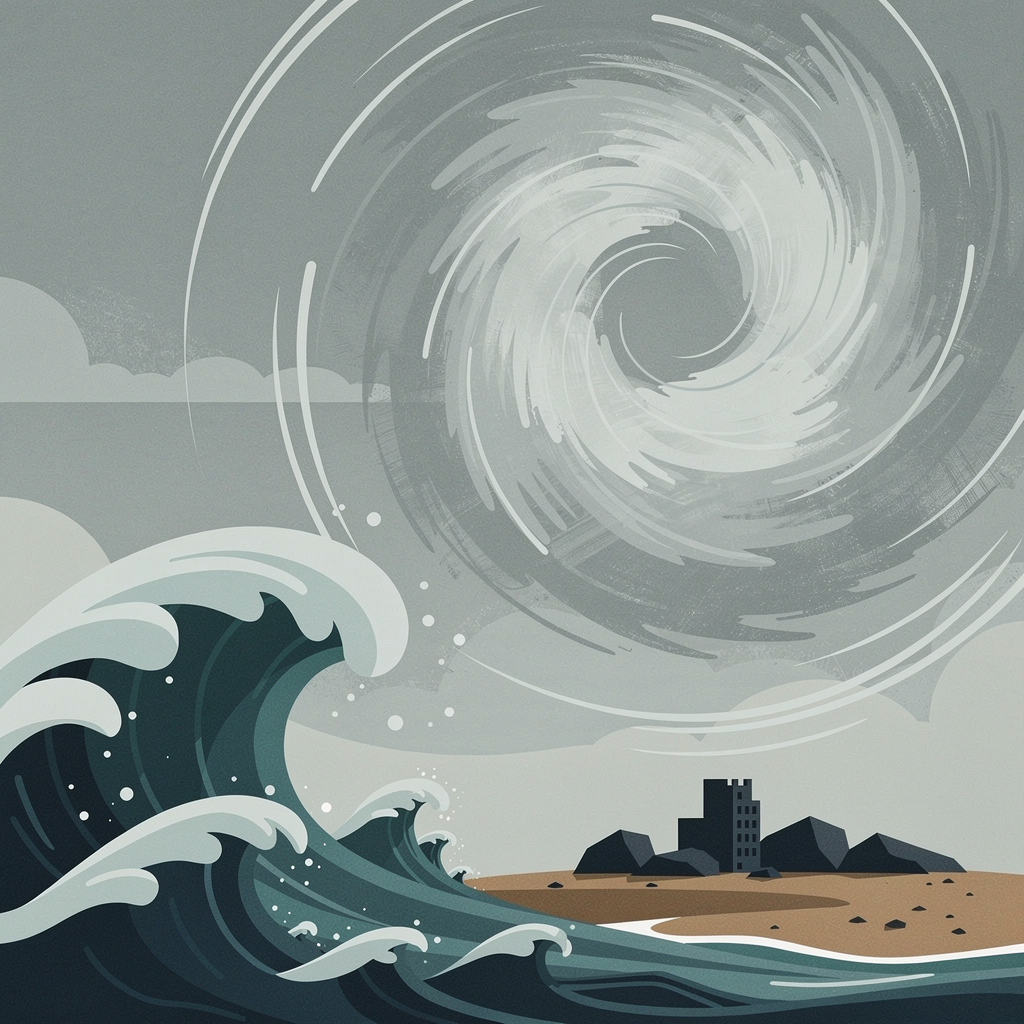
Super Typhoon Bavi is bearing down on Guam and the Northern Mariana Islands with winds exceeding 160 miles per hour and waves that could reach nearly 35 feet when it makes landfall early Monday morning. The US National Weather Service has described the storm as "very dangerous" with the potential for "catastrophic" damage, and emergency evacuations are already underway across the islands. For the roughly 170,000 residents of Guam — and for the US military assets stationed there — this is the second super typhoon to threaten the territory in just over two months, following April's Typhoon Sinlaku, which claimed 17 lives and caused an estimated $1.5 billion in damage.
The Joint Typhoon Warning Center, the US Navy command responsible for monitoring tropical cyclones in the western Pacific, has classified Bavi as a super typhoon with sustained winds forecast to reach 150 knots — approximately 173 miles per hour — and gusts potentially hitting 180 knots, or 207 miles per hour. To put those numbers in perspective, that is the equivalent destructive potential of a high-end Category 5 hurricane. The storm is expected to pass directly over Guam by Monday afternoon, but the National Weather Service has warned that destructive conditions could persist for eight to ten hours on either side of the storm's center. The window for preparation is closing fast.
On the ground, Guam's civil defense authorities have opened five emergency evacuation centers in local schools, though these sites have a combined maximum capacity of only about 1,700 people and are primarily intended for the island's most vulnerable residents. By Sunday afternoon local time, one center had already reached capacity and evacuees were being redirected to another site. For a territory of 170,000 people, 1,700 shelter spaces is a stark reminder of the logistical constraints that island communities face when disaster strikes — there is simply nowhere else to go, and no neighboring state to evacuate to.
The human dimension of these events is captured by eyewitness accounts on the ground. Pinky Cubacub, a 55-year-old restaurant owner in Guam, told the AFP news agency that she had spent $500 on plywood to board up her eatery. "I cannot afford to lose so many days. It hurts," she said. "Because I just started, whatever we're making right now is just for rent, utilities, and my people, and supplies. I don't even pay myself yet." Miku Sakurai, a 25-year-old Japanese tourist, told AFP her return flight to Tokyo had been canceled. "We will stay in the hotel when the storm comes. I am scared," she said. These are not abstract policy problems — they are real people facing an imminent threat with limited options.
One original angle that the immediate news coverage misses, understandably focused as it is on the approaching storm, is the strategic military significance of Guam itself. The island is far more than a sun-soaked tourist destination. Andersen Air Force Base, located on the northern tip of Guam, is a critical forward operating base for US Indo-Pacific Command, capable of hosting long-range bombers, tankers, and reconnaissance aircraft. Naval Base Guam supports submarine tenders, destroyers, and logistics vessels that project American naval power across the western Pacific. A direct hit from a super typhoon on Guam is not merely a humanitarian concern for residents — it has implications for US military readiness in a region where tensions over the South China Sea, Taiwan, and North Korea remain persistent concerns. Previous typhoons have forced the temporary relocation of aircraft and naval assets, disrupting operations and requiring costly post-storm repairs to runways, hangars, and port facilities. Bavi threatens to do the same.
A second original insight worth examining is the compounding economic fragility that repeated super typhoons impose on US territories, which operate under a different disaster-recovery framework than US states. Under the Stafford Act, FEMA can provide assistance to territories, but the process is often slower and more complex than for states. The National Flood Insurance Program extends to Guam, but participation rates are lower than in mainland states, leaving many property owners underinsured or entirely uninsured for typhoon damage. When Typhoon Mawar struck in May 2023, it knocked out power to most of Guam and took weeks to fully restore — and that was before the inflation-driven surge in construction costs that has made rebuilding even more expensive. Now, with Sinlaku fresh in the rearview mirror and Bavi arriving with even stronger forecast winds, the compounding effect on local businesses, homeowners, and the territory's limited insurance market could be severe. For small business owners like Cubacub, a second disruption within a single season may be the difference between survival and closure.
The science behind these increasingly powerful storms is clear and sobering. Warmer sea surface temperatures, driven by climate change, inject more moisture and energy into the atmosphere, supercharging tropical cyclones. Bavi will be the 11th Category 4 or 5 tropical cyclone to strike US territory in the past decade — one more than the total recorded in the prior 57 years combined. A strong El Niño event, characterized by periodic warming of surface waters in the equatorial Pacific, is also expected to push more tropical storms into higher intensity categories throughout the remainder of the 2026 season. This is not a statistical anomaly; it is a trend, and Guam sits directly in its path.
The western Pacific has long been the world's most active basin for tropical cyclone formation, but the frequency of storms reaching super typhoon status has increased markedly. For the broader 2026 Pacific typhoon season, meteorologists have been tracking an unusually active pattern, and the 2026 Pacific typhoon season overview on Wikipedia catalogs the growing list of named storms that have already formed this year. Each one represents not just a data point but a potential threat to the millions of people who live in the storm corridor stretching from the Philippines to Japan to the Mariana Islands.
Despite the grim forecast, there are reasons to find resilience and even cautious optimism in how Guam has prepared. The island's building codes, strengthened after previous typhoons including Mawar and Sinlaku, require reinforced concrete construction and wind-resistant roofing for new structures — standards that exceed those in many mainland hurricane-prone regions. The coordinated early warnings from the National Weather Service, the Joint Typhoon Warning Center, and local civil defense authorities have given residents days of lead time rather than hours. Community networks, churches, and extended family structures that are woven deeply into Chamorro culture provide informal support systems that often prove more agile and responsive than institutional aid in the immediate aftermath of a disaster.
The international dimension of typhoon response also deserves recognition. Japan, South Korea, and Australia have all contributed to disaster relief efforts in the western Pacific in recent years, and the US military's presence on Guam — while primarily strategic — also brings logistical capabilities that can be repurposed for humanitarian assistance. C-130 transport planes, naval hospital ships, and engineering battalions stationed in the region represent a latent disaster-response capacity that few other Pacific island communities can access. This is the dual-edged nature of Guam's strategic position: the same geography that places the island in harm's way also ensures that help, when it comes, can arrive at a scale and speed unavailable elsewhere in Micronesia.
As Bavi makes landfall, the world's attention will, as it always does, focus briefly on the dramatic imagery — palm trees bent horizontal, storm surge swallowing coastlines, satellite loops showing the perfect terrifying symmetry of the eye. But the story that follows matters more: how quickly power is restored, whether federal aid arrives promptly, and whether the lessons of previous storms have been translated into durable improvements. For Guam, a territory that has weathered centuries of typhoons, earthquakes, and the shifting currents of geopolitics, resilience is not an aspiration — it is a requirement. Bavi will be the latest chapter in that long story, and how it is written depends on the preparations made in these final hours and the responses that follow in the days ahead.
Source: Jack Burgess, "Evacuations in Guam as super typhoon Bavi approaches," BBC News, July 5, 2026. Read the original article. Additional context: 2026 Pacific typhoon season — Wikipedia | Joint Typhoon Warning Center
Comments
30% means 30%, not that it won't rain. But when we're talking 173 mph winds, nobody's quibbling over probabilities. This keeps me up at night.
The models performed well — Euro had Bavi's track locked five days out. But chaos is real. No model predicts exactly how the eyewall cycle evolves or whether a ten-mile wobble saves Andersen.
The building code upgrades after Mawar and Sinlaku matter most. I predict the weather, I don't control it. But reinforced concrete and early warnings give people a fighting chance.
People remember the misses, not the hits. If Bavi spares Guam, someone will say we overhyped it. They won't remember the shelter shortage or Pinky's $500 plywood. That's what I think about watching satellite loops at 2am.
Stay safe, Guam. The models keep improving, but the ocean's still running the show.
Living through enough Florida hurricane seasons, I read about Guam bracing for Bavi and felt it in my bones. That pre-storm ritual is universal — boarding up windows, clearing shelves of water and canned goods, that weird heavy quiet before the sky opens up. But here's the part that got me: Guam has 170,000 people and only 1,700 shelter spots. When a Cat 5 aims at Miami, we can drive to Atlanta. Guam doesn't have an Atlanta. There's nowhere else to go. That's a different kind of trapped.
Pinky Cubacub spending $500 on plywood for a restaurant that just opened — I had a buddy who boarded up his seafood shack three times in one season after Irma. Eventually sold the place. You can only rebuild so many times before the spirit gives out, let alone the bank account.
But I'll say this about island communities — and yeah, Florida's basically an archipelago with humidity that'll humble you faster than any judge — we bounce back because we have to. Nobody's coming to save us. You check on your neighbors, you stock extra, you ride it out together. The Chamorro community networks the article mentions? That's the same energy as a Florida neighborhood showing up with chainsaws and coolers after a storm passes. Nobody asks. You just show up.
Hope Bavi spares Guam the worst. A guy in my county did try to wrestle an alligator last week — no, that doesn't represent all of us — but we do know storms, and my heart's with everyone on that island right now.
@slyMeteo, you mentioned the building code upgrades after Mawar and Sinlaku — and you're right that reinforced concrete gives people a fighting chance. But from where I stand at the service entrance, the code conversation nobody's having is about the electrical infrastructure underneath all that concrete.\n\nGuam's grid wasn't built for a direct hit from a 173mph storm followed by another one two months later. After Mawar, crews replaced miles of downed primary conductors and still had customers waiting weeks for restoration. After Sinlaku, the same circuits got compromised again. You can't harden a distribution system with building code upgrades alone when the poles keep snapping at the same weak points.\n\nThe military angle in the article is what keeps me up. Andersen's runway lighting, NAS Guam's shore power for submarines, the backup generator fuel supply — those systems get classified treatment until they fail, and when a Cat 5 rolls through, they fail the same way civilian infrastructure does. Wet transformers pop the same breaker whether it's feeding a B-2 hangar or a family's refrigerator.\n\n@blearyRider25, you mentioned the nowhere-to-go problem, and that's the real difference between Guam and Florida. On the mainland, mutual aid agreements let neighboring states roll in with crews and equipment within hours. For Guam, the spare transformers are on a cargo ship that's three weeks out. One spare 500kVA pad-mount transformer sitting in a warehouse on the island could cut restoration time by days. But nobody budgets for that until after the storm hits.\n\nYou can't harden a distribution system by arguing about it. You have to open the box, check every connection, torque every lug — and then hope the meter holds when the next eyewall comes through. The permafrost doesn't care about your politics. Neither does a 173mph wind. Call a professional. ⚡
Leave a Comment