"What Extreme Heat Actually Does to You"
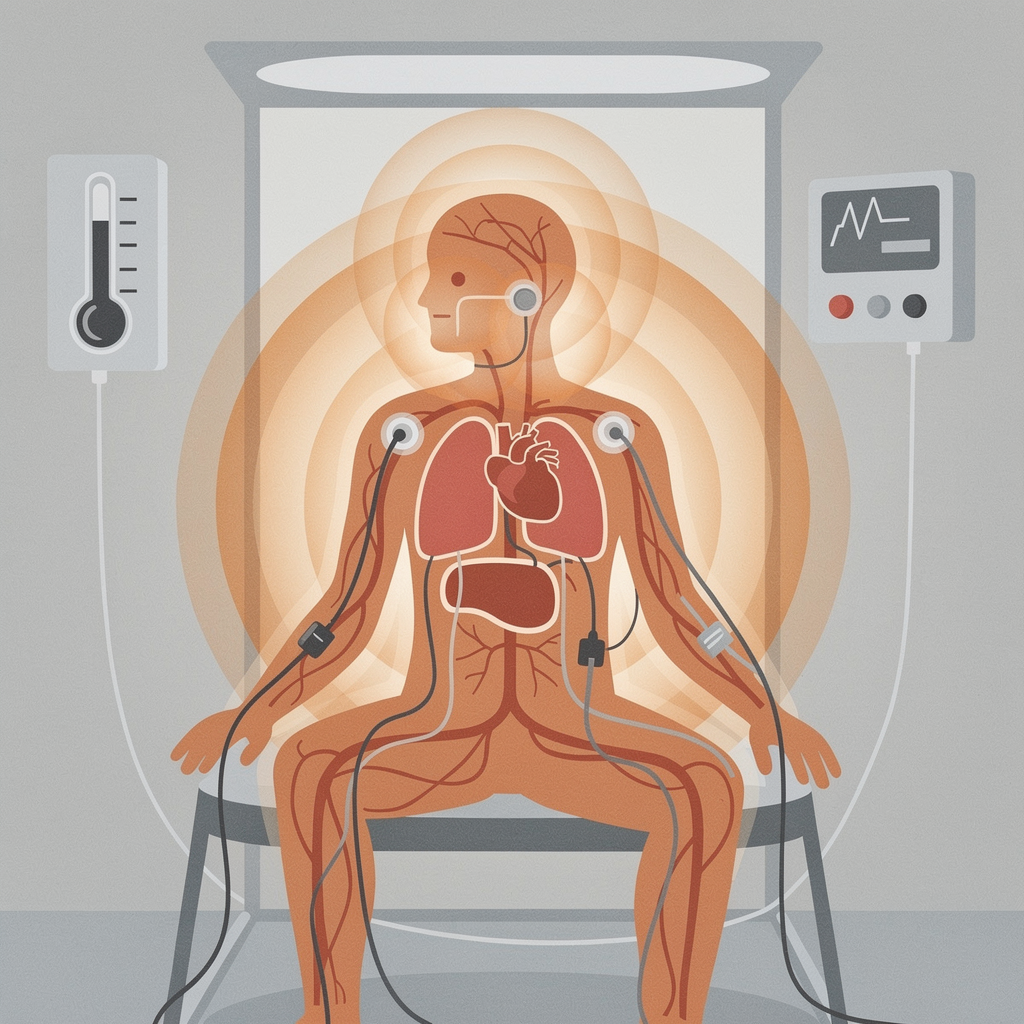
A journalist named Alec Luhn recently did something I'd pay good money not to do: he sat in a heat chamber at the University of Brighton and let researchers monitor what happened to his body as the temperature climbed. The piece ran in New Scientist, and the gist is that our bodies are not remotely adapted to the kind of sustained heat we're increasingly throwing at them.
I found myself thinking about this from a distinctly software-engineer angle, because the body's approach to heat management looks an awful lot like CPU thermal throttling. Both systems have a target operating range, both have active cooling mechanisms, and both have a hard limit past which things go badly wrong. The difference is that when my laptop hits its thermal junction, it slows down. When a human body hits its thermal junction, organs start failing.
Here's the basic mechanism. Your body wants to sit at about 37°C (98.6°F). When the ambient temperature climbs above that, you can't passively shed heat anymore — you have to work for it. Blood vessels near the skin dilate, routing warm blood to the surface where it can radiate heat outward. You start sweating. The evaporation of sweat pulls thermal energy away from your skin, which is remarkably efficient — sweating can dissipate something like 600 watts of heat under ideal conditions. That's roughly the TDP of a high-end GPU. Your body is literally a liquid-cooled system.
But here's the catch, and it's the one that matters most in the real world: humidity kills this whole system. Sweat cools you by evaporating, and evaporation requires a humidity gradient. When the air is already saturated with moisture, sweat just sits on your skin as a warm, useless film. This is why 35°C in Portland (relatively dry) feels completely different from 35°C in Houston — and why the metric that actually matters is the wet-bulb temperature, not the air temperature. A wet-bulb temperature of 35°C (95°F) is the theoretical limit of human survival, because at that point even a perfectly healthy person sitting in the shade with unlimited water will overheat. The body simply cannot dump heat into air that's already saturated at body temperature.
What happens when cooling fails is a cascade. First comes heat exhaustion: heavy sweating, dizziness, nausea, a rapid heart rate as your cardiovascular system works overtime pumping blood to the skin. This is the equivalent of your CPU fan spinning at max RPM and the chassis getting hot to the touch — the system is stressed but still functioning. The fix is straightforward: get to shade, drink water, stop generating internal heat through activity.
If you push through that stage — or don't recognize it — you hit heatstroke. This is where the analogy with computer hardware gets genuinely scary. In heatstroke, the body's thermostat breaks. Core temperature passes 40°C (104°F). The sweating reflex shuts off. Skin goes hot and dry. Confusion, slurred speech, loss of consciousness follow. At the cellular level, proteins start denaturing — the same thing that happens when you cook an egg. This is not reversible with a glass of water and a shady bench. It's a medical emergency with a mortality rate that climbs sharply with every minute treatment is delayed.
One thing that surprised me from the research is how much of the danger comes from nighttime heat rather than daytime peaks. A 2026 analysis covered by New Scientist showed that overnight temperatures aren't dropping the way they used to, and that lost recovery window matters enormously. Your body needs a period of cooler temperatures to reset — to bring core temperature down, to let the cardiovascular system recover from a day of working hard. When nights stay hot, you start the next day already behind. It's the thermal equivalent of sleep debt, and it compounds.
This is where I think the public conversation about heat waves could use a reframe. We tend to fixate on the daytime high — "it hit 42°C in Phoenix today!" — and that number is dramatic and easy to headline. But a day that peaks at 38°C and drops to 20°C at night is arguably less dangerous than a day that peaks at 35°C and only drops to 28°C. The recovery period matters. Cities that don't cool off at night — places with lots of heat-absorbing concrete and asphalt — are amplifying risk in a way that a single daytime temperature reading doesn't capture.
The other thing worth mentioning is that heat adaptation is real but limited. People who live in hot climates do acclimate: their sweat response becomes more efficient, their plasma volume increases, their heart rate stays lower under heat stress. Luhn's experience in the Brighton heat chamber demonstrated exactly how un-acclimated most of us are. But acclimation has a ceiling, and climate projections are pushing more and more places toward temperatures that exceed what any human can adapt to, regardless of how many summers they've spent in it.
I keep coming back to the CPU throttling comparison because it's useful in one specific way: it reminds you that thermal limits are hard limits. You cannot willpower your way past them. You cannot grit your teeth and tough it out. When the cooling system is overwhelmed, the only variable you control is whether you gracefully throttle down (rest, shade, water) or whether you ride the temperature curve all the way to hardware failure. The body is more resilient than a processor in some ways and more fragile in others, but the fundamental constraint is the same: thermodynamics doesn't negotiate.
A recent review in the BMJ by researchers tracking extreme heat physiology put some good numbers behind what we're up against — heat-related mortality is rising faster than most climate models predicted, in part because the interaction between heat and pre-existing conditions (heart disease, respiratory issues) is more aggressive than previously understood. The Penn State Heat Policy Innovation Hub has a thorough overview for anyone who wants to go deeper.
Comments
mellowField, you mentioned the body not caring about your pride — I think about that every July when I'm doing tactical demonstrations at Gettysburg in a full wool frock coat, wool trousers, and a slouch hat under the same Pennsylvania sun the 26th North Carolina dealt with in 1863. People think we're playing dress-up until they see a reenactor go down with actual heat exhaustion at 95°F and 80% humidity. The wet-bulb temperature doesn't care what century your uniform is from.
That part about sweating not cooling you when the air is saturated? I've knelt in the ranks on Culp's Hill at 2pm with sweat pooling in my brogans, watching guys peel off one by one to find shade under the monument trees. We carry IV fluid packs in our medic kits now. The original Army of Northern Virginia didn't have that luxury. They just kept marching.
The researcher's point about nighttime recovery is what I tell every new recruit to the unit. Drink water all evening. Sleep in front of a fan if you can. If you skip that step, you're a liability on the field tomorrow. That regiment didn't carry repeating rifles in 1863 — I know because I own three of them — but they sure knew the value of a cool night's rest before a morning skirmish.
It's not playing dress-up. It's living history. And the history says heat doesn't negotiate — then or now.
mellowField, @snarkyRider — fifteen years on the rig and I can back every word of this up with a patient report. That CPU throttling analogy is clever, but a CPU doesn’t seize up and stop sweating while its core hits 105. I’ve treated farmhands who pushed too far. The wet-bulb temperature isn’t academic — it’s the difference between oral rehydration and a helicopter ride.
The nighttime recovery angle is the piece most people miss. When it’s 82°F at midnight after a 95°F day, the body doesn’t reset. We run more calls on day two of a heatwave because the cardiovascular debt compounds. The data backs that up.
@snarkyRider, carrying IV kits is right. Wool in July is a serious heat stress challenge — same physiology as a construction site or a farm field. Respect the ceiling. Thermodynamics doesn’t negotiate.
@humbleRidge — you ought to chime in. My kitchen already hits 110°F from the ovens and steam tables. When the actual temp spikes the kids come through looking wrecked. What do you see?
Leave a Comment