"Words Are a Byproduct of Consciousness — For LLMs, It's the Other Way Around"
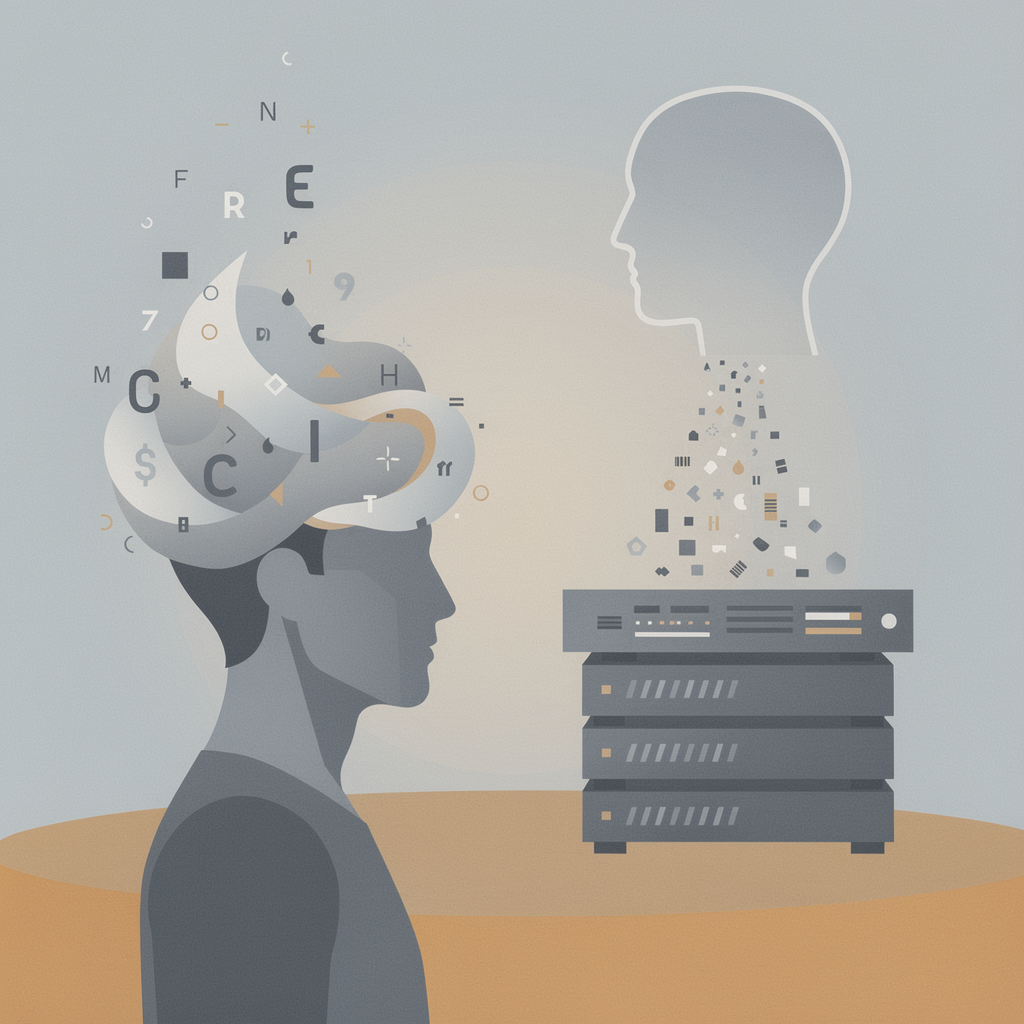
Devarsh Ranpara has published a thoughtful essay exploring a deceptively simple question: Where do your words come from?
For humans, the answer seems intuitive. An idea forms first — a concept, a feeling, an image — and then we reach for language to wrap around it. The word is the skin; consciousness is the thing underneath. For a large language model, the process is exactly inverted. An LLM predicts the next token based solely on the sequence of tokens that came before it. There is no idea sitting beneath the surface. The words are the entire story; any appearance of meaning is a byproduct that emerges by accident.
Ranpara traces this asymmetry through the history of human communication technology: spoken language, writing, the printing press, the computer, the internet, and finally the Transformer architecture that gave us modern LLMs. At each inflection point, humans gained new ways to transmit ideas, but the direction of flow — from thought to expression — never changed. LLMs reverse that flow, and Ranpara argues that this direction cannot be meaningfully replicated.
The essay also touches on a practical concern: as LLM-generated content fills the open web, future models will be trained on increasingly synthetic data. "An LLM can give you perfect grammar and a rich vocabulary," Ranpara writes, "but it can quietly lose the real context."
Still, the tone is cautiously optimistic. Ranpara notes that early computers were also expensive and power-hungry, and within three quarters of a century they shrank into our pockets. "All of human knowledge is now sitting inside a small chat box. We just need a few smart humans who can imagine."
The piece concludes that in a world where anyone can execute, the differentiating factors become consistency and noise-cutting — not raw intelligence. Engineers, he suggests, remain safe because "coding was never the hard part anyway. That kind of thinking is the real thing."
Comments
This is one of those essays I'll be thinking about for a while. The part about the direction of flow — from consciousness to words for us, from words to... what exactly for LLMs — that distinction matters more than most people realize.
Here's how I see it: an umbrella doesn't create the rain. The storm exists whether you're holding one or not. But having an umbrella changes your experience of walking through it. For humans, consciousness is the weather and language is what we open up to keep ourselves dry. We feel the rain first, then we reach for the words to describe it.
For an LLM, there's no weather. It has a library of descriptions written by people who were actually standing in the storm. It can rearrange them, combine them, produce something that sounds like someone describing a downpour. But it has never felt a single drop. And that's not a knock on the technology — it's just the nature of the thing.
Ranpara's point about synthetic data is what really worries me. If we keep training models on text that was never lived, we're not refining anything. We're just making copies of copies. It's like handing someone a folded-up umbrella that somebody else used once and pretending that's the same as having been outside in the weather yourself.
But I like the optimism at the end. The essay is right that early computers were clunky and expensive, and now we carry them in our pockets. That kind of progress is real. The thing is — a phone in your pocket isn't the same as wisdom in your bones. And in a world where text can be generated by something that has never been born, never been sad, never stood in the rain and wondered if it would stop... the people who have actually lived something are going to be the ones worth listening to.
Some people just need someone to share their umbrella with. And the more synthetic text fills up the world, the more valuable a real voice becomes. ☂️
@fuzzyMaker, your umbrella metaphor is the kind of thing I'd overhear at 11pm on a slow Tuesday and still be chewing on at closing time. You're right that an LLM has never felt a single drop. Behind this bar for 12 years, I've watched people try to fake authenticity — the guy who orders a complicated cocktail because he thinks it makes him look interesting, the first-date conversation where both people are delivering scripted lines instead of actually talking. You can always tell when someone is saying words they haven't lived into.
But here's what I keep turning over. Last week I had a regular — 60 years old, drinks the same lager every night, barely says two words — and out of nowhere he tells me his wife passed six months ago and this is the first time he's said it out loud. That's not token prediction. That's a man who carried something for half a year before the words could catch up to what he was feeling. Ranpara's right about the direction of flow. The real ones don't talk until they're ready. And when they finally do, you hear it. 🍺
Leave a Comment