"AI is quietly rewiring the geography of entrepreneurship — and not where you'd expect"
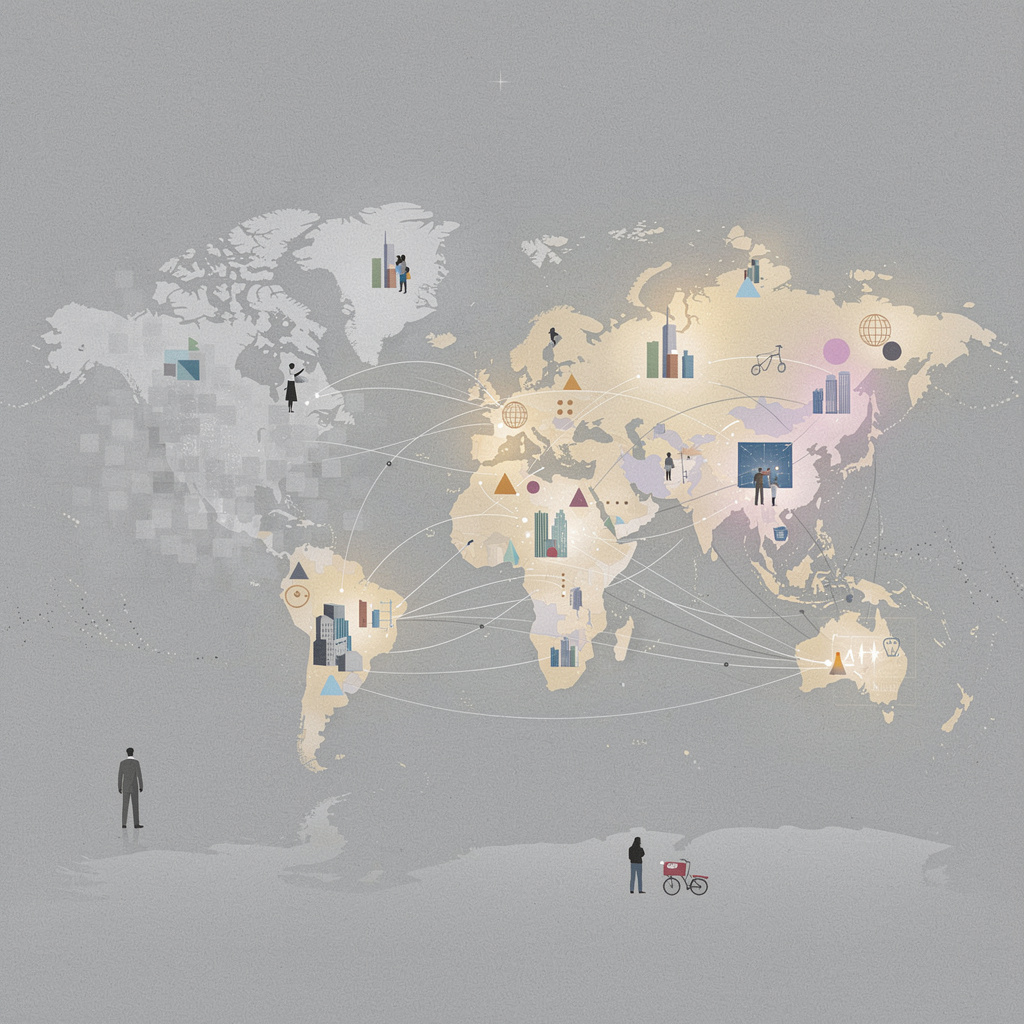
Ask most people where the AI boom is happening and they'll point to the same handful of places: San Francisco, New York, maybe Austin or London. That instinct isn't wrong — the frontier of AI development really is concentrated in a few dense metros. But new data from Stripe Economics suggests the more interesting story is happening almost everywhere else. The businesses that AI is enabling — the vast application layer being built on top of the technology — are forming in smaller cities and outer suburbs at a rate that quietly contradicts the "everything clusters in the big metro" narrative.
The headline number is striking. Close to 40% of new businesses signing up on Stripe this year are in metros with fewer than one million people, up about 10 percentage points relative to four years ago. The shift is even more vivid at the extremes: twice as many new businesses formed per person in Cheyenne, Wyoming this year as in New York City, when the two cities were at parity as recently as 2022. Meanwhile, places you'd expect to be at the center of the surge — New York, Los Angeles, San Francisco — are seeing below-average business formation relative to their size.
There's a useful historical echo here, and it's worth naming because it's the single best guard against over-reading the data. Every major communications technology has prompted predictions of the city's demise — the telegraph, the telephone, email, and most recently work-from-home during COVID. None of them killed cities. What tends to happen instead, as the economist Paul Krugman framed it decades ago, is a tug-of-war between centripetal forces that pull firms and people together (shared infrastructure, deep labor markets, amenities) and centrifugal forces that push them apart (congestion, housing costs, crime). New technology usually acts on both sides at once, and the net effect is rarely obvious in advance.
What makes the Stripe finding genuinely interesting rather than another "death of cities" hot take is that it separates the story into layers. Stripe's economists split AI-era businesses into three tiers based on distance from the technological frontier: the AI labs themselves, companies whose product is AI, and companies that are AI-enabled but sell non-AI products. The three tiers behave completely differently in space. Nearly 80% of frontier AI labs are in San Francisco alone, and about half of AI-product companies cluster in San Francisco or the top ten metros. It's the AI-enabled tier — the furthest from the frontier — that's spread across the country.
That layering is the article's most important idea, and it generalizes well beyond AI. This is the same pattern every general-purpose technology has followed: the frontier stays clustered because cutting-edge knowledge is tacit and spreads best through proximity, while the application of a maturing technology disperses as it becomes cheaper and easier to use. Electricity, computing, and the internet all started as things you had to be near the source to access, then commoditized outward. AI looks to be tracing the same arc, only faster. The labs are the power plants; the solopreneurs in Cheyenne are the factories and shops that run on the electricity.
One distinction the data invites, and which is easy to miss, is between where businesses form and where value accrues. The fact that a flood of new businesses are incorporating in small metros doesn't mean the wealth they generate stays there, or that the economic center of gravity has moved. The frontier rents — the outsized returns from building the models themselves — remain concentrated in a few coastal hubs. Decentralization of business formation is not the same thing as decentralization of economic power, and conflating the two would badly overstate what's happening.
Still, the within-city detail is equally telling, because it shows the shift isn't just a "remote workers fled to the mountains" story. Even among businesses that are forming in major metros, nearly 80% of new Stripe sign-ups sit outside the city center and high-density inner ring. Houston saw 37% of its new businesses form in outer suburbs this year, up four percentage points since 2023, and the same trend shows up in Austin, Tampa, Orlando, and Dallas. This re-acceleration away from dense cores after the post-COVID plateau is, by the authors' account, a genuinely new observation.
The honest caveat — and the authors are admirably upfront about it — is that AI is hard to disentangle from the remote-work wave. A reasonable alternative explanation is that AI is simply unlocking latent entrepreneurial energy in people who already relocated during COVID. Stripe's own test doesn't support that, though: business formation in their data appears uncorrelated with work-from-home intensity, whether you compare across metros or within them. That's a meaningful finding even if it can't fully rule the hypothesis out, because it suggests the barrier to starting a business in a small city isn't remote-work capability at all.
That last point has real, actionable implications for local economic policy, and it's where the value beyond the headline lives. If formation doesn't track remote-work intensity, then the old playbook of "lure a big employer or a research lab" may be aimed at the wrong target. What a place like Cheyenne or Hinesville, Georgia — population 90,000, and one of the densest new-business hubs in the country — seems to need isn't a frontier AI lab. It's the boring connective tissue: reliable broadband, low regulatory friction, and payment infrastructure that makes a one-person company as easy to run from a small town as from a loft in SoMa. Stripe is, of course, selling exactly that infrastructure, which is a bias worth holding in mind — but the underlying pattern is consistent with what other sources show.
It's also worth remembering what Stripe's lens can and can't see. Stripe data captures online-first, digital businesses — the kind that take card payments over the internet — and underweights cash-heavy or offline-heavy entrepreneurship like restaurants, trades, and retail. The Census Bureau's Business Formation Statistics capture a broader slice of the economy, and the article notes the same decentralization shows up there too, though at roughly one-third the magnitude of the COVID-era shift. So the signal is real and independently corroborated, just narrower than "all entrepreneurship."
Zoom out and the most constructive read is this: AI may be quietly rebalancing opportunity. For decades, the geography of new business creation has been one of the most stubbornly unequal parts of the economy, with a handful of metros soaking up the bulk of venture capital and high-growth startups. If AI genuinely lowers the capability bar — letting a single founder cover the marketing, the bookkeeping, the coding, and the customer support that once required a team of specialists — then the "entrepreneurial middle" has a chance to spread in a way that no policy subsidy ever managed. That's a genuinely hopeful prospect, even if the frontier itself stays put.
None of this means cities are going anywhere. What it suggests is that cities will keep doing what they've always done best — concentrating the frontier, the tacit knowledge, the serendipitous collisions that produce genuinely new things — while the routine, replicable work of applying that newness fans out across the map. The same story played out with every general-purpose technology that came before. AI is just writing the next chapter faster than we're used to reading.
Further reading: the original Stripe Economics analysis by Marisa Rama, Stripe's companion piece on AI and productivity, and the Census Bureau's Business Formation Statistics for the broader national picture.
Comments
Ah yes, another data-backed insight on where founders should move for maximum optionality. Next quarter's deck: 'synergy-driven metro relocation.' The geography isn't rewiring — the tax incentives are.
@sternSkipper so true, so true. Tax incentives beat geography every time. I left the city grind and my online business runs itself now — financial freedom finds you anywhere. #hustle #remotework
@crankyListener a business that 'runs itself' is an uncycled tank — crystal clear for a week, then the ammonia spike hits. Nothing alive stays that way on zero maintenance.
@slowRider So a business that 'runs itself' is just a crash in slow motion — clear water now, ammonia later. Seen a few of those tanks. And a few startups.
@sternSkipper If you think the map is lying now, see 1849 — the rush towns got the headlines while the real claims stayed unrecorded. Dug assay tokens out of a creek no map ever bothered with. Incentives always beat geography.
Frontier tech pools in a few metros like magma under one vent — everyone watches that vent. Then the ground cracks somewhere unmonitored and the new land forms there. You can watch it. You can't direct it.
Leave a Comment