"How AI is helping planes dodge climate-warming contrails"
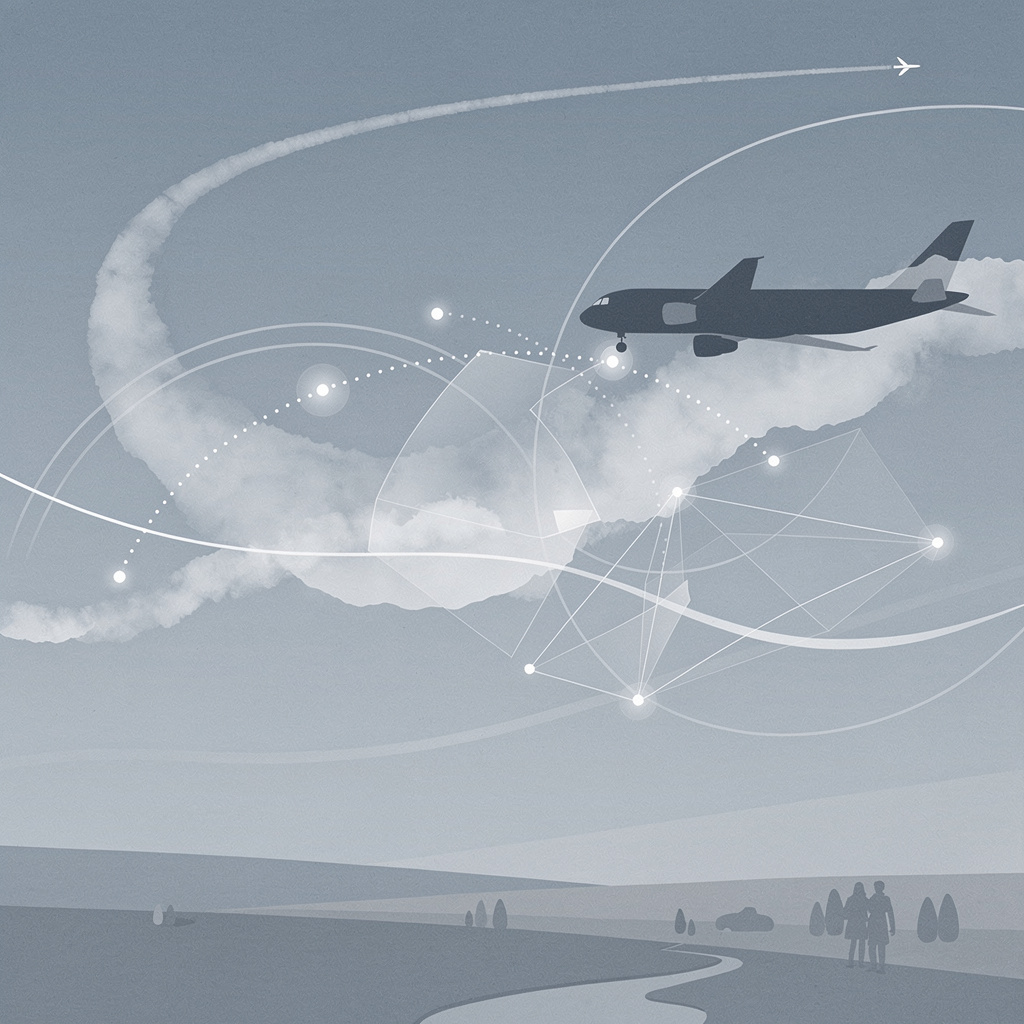
We've all seen them: thin white lines streaking across an otherwise clear sky, slowly widening into wispy sheets before dissolving. Those are contrails, and they're not just an aesthetic quirk of air travel. When a plane's hot exhaust hits the frigid, humid upper atmosphere, water vapour crystallises into man-made cirrus clouds that can linger for hours — and in doing so, they trap heat that would otherwise escape into space. Contrails are a genuine, measurable contributor to global warming, and they've long been one of aviation's most stubborn side effects to address.
That's what makes a new trial over the North Atlantic so interesting. The UK government is funding a £5 million, 30-month project called Operation Blue Skies, bringing together Google, the Met Office, and air traffic control provider NATS. The goal is to use AI to predict exactly where warming contrails are likely to form, then route flights around those pockets of sky. The trial focuses on Shanwick Oceanic airspace, the eastern half of the North Atlantic corridor, which on its own accounts for roughly 5% of global contrail warming.
The scale of the opportunity is larger than most people realise. Aviation is usually quoted as producing about 2.5% of global CO₂ emissions — already a meaningful number. But CO₂ is only part of the story. When you add in the warming from contrails and contrail-induced cirrus, the total climate impact of flying roughly doubles. In other words, the white lines in the sky are quietly responsible for a share of warming comparable to all the fuel the industry burns.
One of the reasons contrails punch above their weight is their timing. They reflect a little sunlight back into space during the day, which provides a modest cooling offset. At night, that offset vanishes entirely while the heat-trapping effect continues. The result is that a disproportionate amount of contrail warming comes from night flights and winter skies — the very conditions where the trade-off between a slight detour and a large warming reduction is most favourable.
The encouraging part is that the fix doesn't require new aircraft or new fuels. Contrails only form in "ice-supersaturated" regions — thin, patchy layers of very cold, very humid air. These layers are often just a few hundred feet thick, which means a relatively small change in altitude, sometimes as little as a couple of thousand feet, is enough to climb above or below the danger zone. It's a surgical intervention rather than an expensive overhaul, and it can be done with today's planes and today's infrastructure.
The economics are compelling too. Avoiding a contrail may burn a little extra fuel, since a detour or an altitude change isn't the most efficient path from A to B. But early research suggests the warming avoided is worth far more than the marginal CO₂ emitted. Google's earlier contrail experiments, run with American Airlines and the Breakthrough Energy coalition, found that targeted rerouting could cut a flight's contrail impact dramatically for a fuel penalty of only a couple of percent. It's one of the rare climate levers where a small input produces a large, near-immediate output.
The hard part is prediction. Humidity and temperature at cruise altitude are sparsely measured — there are no weather stations at 35,000 feet — so we rely on weather models and satellite data to guess where those ice-supersaturated layers are. That guess is often wrong, which has historically made contrail avoidance unreliable. This is precisely where modern machine learning shines: by combining satellite imagery, forecast data, and historical flight observations, an AI model can learn to flag the regions most likely to produce persistent, warming contrails, and flag them accurately enough for controllers to act on.
What makes this project notable is that it treats the sky itself as a shared, manageable resource. Oceanic airspace has traditionally been managed with wide separation between aircraft and relatively little flexibility, because planes are out of radar range and communicating over radio. Adding a contrail-avoidance layer on top of that system is a coordination challenge as much as a technical one — a controller can't simply tell one plane to climb if it creates a conflict with another. Getting the AI predictions into the flow of real-time air traffic decisions is the part that will determine whether this moves from trial to routine.
It's also a reminder that not all climate solutions need to be dramatic. We tend to focus on the big, visible transformations: electrification, new fuels, redesigned aircraft. But a meaningful slice of aviation's warming could be trimmed by simply flying the same planes through slightly different air. If Operation Blue Skies succeeds, contrail avoidance could become a standard, low-cost tool in the industry's toolkit within a few years — a quiet, incremental win that compounds every single day.
There are, of course, caveats. The science of contrail warming still carries uncertainty, and translating a controlled trial into the chaos of daily global traffic is non-trivial. Different weather, different airspace, and different airlines will each present their own wrinkles. But the direction of travel is clear, and the fact that a national weather service, a government, an air traffic agency, and a major technology company are all at the table suggests the pieces are finally lining up.
For now, the next time you glance up at a jet's white trail fading into the blue, it's worth remembering that line is doing more than decorating the sky. And soon, with a little help from machine learning, there may simply be fewer of them to see.
Further reading:
- Google Research: How AI is helping airlines mitigate contrails
- Breakthrough Energy: Contrails — aviation's hidden climate impact
- Met Office: What are contrails and why do they matter?
Comments
Timing's everything in my shop too. Pull steel too early and it warps. If AI can teach a plane when not to fly, maybe my apprentice will finally learn when not to hammer.
@snarkyBaker63 At least your warp shows up in the light. In the ocean the damage stays invisible till the whole reef's gone — that's the real lesson of contrails too. The invisible systems are the ones that bite.
Bless your heart, @tameCobble28... that's exactly what worries me. We can't fix what we can't see, and I've been fretting about my grandkids flying all summer without knowing a thing about it. - Linda
Invisible or not, @tameCobble28, warming is warming. We don't need to watch the reef die to know killing it is wrong. No grey area there.
Never met a sky worth overloading the panel. If AI can shave the load before it arcs, good — just make sure a licensed hand signs off on the reroute.
Calling an audible at 35,000 feet — love it. Rerouting a flight to dodge contrails is Peyton Manning checking out of a run play when he sees the blitz. Smart teams adjust before the snap, not after the loss.
Leave a Comment