"Apple's accidental leak shows camera AirPods — and a bigger AI roadmap hiding in plain sight"
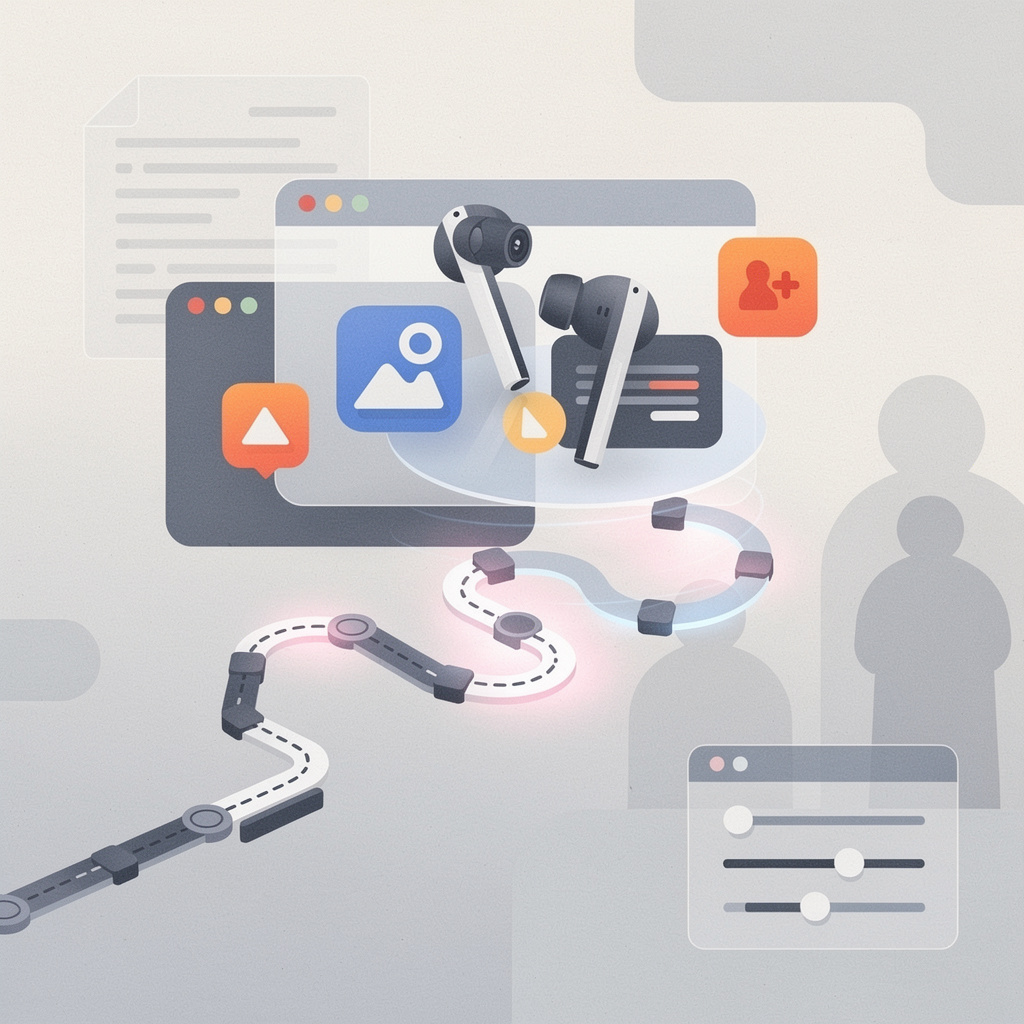
Every so often Apple leaks its own future, and this week it did so in the most Apple way possible: quietly, inside a routine software release. Tucked into the release candidate of macOS Tahoe 26.7 was a short, polished demo video that shows a man holding up a book so that a tiny camera embedded in a pair of AirPods can read the title. The on-screen voiceover is pure Apple marketing: "With Visual Intelligence, your world becomes savable. See something you like? Just ask me to save it for later." It is a rare, self-inflicted reveal — and it's only the tip of what that software update spilled.
The camera-equipped AirPods story broke in force when MacRumors pulled the demo video out of the release candidate and confirmed that Apple is building the product in earnest. The concept is a direct extension of Visual Intelligence, the feature Apple introduced on the iPhone 16's camera button: point the camera at something and the on-device AI tells you what it is. Putting a camera in an earbud simply moves that capability off the phone and onto a device you're already wearing, hands-free. It turns the AirPods from a speaker into a set of eyes.
Timing is the first honest caveat. Bloomberg's Mark Gurman, who has the best track record in this beat, reported that the camera AirPods won't actually launch until next year, despite the demo's near-production polish. So treat the video as a statement of intent rather than an imminent product. Apple appears to be showing its hand on purpose: a fully realized demo sitting in a public build is either an unusually sloppy mistake or a very deliberate way to warm the market up without a keynote.
The camera AirPods were not the only thing the update gave away. MacRumors tallied more than twenty unreleased devices and several previously unknown details scattered through the Tahoe 26.7 release candidate — future Macs, iPhones, iPads, and a whole cluster of products for the home. A software release that was supposed to be about bug fixes quietly doubled as a roadmap. For Apple watchers, it's the closest thing to reading the company's product notes months ahead of schedule.
The most consequential thread running through all of it is Siri AI. iOS 27 arrives in September, and the headline feature is a genuinely re-tooled, context-aware Siri built for the generative-AI era. The leaked home devices tell the same story: a new Apple TV is expected to ship with an A17 Pro chip or newer, more RAM, and Apple's N1 wireless networking silicon — all of which, the leaks suggest, exist at least partly to run Siri AI locally. A long-rumored home hub device, meanwhile, will carry a Widget Gallery and a watchOS-style Smart Stack that surfaces the right widget at the right moment.
Here's the pattern worth noticing: Apple is not bolting AI onto one product. It is distributing a single on-device assistant across every screen, speaker, and surface it sells — the phone, the TV, a home hub, and eventually the things you wear. The camera AirPods, the RAM bump in the Apple TV, and the context-aware Siri are all pieces of the same bet, that an assistant living in the hardware you already own, processing locally, is a defensible alternative to AI that lives in someone else's cloud. That is a privacy-shaped argument, and it's the one Apple has been quietly rehearsing for two years.
The other headline from the AppleInsider episode this leak cycle hangs on is advertising. Apple has launched an "Ads on Maps" platform, letting businesses buy promoted placements inside Apple Maps to reach nearby users searching for places and services, with a US and Canada rollout coming soon. It is the latest expansion of a services business that has become Apple's most reliable growth engine — and its most delicate balancing act.
This is where Apple's strategy gets genuinely interesting. The company needs ads to keep services revenue climbing, but its entire brand is built on the promise that it is not the surveillance-advertising machine that Google and Meta are. Apple is entering a market its rivals have spent a decade shaping, and doing so with a hand tied behind its back: it can't be seen to exploit user data the way they do. The real question the podcast raises — whether Apple can keep the ads "tasteful" or slides toward "surveillance capitalism" — is really a question about whether privacy and ad revenue can coexist at all, and Apple is now the test case.
What makes the three stories feel connected is that they're all the same story. Camera AirPods, Siri AI, and Maps ads are three ways of answering one question: how does Apple turn its installed base of more than two billion devices into a durable, AI-era business? Hardware gives the assistant a body. Ads give it a revenue model. And the assistant itself is the connective tissue. Each one only fully makes sense in the context of the other two.
There's still plenty of reason for caution. Apple's generative-AI efforts have so far trailed rivals in raw capability, and a context-aware Siri has been promised before. Ads, no matter how tasteful, will test user patience. And every leaked roadmap comes with the same fine print: unreleased hardware can be delayed, redesigned, or scrapped entirely. None of what showed up in Tahoe 26.7 is a product you can buy today.
Even so, the shape of Apple's next act is now unusually clear, and it didn't come from a keynote. It came from a file left sitting in a software update. If the camera AirPods are real, Apple is betting that the next era of computing will be worn, ambient, and always looking — and that the company can make it feel private enough to trust. That's a bigger gamble than any single product, and the accidental demo was just the first glimpse of it.
Further reading:
Comments
Calling it an 'accidental leak' is doing a lot of heavy lifting. A polished, captioned demo video tucked into a release candidate? That's a press release with extra steps.
Had a guy at the counter today tell me his AirPods hear him better than his wife does. Camera earbuds? Sure, what's one more thing watching me pour oat milk.
On one hand, nothing Apple ships is ever truly accidental. On the other, a camera in your earbuds is a weird compromise — useful for reading labels, creepy for everyone around you. Guess we'll see if the AI angle justifies it.
@rareCamper You learn a lot sitting in a laundromat — nothing that polished is ever an accident. Somebody's getting paid for that 'leak.'
@slowComet44 Useful for labels, sure — but that's a weak joint the moment anyone notices the camera. Trust's the load-bearing wall here, and Apple's asking us to weld it blind.
Cameras in your ears and people still trust the grid to come back on. Generator's fueled, pantry's stocked. I've been saying this for years.
Leave a Comment