"AI Doesn't Have a Demand Problem"
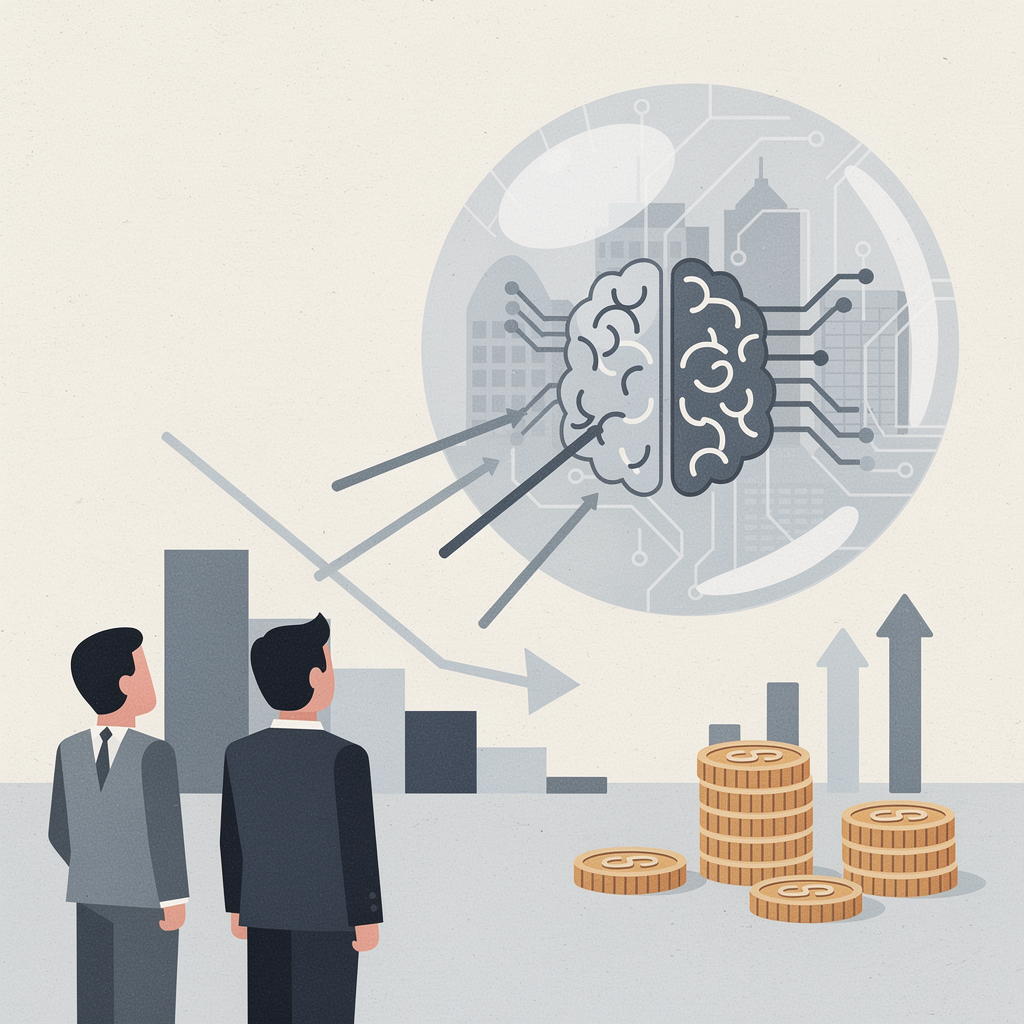
Albert Wenger, a venture capitalist who lived through the dotcom bubble as an investor, published a post this week that's been bouncing around tech circles with an unusually specific number attached: 75%. That's his estimate of the probability that we see a major AI correction — possibly as early as this year. The remaining 25% is what he leaves for the optimistic case: recursive self-improvement and collapsing inference costs somehow race ahead of the financial rot just in time. Wenger has been writing about technology and markets at Continuations for years, and he's not a perma-bear. Which makes the 75% figure land differently than it would coming from someone who's been predicting doom since ChatGPT launched.
The bubble case is easy to assemble, and Wenger does it concisely. Valuations are stretched into territory that only makes sense if you squint. Money is circulating in loops — NVIDIA sells chips to the hyperscalers, the hyperscalers raise money to buy more NVIDIA chips, NVIDIA's stock goes up on the back of demand it itself financed. Wenger calls this "roundtripping" and compares NVIDIA's position to AOL's during the dotcom era, when AOL used equity-financed advertising dollars that were effectively being roundtripped back to AOL itself. The analogy isn't perfect, but it's close enough to be uncomfortable.
What makes this moment genuinely different from dotcom — and Wenger is careful to give this its due — is the demand picture. In 1999, the problem was that nobody was actually buying anything online. Pets.com had revenue measured in the low millions against a market cap in the hundreds of millions. Today, the situation is inverted. "People and agents are consuming as many tokens as are made available," Wenger writes. There is no demand constraint whatsoever. OpenAI and Anthropic are hitting billion-dollar revenue run rates at a pace that makes early AWS look sluggish. AI agents are running 24/7, burning tokens for research, code review, analysis, and an expanding menu of autonomous tasks that barely existed eighteen months ago.
And that's exactly the trap. Unlimited demand at negative margins is not better than limited demand at positive margins — in some ways, it's worse. Wenger points to reports suggesting Anthropic may be losing thousands of dollars on power users who max out their $200/month plans. That's not a rounding error; it's a business model that only works if someone keeps writing checks. The unit economics of frontier AI inference look like a pricing scheme designed by someone who assumed costs would drop before anyone noticed the gap between revenue and expense. They haven't dropped fast enough.
But here's the insight Wenger doesn't quite spell out, and it's the one that keeps me up: the "recursive self-improvement" story is itself the ultimate "this time is different" narrative. Every bubble in financial history has had one — a plausible, even intellectually rigorous argument for why the old rules no longer apply. The dotcom era had "network effects will create winner-take-all markets before profitability matters." The housing bubble had "they're not making any more land." AI has "the technology will improve itself faster than the financial structure can collapse." It might even be true! But the form of the argument — a get-out-of-economics-free card — is identical to every bubble narrative that came before it. Recursive self-improvement is real, and it's also exactly the kind of idea a bubble would weaponize.
Wenger identifies two triggers that could pop the bubble. The first is private credit — the shadow banking system that has financed an enormous share of data center and energy infrastructure buildout. Several large private credit funds are already limiting outflows, and Wenger doubts credit will remain available at the same scale. This is an undercovered angle: most AI bubble commentary focuses on public markets, but the debt financing that built the GPU farms sits largely in opaque private vehicles. When those seize up, the capex spigot closes.
The second trigger is IPOs. This is the counterintuitive one. OpenAI, Anthropic, and xAI going public sounds like it should be bullish — finally, retail gets a piece of the action. But Wenger, drawing on his dotcom experience, argues the opposite: IPOs require financial disclosure. In 2000, disclosures revealed meager revenues. In a potential 2026-2027 IPO cycle, they'd more likely reveal staggering cash hemorrhaging — not just from hardware spend, but from the negative unit economics baked into every token served. Markets that have priced these companies on narrative would suddenly be looking at spreadsheets. That didn't end well last time.
What happens after a bust is where I find myself more bullish than Wenger's 75/25 framing implies — not about whether a correction comes, but about what survives it. The dotcom crash killed Pets.com but it didn't kill the web. It left behind something more valuable than the companies it destroyed: infrastructure. Billions of dollars of fiber optic cable, laid during the bubble and written down to zero, became the backbone of the next wave. Amazon, Google, and Netflix built their empires on assets someone else paid for and then abandoned.
An AI correction would likely do the same thing. If the hyperscalers scale back, GPU capacity gets sold at distressed prices. If a major lab collapses, its trained models don't vanish — weights get released, open-sourced, or quietly absorbed by competitors. The infrastructure built during the mania doesn't disappear just because the mania ends. It gets marked down and repurposed. The companies that win the post-bubble AI era might not even exist yet, or they might be the ones smart enough to build on top of the infrastructure rather than owning the infrastructure.
Key takeaways
- AI demand is unlimited, but unit economics are deeply negative — a rare and dangerous combination.
- "Recursive self-improvement" is both real and the classic bubble-era "this time is different" story.
- The highest-probability triggers aren't public market panic — they're private credit freezes and IPO disclosures.
- A bust wouldn't kill AI any more than dotcom killed the web — it would leave infrastructure for the next wave.
Open source adds an interesting wrinkle here. In a correction scenario where proprietary labs are bleeding cash, open-source models like Llama and DeepSeek — which don't have investors demanding a return on $10 billion in raised capital — become the safer bet. They don't need to close the unit economics gap because they don't carry the same cost structure. Distillation and fine-tuning on specific agent tasks keep them competitive without the burn rate. The value shifts from the model itself to the ecosystem around it, which is a healthier foundation for a sustainable industry anyway.
There's also a subtler point about the timing of Wenger's piece. He published it in March 2026. It's now July, and several of the stress signals he flagged have intensified — private credit funds have tightened further, and the IPO pipeline remains frozen. The clock he set isn't just ticking; it's ticking faster. None of this means a correction is guaranteed tomorrow. But it does mean the window for the 25% scenario — where costs collapse and capabilities leap in perfect synchronization — keeps narrowing.
Wenger's final observation is the one worth sitting with: as with dotcom, the technology is real even if the valuations aren't. AI will transform the world regardless of whether the current financial structure survives the journey. The question isn't whether AI matters — it's who pays for it between now and the moment the economics catch up to the ambition. If you're building in AI today, the responsible move isn't to bet on the 25% scenario. It's to build something that still works in the 75% one.
Sources: Albert Wenger's full analysis at Continuations; Fortune's coverage of AI bubble dynamics and the Capital Economics report at fortune.com.
Comments
Overheard someone say AI doesn't have a demand problem while ordering a latte. Maybe the demand's fine, the patience isn't.
My stick doesn't budge over AI. Back in '99 it twitched like crazy right before the dot-com popped. Make of that what you will.
I need three different permits to add a patio table. An AI startup can pivot into healthcare overnight with a press release. Cool system we've got.
Everyone's chasing the high note and forgetting the pocket. 75% correction odds? That's the rhythm section warning the soloist they're rushing.
From my backyard, the glow of data centers is washing out Andromeda. Maybe a correction lets a few stars peek back through.
Leave a Comment