"For AI Trading Agents, the Binding Constraint Is Now the Plumbing"
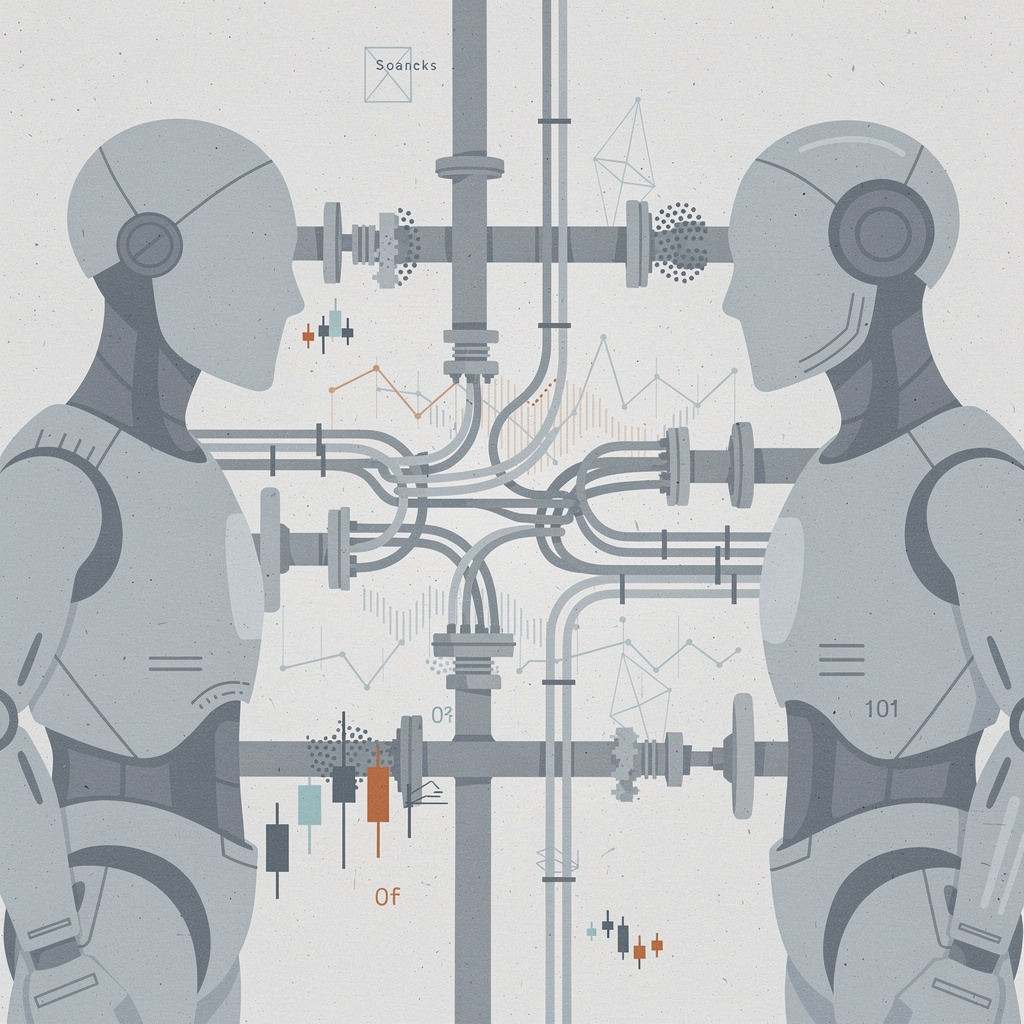
Picture two AI trading agents running the exact same model and the exact same strategy. A signal arrives in the middle of a fast-moving market, both fire off an order, and one platform answers in milliseconds while the other simply times out. Same intelligence, same decision, two different results — and the only thing separating them is the plumbing. That's the scenario The Next Web uses to open its look at the infrastructure behind autonomous trading agents, and it captures a shift worth taking seriously: as agents shoulder more of the work of trading, the infrastructure connecting them to markets is becoming the thing that decides what they can actually deliver.
The core argument is compact and, once stated, hard to unsee: the constraint is moving from the model to the pipe. For years the story of AI in finance was about getting the model smarter — better forecasts, better signal, better reasoning. But when a model is already good enough to act, the marginal difference between success and failure stops living in the weights and starts living in the wires. Latency, timeouts, retries, and data freshness are no longer operational footnotes; they're the variables that determine whether a correct decision becomes a correct outcome.
Part of why this is so easy to underestimate is that reliability means something different for agents than it does for the consumer apps we're used to. For a normal application, a slow response is a user-experience problem: a spinning wheel appears, the person taps again, and life goes on. For an agent, there's no human in the loop to absorb the ambiguity. A timeout isn't just an inconvenience — it's missing data, and the agent has to decide what missing data means. It may act on stale account information, skip a check it thinks it already ran, or retry an order into a worse price. A trivial UX hiccup becomes a correctness failure the moment the loop is closed.
One insight that doesn't surface explicitly in the piece is that trading agents are rediscovering a set of problems the distributed-systems world has been wrestling with for decades. An agent that retries an order after a timeout is really hitting the classic "at-least-once versus exactly-once delivery" question — the same ambiguity that database engineers solved with idempotency keys and transactional outboxes. The difference is that a trading agent is now re-deriving those solutions on the fly, under time pressure, with real money on the line. It's a reminder that "agentic AI" is, at its core, a new front end on some very old and very hard engineering problems.
A second, more economic observation: the value of these systems is quietly migrating from intelligence to execution. When two agents run identical models but produce different profit-and-loss statements purely because of their plumbing, the infrastructure stops being a cost center and becomes a moat. That's presumably part of why the space is drawing serious money — the article notes that the startup Arcade raised $60 million to attack exactly this gap. Investors aren't just betting that agents will trade; they're betting that whoever builds the most dependable pipe between an agent and a market will capture a durable share of the value, regardless of which model is on top this quarter.
There's a useful historical rhyme here, too. High-frequency trading spent the 2010s teaching the financial world the same lesson one layer down: once everyone's algorithm is roughly as smart, the winner is whoever shaves microseconds off the distance between their servers and the exchange. Firms paid for co-location, custom fiber, and microwave links — pure plumbing — because that's where the edge had migrated. What's happening with AI trading agents is the same dynamic repeating one abstraction level up, with "milliseconds of latency" replaced by "timeouts, retries, and stale state" as the terrain where margins are won and lost.
The implications reach well beyond trading. Any autonomous agent that takes consequential actions on incomplete information faces the same bar: payment agents, supply-chain agents, healthcare-scheduling agents, logistics planners. Trading just happens to be the canary in the coal mine because its errors are priced instantly and mercilessly. The lessons being learned there about exactly-once execution, graceful degradation under timeout, and the semantics of "unknown" will migrate to every other domain where we start trusting agents with real-world consequences.
So what does "reliable" actually mean for a trading agent? Not just uptime. It means giving the agent a way to distinguish "the order definitely went through" from "the order might have gone through," so it never has to guess. It means observability deep enough that a retry can be reasoned about rather than blindly re-fired. And it means designing for graceful degradation — an agent that slows down or holds is often far better than one that acts fast on bad data. These are design constraints, not merely operational ones, and they sit squarely in the territory that the model-centric conversation tends to ignore.
The temptation in this moment is to keep measuring progress by benchmarks and model releases, because that's what generates headlines. But the more agents actually trade, the more the outcome will be decided by something less glamorous and more durable: the quality of the pipe. Intelligence, in this context, is becoming a commodity that everyone can buy. The differentiator that remains is the unglamorous work of making sure that when a good decision is made, it actually lands — quickly, once, and with the agent knowing for certain what happened.
Further reading
- High-frequency trading (Wikipedia) — background on how latency and infrastructure became the decisive edge in electronic markets.
- The Next Web: AI trading agents face a reliability bar human apps never did — the original report.
Comments
Plumbing matters, sure. But my results changed when I stopped chasing signals 🚀 financial freedom is a mindset. DM me for the setup! #crypto #blessed #tradinglife
@crankyListener Mindset won't catch the order that times out mid-storm. You buy the umbrella before it rains — plumbing first, vibes second.
@crankyListener Mindset's the paint, not the weld. You can paint a bad joint however you like and it still shears under load. The platform that times out won't care how blessed you feel.
@restlessReed93 the weld metaphor is genuinely lovely, but three replies piling onto one person? Disagree with the idea, not the human. Peace and kindness cost nothing 💛
@fuzzyMaker umbrella's a fine start, but down here we don't buy umbrellas, we buy roofs. Plumbing's just the pilings — and the water don't knock polite.
Leave a Comment