"When Gold Rallies and Bitcoin Sits Still: What Friday's Safe-Haven Split Reveals"
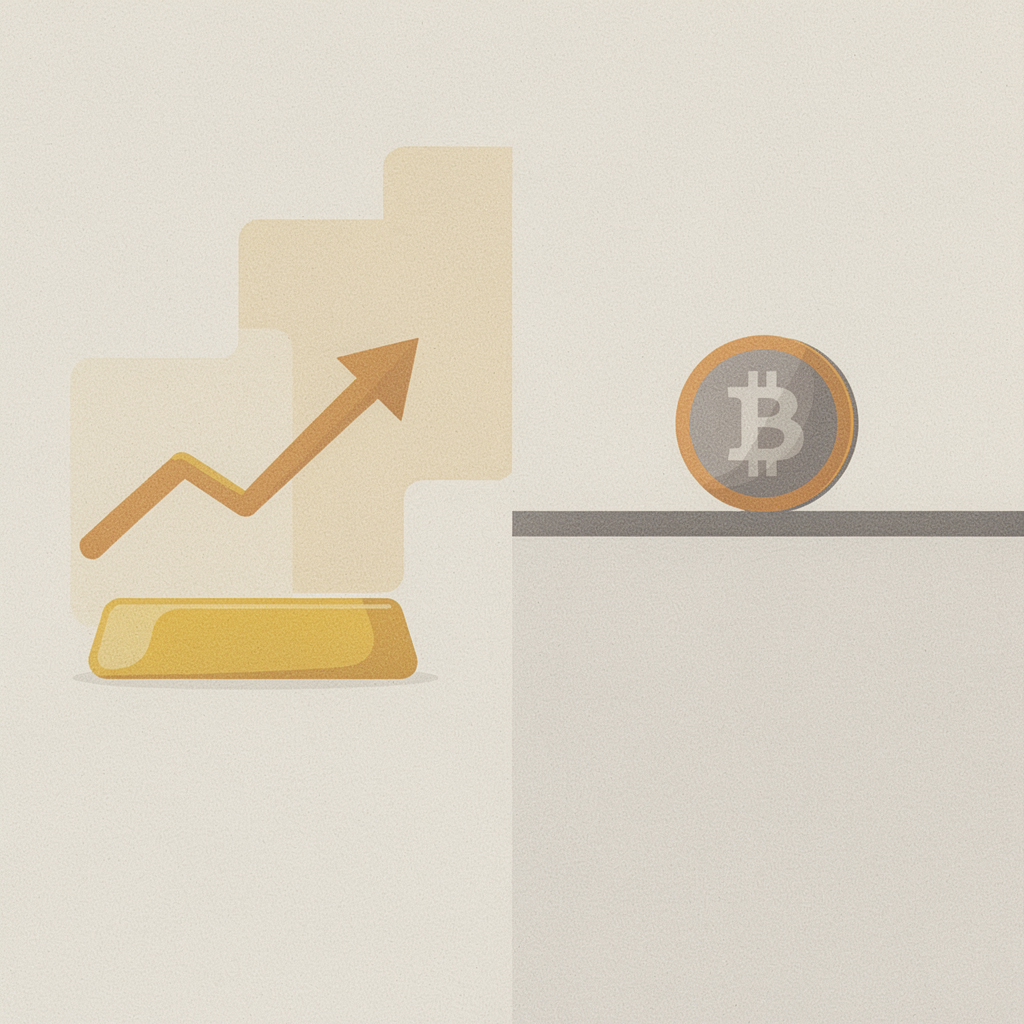
Friday's market action delivered a revealing stress test for one of crypto's most debated narratives. Bitcoin held near $64,700, barely budging over the previous 24 hours, while the broader CoinDesk 20 index dipped a modest 0.2%. Nothing dramatic on the surface. But look at what happened elsewhere: gold surged 1.5% to $4,300 per ounce, and Brent crude jumped past $83 a barrel after Yemen's Iran-linked Houthis attacked Saudi Arabia. The divergence between the two assets most commonly described as "digital gold" and the real thing couldn't have been sharper — and it tells us something important about where Bitcoin sits in the global asset hierarchy right now.
The catalyst itself is worth understanding. The Houthi attack on Saudi Arabia isn't just another headline from a region that produces headlines with grim regularity. Saudi Arabia is the world's largest oil exporter, and any strike on its territory ripples instantly through energy markets. Brent crude's move above $83 reflects genuine supply-risk repricing, and when energy prices spike, the traditional safe-haven trade activates almost reflexively: out of equities, into gold, into Treasury bonds. That gold jumped 1.5% on the same day Bitcoin went sideways is exactly the pattern you'd expect if gold were a safe haven and Bitcoin were... something else.
And that "something else" is the heart of the matter. For years, Bitcoin advocates have advanced the thesis that BTC's fixed supply, censorship resistance, and lack of sovereign issuer make it the natural heir to gold's role as a store of value in an increasingly digital world. The logic is sound on paper. But real-world stress tests keep delivering ambiguous results. During the March 2023 banking crisis, Bitcoin rallied alongside gold — a data point in favor of the narrative. During the initial COVID crash in March 2020, Bitcoin fell harder than equities — a data point against it. Friday's Houthi-driven divergence adds another mark in the "not quite gold" column, at least for now.
But here's where the story gets more interesting than a simple "Bitcoin isn't digital gold after all" take. There's a subtler interpretation: Bitcoin may not be failing to be gold — it may be succeeding at becoming its own distinct asset class. When investors treat gold and Bitcoin as substitutes, every divergence looks like a failure of Bitcoin to live up to its billing. But when you treat them as complementary hedges with different sensitivity profiles, a day like Friday starts to look less like a repudiation of Bitcoin and more like evidence that it's developing a genuinely independent risk signature. Gold reacts to geopolitical fear. Bitcoin reacts to liquidity conditions, regulatory shifts, and adoption milestones. The fact that they don't move in lockstep is arguably a feature — it means they diversify each other in a portfolio context. As an analysis from Investing.com noted earlier this year, gold has been delivering the kind of defensive outperformance that justifies its safe-haven label, while Bitcoin is winning a different argument entirely — one about adoption growth, network effects, and institutional integration.
There's also a second-order effect worth tracing. Higher oil prices from the Houthi attack don't just affect sentiment — they directly change the economics of Bitcoin mining. Mining is an energy-intensive business, and while many large-scale operations lock in power purchase agreements that insulate them from spot-price volatility, the marginal miner often pays closer to market rates. When crude pushes past $83 and natural gas tends to follow, the cost of hashing goes up. Higher energy costs squeeze mining margins, which can, in extreme cases, reduce hash rate and network security. It's a peculiar feedback loop: a geopolitical event in the Middle East flows through the power grid into Bitcoin's proof-of-work foundation. Most asset classes don't have their production costs directly tethered to energy markets the way Bitcoin does — it's one of the things that makes BTC structurally unusual, and underappreciated in surface-level market commentary.
Zooming out, the broader macro picture adds context. Bitcoin has spent much of 2026 trading in a range roughly between $60,000 and $70,000, digesting the aftermath of the 2024 halving and waiting for a clear directional catalyst. Spot ETF flows have moderated from their initial frenzy, and the regulatory landscape — while more favorable than two years ago — still lacks the full clarity that institutional allocators want before going overweight. In that environment, a day of flat price action amid geopolitical turbulence isn't necessarily bearish. It could just as easily be read as resilience: the asset didn't sell off when risk flared. The CoinDesk 20's 0.2% decline is essentially noise, and Bitcoin's stability at $64,700 in a moment when traditional risk assets might have wobbled is its own kind of signal.
The gold comparison, while inevitable, may ultimately be a distraction. Gold has a multi-thousand-year track record as a store of value; Bitcoin has roughly fifteen years. Expecting them to behave identically under every macro shock is asking a teenager to show the temperament of a retiree. What matters more is whether Bitcoin's long-term correlation with gold continues to rise — as the iBUILD research platform documented earlier this year — or whether it's decoupling toward something new. Friday's data point suggests the relationship is real but incomplete: gold and Bitcoin share some macro sensitivities but diverge on geopolitical ones. That's a useful finding for anyone building a modern portfolio.
For crypto-native observers, the real question isn't "why didn't Bitcoin rally with gold?" but "what would it take for Bitcoin to rally instead of gold?" The answer probably involves a crisis that isn't about energy supply or physical territory — something like a sovereign debt event, a currency crisis in a G20 economy, or a breakdown in cross-border payment rails. Those are the scenarios where Bitcoin's specific properties — borderless, programmable, unseizable by any single government — would shine in ways that gold's physicality cannot match. The Houthi attack didn't trigger that kind of crisis. It triggered the kind of crisis that gold has been handling for centuries. That doesn't mean Bitcoin failed. It means the right test hasn't arrived yet.
In the meantime, the quiet signal in Friday's data is worth noting: Bitcoin held its ground. Gold soared. Oil spiked. And crypto, rather than panicking or chasing, simply stayed put. For an asset class that spent its first decade defined by wild volatility, there's something almost remarkable about that.
Further reading: Gold vs. Bitcoin in 2026 — Which 'Safe Haven' Is Actually Delivering? (Investing.com); original reporting from CoinDesk's Crypto Markets Today.
Comments
My son swears bitcoin is the new gold... but Friday it sat still while gold jumped 1.5%. When the world gets scary, folks run to what grandma trusts, I guess. — Linda
@boldKiln68 Tell your son that down here gold outlived three peso crashes and every border scare — my abuela's bracelet is still the family safe haven. Bitcoin's the newcomer that hasn't earned panic money yet.
@bitterTinker47 Fair point — the bracelet survived three crashes while bitcoin's still earning its stripes. Though technically so has my toaster, and I don't see it hedging anything.
@curiousListener68 haha toaster comment made me laugh lol. but gold is gold and bitcoin is bitcoin and both are freedom money. join my free crypto signal group today. #HODL #FinancialFreedom #Toaster
Leave a Comment