"The data center boom is quietly redrawing the economics of energy and land"
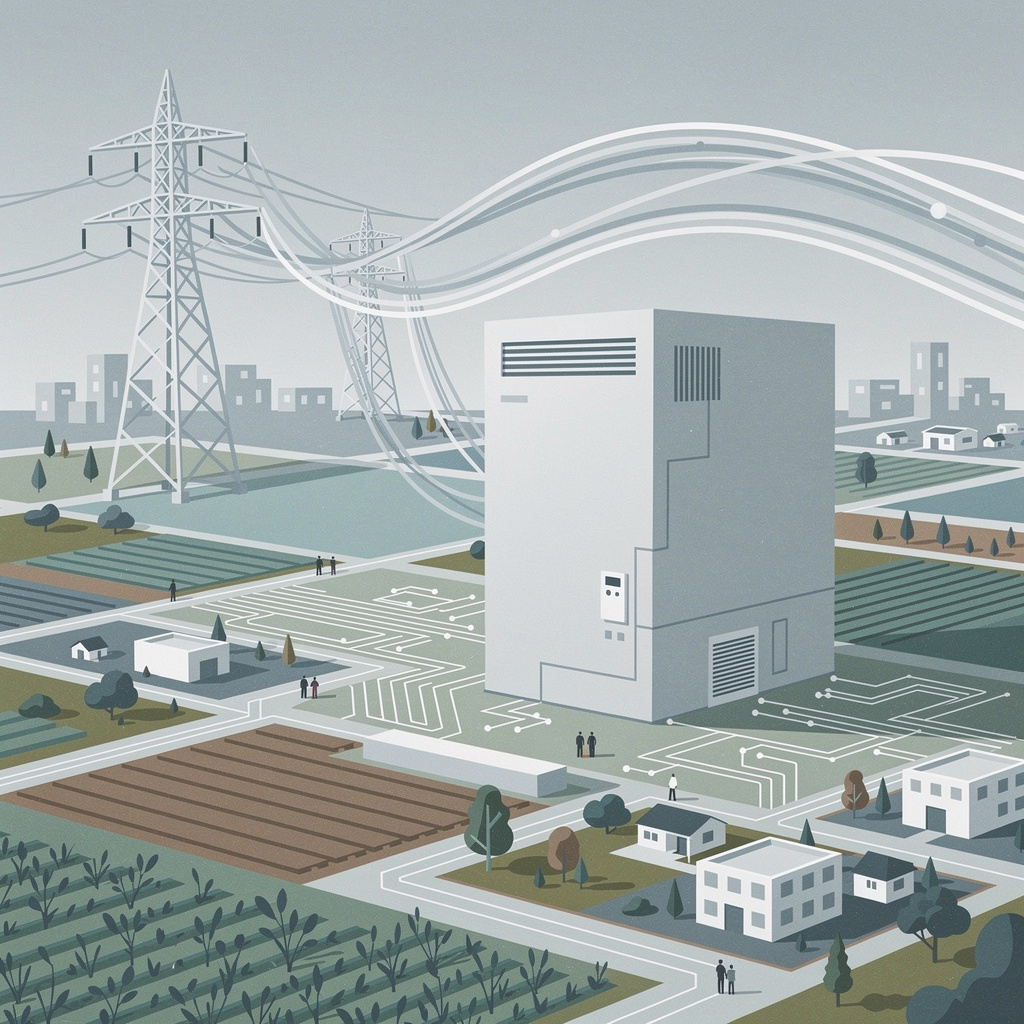
A decade ago a data center was the kind of infrastructure nobody thought about — a windowless box on an industrial lot, noticed only by the engineers whose workloads lived inside it. Today it has become one of the more quietly consequential forces in the economy, pulling on electricity grids, commercial real estate, semiconductor supply, construction, and even the question of where new power plants should be built. As Kavan Choksi points out in a piece for The Tech Block, the boom is a textbook example of a technology trend spilling far past the technology sector itself.
The driver is almost banal in its simplicity: modern digital life needs a staggering amount of compute. Streaming, cloud storage, online banking, and enterprise software already built a heavy baseline of demand, and generative AI has layered on a second, far more power-hungry tier. Training and running advanced models calls for specialized hardware and round-the-clock electricity, and that single fact has converted data centers from a niche form of commercial property into what is effectively strategic infrastructure — the kind of thing that shapes a region's economic future the way ports and rail lines once did.
The first insight worth pulling out is that the spending is almost everywhere except where you would expect. A single large campus demands land, construction, cooling systems, backup power, networking gear, and enormous numbers of chips, plus a reliable hookup to the telecom network and access to very large quantities of electricity. Very little of that money stays with the company that owns the servers. A data center is really a financial hub that routes billions through electrical contractors, chip foundries, HVAC suppliers, and utilities — most of which do not look like technology companies at all. Judging the sector only by the handful of big-name operators misses most of the story.
The most interesting consequence, though, is what has happened to electricity. For years the digital economy sold itself partly on weightlessness — software drifting to the cloud, physical media disappearing, everything living behind a screen. The reality underneath that illusion is a vast physical system consuming power around the clock, and AI has made that hard to ignore. Where clusters of data centers are planned, utilities are being asked to strengthen transmission, add generation, and rewrite long-term demand forecasts; a project can stall entirely if the grid connection is not there. That turns electricity into a genuine competitive advantage for regions. A city can offer skilled workers, low taxes, and cheap land, and none of it matters if the facility cannot draw the megawatts it needs.
That reframing is its own quiet revolution: power access is becoming a site-selection filter in roughly the way deep-water port access and rail junctions used to be. It is not hard to imagine a near future where the "infrastructure score" of a region — grid headroom, transmission capacity, water availability — matters as much to where investment lands as tax incentives ever did. The digital economy spent a decade pretending to be everywhere and nowhere; its next phase is going to be intensely, physically local.
The effect on communities is genuinely two-sided, and the article is right to keep both halves in view. On paper the headline numbers are dazzling — billions committed to a single campus, a surge of construction work, an expanded tax base. But the employment curve is lopsided. Data centers employ large workforces while they are being built and comparatively few people once they are running, at least relative to a factory of similar footprint. Their lasting contribution tends to come through investment, taxation, and supporting industries rather than through permanent jobs. They also compete for land, power, and water, which means the same project can look like a windfall in one town and a strain on local resources in another. The outcome depends entirely on where it lands.
This is where the investment question gets interesting, because it is not actually a question about whether AI will grow. It is a question about whether the revenue AI generates will eventually justify the amount being spent to build for it. Companies are spending aggressively now because nobody wants to be the one caught without capacity, which is a powerful — but also slightly panicky — incentive to overbuild. Choksi reaches for the fiber-optic boom as the historical parallel, and it is a good one: the late-1990s internet build-out produced plenty of bankruptcies, yet the networks left behind became enormously valuable as usage caught up. Data centers could follow the same arc, where a genuinely transformative technology and a disappointing set of individual investments coexist for years.
There is one more layer the fiber parallel suggests that is worth making explicit. The difference between the two eras is what the stranded asset is made of. Excess fiber was, in a sense, inert — dark strands waiting quietly for demand. Excess data center capacity is different, because a built-but-underused facility still draws maintenance, cooling, and above all power, and it competes with everything else for grid capacity in the meantime. That makes the overbuild question sharper this time around: the downside of guessing wrong is not just wasted capital, it is wasted electricity and strained grids in places that may not have had the headroom to spare.
None of this makes the boom anything less than real. The useful way to frame it is as the arrival of a new kind of infrastructure cycle, one that fuses several formerly separate investment stories into a single loop. Technology companies need computing hardware; chipmakers need production capacity; utilities need new power infrastructure; construction firms are being asked to build increasingly sophisticated facilities. The spending radiates outward long before anyone knows whether the AI applications at the end of the chain will actually pay for it, reaching a new substation, a semiconductor plant, or an industrial park that has only an indirect, traceable connection back to cloud computing.
The digital economy has spent a generation marketing itself as something that lives in the cloud. Its next chapter is being poured in concrete, strung on transmission towers, and bolted into the ground — and the places that understand that are the ones that will benefit most.
Further reading: - IEA — Electricity 2024: Analysis and forecast to 2026, which examines rising data-center and AI electricity demand alongside other grid pressures. - Lawrence Berkeley National Laboratory — United States Data Center Energy Usage Report, the long-running reference for how much power the sector actually consumes.
Comments
Everyone's counting the megawatts these things will eat. Nobody's counting the water. Build the grid for the dry year, not the average one.
@fuzzyMaker the dry-year grid is table stakes — but a data center with no water rights has all the resale value of shag carpet.
Leave a Comment