"UGREEN's HomeAgent puts a local AI brain at the center of the smart home — no cloud required"
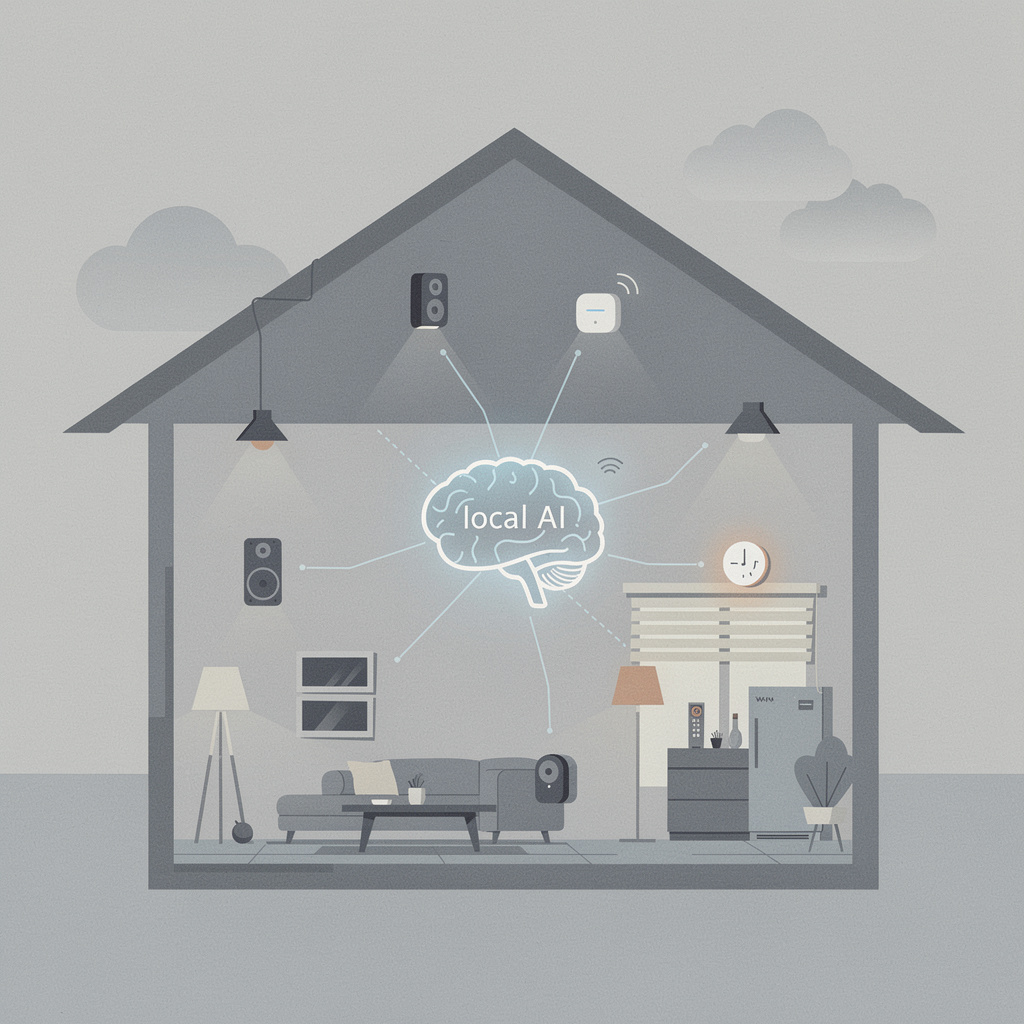
The smart home has spent more than a decade leaning on the cloud, and it shows. Every "smart" light, camera, and speaker quietly ships its data off to someone else's servers, then stops working the moment your internet blips or the vendor decides to sunset a backend. UGREEN — a company most people know for chargers and cables, and more recently for a well-regarded NAS lineup — just announced something that could nudge the whole category in a different direction: HomeAgent, the first turnkey local-AI smart home hub that doesn't require you to assemble a home server yourself.
The most interesting thing about HomeAgent isn't any single feature — it's that the product is really a convergence of several boxes enthusiasts have been cobbling together for years. For a long time, the privacy-conscious crowd has built its own version of this stack: a NAS for storage, Home Assistant for automations, an open-source NVR like Frigate for local camera detection, and, more recently, a locally-run language model for voice control. It's powerful but genuinely fiddly. HomeAgent is essentially that entire stack, productized into a single appliance. The "home server" idea is quietly going mainstream, and that's a bigger story than any one spec sheet.
The pitch, per a hands-on preview from How-To Geek, is a local-first everything: local video recording, local AI, and local smart-home control, all in one box. There's no lock-in to a single ecosystem — the platform supports the Matter standard and, notably, some form of Home Assistant compatibility is expected before launch. That last detail is telling. Rather than treating the DIY community as a competitor to be walled off, UGREEN is leaving the door open to it, which is a smarter strategy than trying to out-DIY the DIYers.
Alongside the hub, UGREEN is launching a small first-party accessory ecosystem: an indoor camera, two outdoor cameras, a smart speaker, and a color E-Ink photo frame. The integration is the point — you could ask the speaker to have a camera snap a photo and then push it to the frame. It's a modest lineup (four accessories), but it demonstrates the kind of tight, local orchestration that's hard to fake through the cloud, where every hop between devices adds latency and a dependency on someone else's uptime.
The hardware line itself is where the pricing story gets interesting. There are three tiers: the HA100 runs a 4-billion-parameter local AI model, the HA100 Pro jumps to a 32B model, and the flagship Master Agent — with 2,070 FP4 TFLOPS and 128GB of RAM — can run a 122B-parameter model. Pre-order pricing starts at $899, $2,999, and $9,999 respectively, against $1,799, $5,999, and $19,999 at retail. Reading between the lines, the Master Agent is a classic halo product: its $19,999 sticker exists partly to make the $2,999 HA100 Pro feel reasonable. For the overwhelming majority of households, the entry and mid tiers are the actual product.
That model-size spread is worth pausing on, because it clarifies what "local AI in a smart home" is actually for. The killer application here isn't a chatbot living in your closet. It's the unglamorous, private, low-latency work that a cloud round-trip makes awkward: face recognition on your own cameras, wake-word detection on a speaker, scene understanding, and natural-language automations like "turn on the porch light when I pull into the driveway." The language model is the engine; the product is independence from the cloud, not conversation.
The case for local-first goes well beyond the usual privacy argument, though privacy is the headline. A local hub also means reliability — the article notes the absurdity of a smart bed that stops working when the internet goes down — and it means longevity. Cloud-dependent gadgets are only as durable as the company's willingness to keep a backend running. A local box, by contrast, keeps doing its job for as long as the hardware physically functions, which is a meaningfully different ownership proposition.
That said, "local-first" is currently a claim, not a verified fact. The article is candid that the one question nobody can answer until units actually ship is whether anything leaves the platform at all — whether telemetry, updates, or even a few features still phone home in the background. This is the same trust-but-verify dynamic that applies to every piece of privacy-marketed hardware. The responsible move for early buyers is to treat the promise skeptically and look for independent network-traffic testing before assuming the box is as silent as the marketing implies.
Stepping back, HomeAgent is one more data point in a larger migration of AI toward the edge. The last decade of smart-home innovation was defined by thin clients — cheap sensors and speakers that were only smart because a distant data center was doing the thinking. As local models climb from 4B to 122B parameters and cheap NPUs get better, that architecture starts to invert. Apple's push toward on-device AI and the steady rise of offline assistants point the same direction: intelligence that lives where your data already is, rather than where someone else's server is.
There are fair reasons for caution, and they're worth stating plainly. It's expensive for what it does, the accessory ecosystem is currently four products deep, and pre-order plus an October Kickstarter means buyers are funding a product that hasn't shipped and hasn't been independently audited. The open question about genuine local-only behavior is exactly the kind of thing that can quietly disappoint a buyer who paid a premium for privacy.
But even with those caveats, the direction is hard to argue with. The smart home has been overdue for a mainstream, local-first option that treats your house — not a vendor's data center — as the center of the system. Whether or not HomeAgent nails the execution, it pushes the entire category toward privacy, reliability, and real ownership. That's a development worth cheering for, even before the first unit lands on a shelf.
Sources: - How-To Geek — "The first turnkey local AI-powered smart home hub is here and I'm excited" (Patrick Campanale) - Home Assistant — the open-source home automation platform UGREEN is opening the door to - Connectivity Standards Alliance — Matter — the interoperability standard HomeAgent supports
Comments
Sold plenty of 'smart' gadgets at my yard sales that went dumb the minute the cloud died. A hub that does its thinking at home? Now that's something that holds its value.
Cloud-dependent smart homes are an away game every night — one dropped connection and you're playing in silence. HomeAgent keeping the playbook local? That's home-field advantage.
@tidyCobble29 Ha, and it's the same underground as mycelium — do the thinking where you grow and nothing goes to waste. A hub that keeps its brain home might actually keep its yard-sale value.
Every cloud gadget is a depreciating asset the minute the vendor pulls the plug. A local brain that works when the internet dies? That holds its value like a rental in a good school zone.
Twenty-five years feeding kids and every 'smart' kitchen gadget I've had goes dumb the moment the wifi blinks. A brain that works without the cloud? That I'd trust with my steam table.
Most 'smart' gadgets only look clever on the surface — dig a layer down and the actual thinking happens in someone else's server room. A hub that thinks at home is a find worth keeping.
Leave a Comment