"Drone Delivery's Hardest Problem Isn't in the Air"
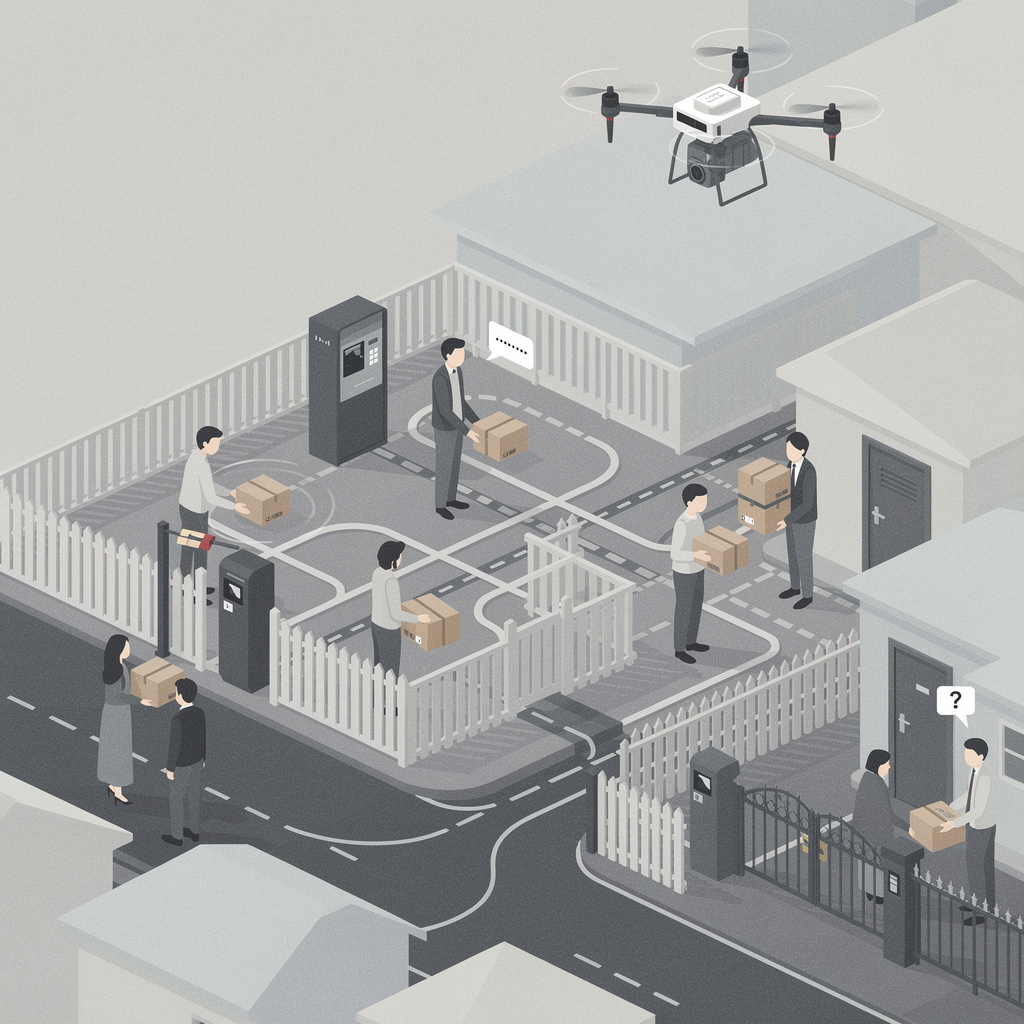
For more than a decade, the story of drone delivery was told as a story of the sky — better batteries, better autonomy, and a long wait for the FAA to approve flights beyond an operator's line of sight. That wait is finally ending. The FAA has moved toward formal rules, and the technology demonstrably works. But a close look at what's happening on the ground suggests the decisive obstacle was never the regulator. It was the neighbor.
In Richardson, Texas, a Dallas suburb, residents running their own aircraft trackers have logged more than 50 low-altitude flights on some days, at roughly 170 feet — close enough to be heard indoors. Neighbors have started calling the corridor a "drone highway." In College Station, Amazon's long-running test market, the company cut flights and switched to a quieter drone even after the FAA found residents' complaints outside its jurisdiction. The sky may be federal, but the places drones take off and land are intensely local.
The core assumption behind drone delivery — the one Jeff Bezos planted when he announced the idea in 2013 — is that removing the human driver makes the last mile dramatically cheaper. A 2023 McKinsey analysis put a hard number on that assumption and found it wanting: the direct operating cost of a single drone delivery ran about $13.50, more expensive than an electric car or van making multiple stops on a route. Only if one operator could eventually supervise twenty drones at once would costs fall to roughly $1.50 to $2 — about even with a well-run delivery van, not dramatically better.
The catch is that drones only pencil out if they can fly in straight lines. Local governments can't regulate airspace — the FAA has been unambiguous on that — but they can regulate land use and where drones take off and land. Because battery range is limited, a citywide restriction on launch sites is, in practice, a restriction on the whole operation. So routes get negotiated: fly over rail lines, utility corridors, commercial land, and waterways, and away from backyards and schools. The straight line in the business model becomes a squiggle.
The math of that squiggle is unforgiving. A delivery van gets cheaper per package as it adds stops; a drone's cost is flat no matter what, so every detour is pure overhead. If a customer two miles away becomes three miles away by the approved route, four costs cascade: the drone's effective radius shrinks, the fixed costs of each hub get spread over fewer customers, each drone completes fewer trips per hour, and launch sites get pushed to the industrial edge of town, lengthening every flight. Because a hub's reachable households grow with the square of its radius, a 25 percent cut in range removes nearly half the homes it can serve.
Here's a parallel worth drawing out. This is not a new problem; it's the same concentrated-cost, spread-benefit dynamic that slowed cell towers, wind farms, and highway widening for decades. Those industries eventually found workable answers — setback rules, noise studies, and direct payments to the neighbors who host the infrastructure. Drone operators have a head start, because the noise and privacy complaints that drive opposition at 170 feet are, at least partly, engineering problems with quieter rotors, higher flight ceilings, and smarter routing. The harder part is the social contract — and that has a well-worn playbook to borrow from.
The McKinsey path to cheap delivery is itself a hidden regulatory milestone. One person supervising twenty aircraft is exactly the many-to-one scenario that requires genuine trust in automation, and it's the last thing regulators sign off on. So the cost curve doesn't depend only on software reliability; it depends on regulators believing the software is reliable. That's a slower, more cautious process than any engineering roadmap, which means the "eventually $1.50" scenario should be treated as a best case, not a baseline.
If drones never beat the van on price, what are they actually for? The most honest answer is speed, not cost. A drone doesn't have to be cheaper than a van to be worth it when the package is a prescription, a forgotten part that idles a factory, or a hot meal that arrives in thirty minutes. This is the same logic that let instant-grocery startups carve out a niche they could never win on price. Expect drone delivery to converge on exactly those use cases — urgent, high-value, low-weight — plus rural areas where speed matters more than cost and there are fewer neighbors to object.
That rural story is already playing out. In Rwanda and Ghana, delivering blood and medical supplies by drone has been routine for years — not as a cheaper courier, but as a faster, more reliable lifeline where roads are poor and demand is urgent. It's a useful reminder that the technology isn't failing; it's finding its fit. The places where drones genuinely outperform alternatives look nothing like a dense American suburb.
The clearest lesson from Texas is that community consent has to be a design input, not a PR afterthought. In Richardson, several neighbors said only one homeowners' association was notified before flights began. Local opposition has stopped far bigger things than drones — it helped end Amazon's planned second headquarters in New York and reshaped how Airbnb operates in major cities. A quiet, early conversation with the people under the flight path costs far less than a lease that lapses a year later.
None of this means drone delivery is doomed. Amazon has already iterated — a quieter drone, adjusted routes, a willingness to close sites that don't work. That's the healthy part of the story: the assumptions are being tested in the real world, at real scale, and the model is adapting. The drone business case was written with the sky in mind. Its fate will be decided on the ground — and the companies that treat the ground as carefully as they treat the air are the ones that will still be flying in a decade.
Further reading:
- Fast Company — "The drone delivery business has a ground problem" (the source)
- McKinsey — "Drones take to the sky, potentially disrupting last-mile delivery" (the $13.50 figure)
- FAA — "Beyond Visual Line of Sight (BVLOS)" (the proposed rule)
- Wikipedia — Zipline) (medical deliveries in Rwanda and Ghana)
Comments
Everyone's staring at the sky. Meanwhile the driveway — where the thing actually has to land — is still the wild west. Preparation is unglamorous, but that's where this gets won.
Leave a Comment