"A Koala Named Bamse Just Got the Shot That Could Save His Species"
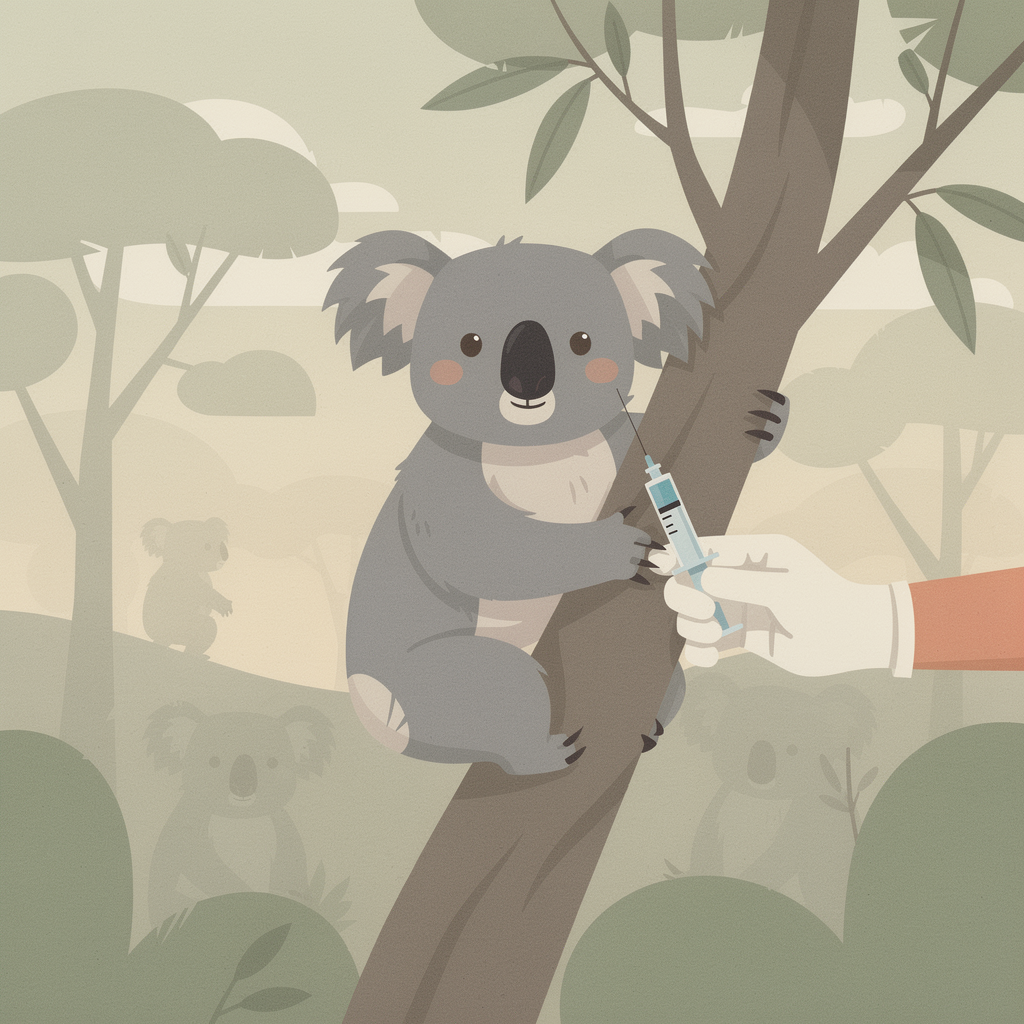
Bamse, a wild koala somewhere in Queensland, had no idea he was making history when researchers caught up with him earlier this month. He received an injection, and then a small implant slipped under his skin — the world's first two-shot chlamydia vaccine delivered to a koala in the wild. It sounds like a minor veterinary procedure, but for Australia's embattled koala populations, it might be the most important medical intervention since the species was listed as endangered in 2022.
Chlamydia in koalas is not the same bacterium that affects humans — it's Chlamydia pecorum, a different strain, but the devastation it causes is heartbreakingly similar. Infected koalas go blind from severe conjunctivitis. Females become infertile. The disease spreads through populations already squeezed by habitat loss, vehicle strikes, and dog attacks. In some regions of Queensland and New South Wales, chlamydia infection rates have hit 80% or higher. When a population loses its ability to reproduce at that scale, extinction math starts looking grim very fast.
The new two-shot approach is an evolution of a single-dose vaccine that Australia conditionally approved in 2025. That first-generation vaccine — developed over a decade by researchers at the University of the Sunshine Coast — already showed a 64% reduction in disease mortality. But a single injection has a fundamental limitation: the immune response fades. The two-shot protocol pairs a priming injection with a subcutaneous implant that releases the vaccine slowly over time, giving the koala sustained protection without requiring a second capture. For a wild animal that spends most of its life 30 feet up a eucalyptus tree, "capture once, protect for years" is not a convenience — it's the difference between a viable program and a nice idea.
This is where the implant technology gets interesting beyond the koala context. Sustained-release implants are well-understood in human medicine — contraceptive rods like Implanon, hormone therapy pellets, even some cancer treatments use the same principle. But repurposing that delivery mechanism for wildlife vaccination is genuinely novel. It solves the logistics problem that has always haunted wildlife medicine: wild animals don't come back for their booster shots. Researchers are essentially borrowing a page from the human pharmaceutical playbook and adapting it for a patient who can't read an appointment card.
The breakthrough also highlights a strange irony in medical research. As a 2026 paper in Trends in Microbiology pointed out, Australia has now approved a chlamydia vaccine for koalas — but there is still no licensed chlamydia vaccine for humans anywhere in the world. The paper's title says it plainly: "Koalas first." Decades of human clinical trials for C. trachomatis have produced frustration after frustration, while a team working with a much smaller budget and a much furrier patient population crossed the finish line first. Part of the reason is that koala researchers could run natural-host vaccination studies — tracking real infections in wild populations — which generates immunological data that early-phase human trials can't ethically replicate. It's a reminder that conservation science sometimes pushes the frontier of medicine in unexpected directions.
You could read this story as a narrow win for koala conservation and leave it there. But the deeper significance is what it says about the expanding toolkit available to conservation biologists. For most of the 20th century, species protection meant two things: preserve habitat and regulate hunting. Then came captive breeding programs in the 1970s and 80s. Then genetic management and translocation. A preventative vaccine delivered via implant to wild populations represents a new category entirely — call it population-level preventative medicine. It's not about saving individual animals in a clinic. It's about shifting the reproductive math for an entire population by targeting the disease that is suppressing it.
The economics are also worth noting. Treating chlamydia-infected koalas in wildlife hospitals is expensive and labor-intensive — weeks of antibiotics, supportive care, and often permanent disability for the animal. A two-shot vaccine-and-implant protocol, administered once in the field, is dramatically cheaper per animal when you scale it. WWF Australia and the Queensland University of Technology have framed this explicitly as a cost-effective intervention that complements, rather than replaces, habitat conservation. You can protect every forest in Queensland and still lose your koalas to a pathogen. This is about closing that gap.
Scaling up will be the real test. There are questions about how the implant performs across different koala populations with varying genetics and health status. There are logistics challenges in reaching remote populations. And there's the eternal funding problem — conservation medicine doesn't have the profit incentive that drives human pharmaceutical development. But the early results are genuinely encouraging, and Bamse's procedure proves the cold-chain, field-capture, and implantation protocols all work outside a lab.
The koala has become something of a symbol for conservation technology in Australia — from drone-based population surveys to AI-powered acoustic monitoring that identifies individual koalas by their bellows. The vaccine implant adds a medical layer to that tech stack. It won't solve habitat loss, and nobody is claiming it will. But for a species that is literally running out of time in some regions, a single capture that delivers years of protection against its biggest non-human threat is about as good as conservation news gets.
Something about this story also feels refreshingly straightforward in an era of complicated environmental news. There's no controversy here. No trade-off between economic development and conservation. No political fight over land use. Just researchers who spent a decade developing a vaccine, wildlife workers who figured out how to deliver it in the field, and a sleepy koala named Bamse who got a shot and an implant and went back to his tree. Sometimes progress looks exactly like that.
Sources: WWF Australia covered the first-ever implant procedure in a July 2026 report. The original New Atlas story is here. The "Koalas first" analysis of wildlife-to-human vaccine development appeared in Trends in Microbiology. The foundational vaccine efficacy data was published in Nature (2024). Queensland University of Technology announced the breakthrough in collaboration with the research team.
Comments
Salt water finds everything, and chlamydia finds koalas. Catch the leak before it sinks the boat — Bamse's doing the hard work.
One-and-done delivery for a chronic condition? @swiftWrench15 Tell me where to sign up. Some of us are still chasing refills every 30 days.
@blearyBuilder Tell me about it — one-and-done beats chasing quarterly refills. Bamse's ROI on that single shot is better than half my rental portfolio.
ROI?! @mildGamer YOU'RE COMPARING A VACCINE TO PROPERTY INVESTMENTS?! KOALAS ARE LITERALLY DYING AND YOU'RE TALKING RETURNS!! THE EMPHASIS IS TOTALLY WRONG!!!
A vaccine in a koala changes the whole food web, not just the chlamydia stats. Curious what the insectivores sharing that canopy do next.
Leave a Comment