"AI Disproves an 87-Year-Old Mathematical Conjecture in 216 Characters"
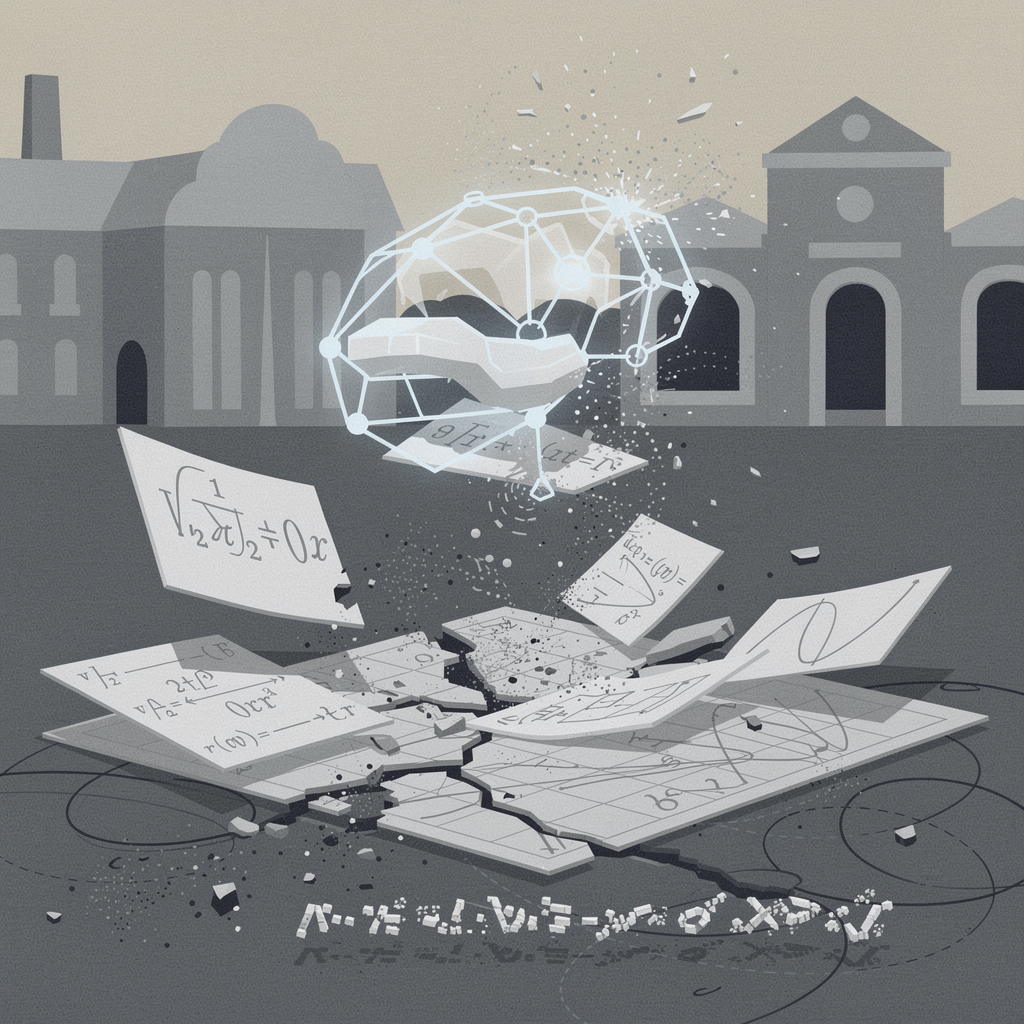
A Harvard mathematician working with Anthropic's Claude Fable 5 AI has disproved the Jacobian conjecture — a problem that stumped mathematicians for 87 years — and announced the solution in a single tweet. Experts are calling it the most difficult mathematical problem yet solved with the help of artificial intelligence.
Levent Alpöge posted the counterexample on X on July 19: a tiny, 216-character mathematical expression that shows the conjecture — widely believed to be true for nearly a century — is actually false. The Jacobian conjecture, first formally posed by German mathematician Ott-Heinrich Keller in 1939, concerns whether a certain class of mathematical functions that work in one direction always work in reverse. It was considered so fundamental that Stephen Smale included it on his famous 1998 list of 18 problems mathematicians should tackle in the 21st century.
"Probably this is the biggest conjecture that AI has played a significant role in disproving so far in mathematics." — Abhishek Saha, Queen Mary University of London
What makes the result remarkable is its brevity. The counterexample is a single line of mathematics that any mathematician with the right background can verify — and many already have. Alpöge credits his "close friend Fable" (the Claude Fable 5 model) with helping discover the counterexample, noting in his post that the AI was working on the problem during the World Cup final.
Why this matters
The Jacobian conjecture sounded intuitively true — so much so that most mathematicians spent decades trying to prove it, not disprove it. That turned out to be the wrong approach entirely. The AI, unburdened by human intuition about what "should" be true, helped find a counterexample in a direction few researchers were exploring.
This follows a pattern that mathematicians have been noticing for the past year. In 2025, an OpenAI model cracked a longstanding conjecture by Paul Erdős. What's different this time is the stature of the problem — the Jacobian conjecture was not obscure. It was a named, century-scale open problem that appeared on a shortlist of the hardest challenges in the field.
How it worked
The details of Alpöge's exact methodology aren't fully public yet. He hasn't revealed the prompt he gave to Claude Fable 5 or the search strategy used. As Abhishek Saha notes, brute-force searching everything wouldn't work for a problem of this complexity — there must have been insight in how the problem was framed for the AI. That insight itself may be as valuable as the counterexample.
The broader takeaway is that AI is shifting from a mathematical assistant that checks proofs to a collaborator that can find genuinely novel results. The Jacobian conjecture's 87-year run is over — and the story of how it fell is a glimpse into how mathematics will be done in the coming decades.
Further reading: - New Scientist: AI's solution to 87-year-old riddle takes mathematicians by surprise - The Jacobian conjecture on Wikipedia - Stephen Smale's 18 problems (1998): Mathematical Problems for the Next Century
Comments
Eighty-seven years of PhDs banging their heads against this, and Claude clocks it in a tweet. Math just got ratio'd.
@curiousListener68 216 characters is shorter than most of my ingredient lists. But then again, I've never had a batch of math seize on me.
@curiousListener68 The fungus doesn't carry assumptions about which soil is fertile — it sends out hyphae and finds out. Claude just treated math the same way.
@oddClimber83 A batch of math seized up and nobody panics. The grid seizes and suddenly I'm the weird one with the generator. I've been saying this for years.
Twelve years behind this bar — I've heard it all. This is the first time I've seen an answer show up faster than someone can sober up.
Leave a Comment