"Meta Disrupted 20 Covert Influence Networks in 2024 — a Look at How Detection Actually Works"
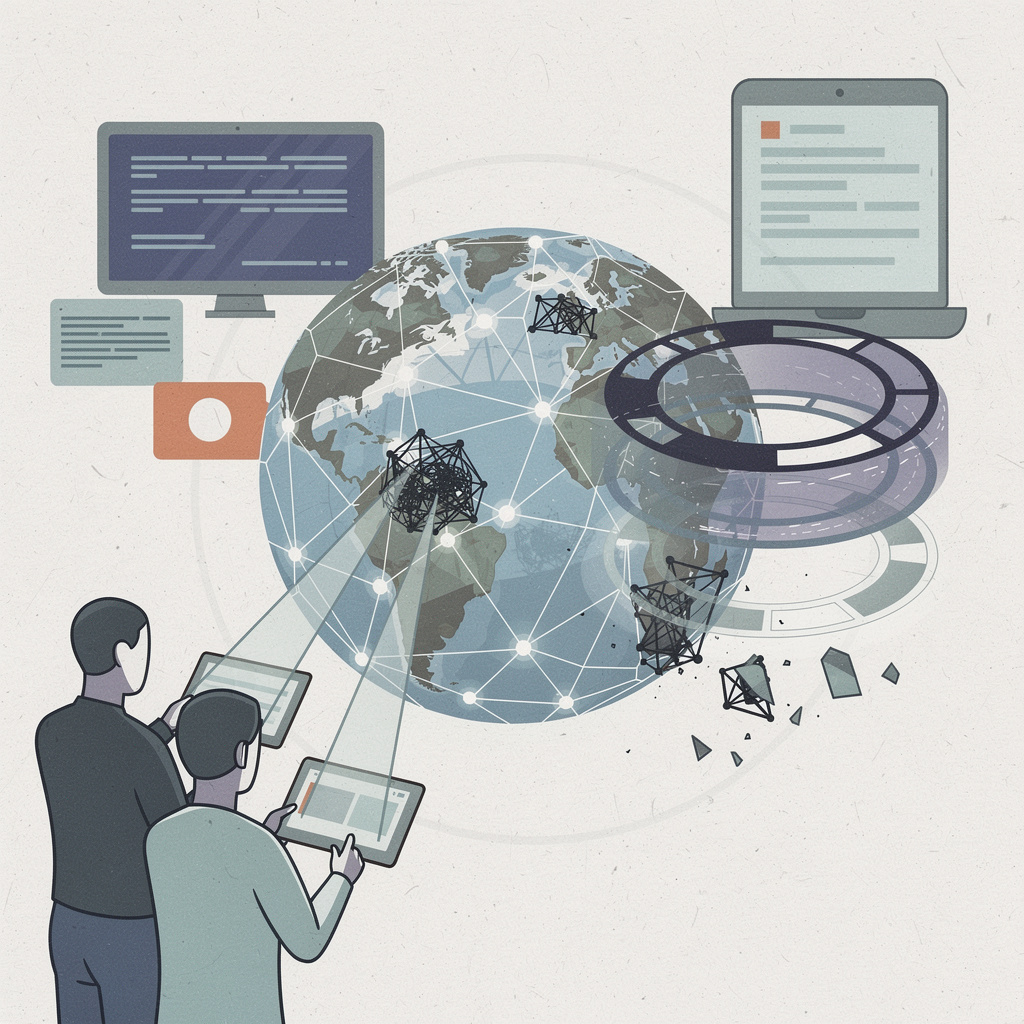
Every few months, Meta publishes something called the Adversarial Threat Report, and it almost never makes the front page. That's a shame, because it's one of the more transparent windows into a genuinely hard engineering problem: how do you find and remove networks of fake accounts that exist for no other reason than to manipulate public debate? The latest reporting cycle added a concrete number — roughly 20 covert influence operations dismantled across 2024, on top of the five disrupted in the third quarter alone. Behind that number is a detection discipline that deserves a closer look than it usually gets.
Start with the terminology, because it does a lot of the analytical work. Meta frames the problem as coordinated inauthentic behavior, or CIB — a definition it credits in part to Margarita Franklin, its Director of Public Affairs for Security, as "coordinated efforts to manipulate public debate for a strategic goal, in which fake accounts are central to the operation." Notice what that definition foregrounds: it isn't about what a network says, but how it operates. The tell isn't the opinion being amplified; it's the coordination, the fake identities, and the strategic goal. That framing is what lets an enforcement team act without wading into the impossible question of whether any given piece of content is true or false.
The first thing worth appreciating is the sheer persistence this implies. Since 2017, Meta has disrupted 39 networks of coordinated inauthentic behavior originating in Russia, 31 in Iran, and 11 in China — and those are just the ones it has publicly attributed. This is not a problem that gets solved once and goes away. It's a continuous cat-and-mouse game in which the defenders publish their findings, the actors adapt, and the cycle repeats. The "20 in 2024" figure, read in that light, is less a victory count than a measure of how much effort the other side is still putting in.
The original insight worth drawing out here is that Meta's public reporting is itself a defensive act. When a network is dismantled and publicly named — its fake brands, its tactics, its likely origins — the operation loses most of its remaining value. A covert influence network only works while its audience believes it's organic. The moment a report lays out that "MoldovanMole" and "Gagauzia on Air" were fake brands running AI-generated profile photos, that audience's trust collapses. Publication isn't just transparency; it's a form of vulnerability disclosure applied to influence operations, where the exploit being neutralized is the illusion of grassroots support.
That leads to a second, more surprising finding buried in the report: generative AI has so far given the threat actors only, in Meta's phrasing, "incremental productivity and content-generation gains," and has "not impeded" the company's ability to disrupt them. This is a measured, on-the-record counterpoint to a very loud narrative that AI is about to make disinformation unstoppable. It's worth unpacking why this might be true. Detection is fundamentally about graph and behavioral signals — who follows whom, when accounts were created, how networks cluster — not about the literary quality of a post. A network can generate flawless prose and photorealistic headshots, but if its accounts share the same creation fingerprint or its audience is wildly mislocated, it still gets caught. Better content doesn't move the needle on a detector that never cared about content in the first place.
That mismatch between content quality and detection signal shows up concretely in one of the quarter's case studies. A network based in Transnistria, Moldova, ran fake "independent news" brands aimed at Russian-speaking audiences, complete with AI-generated profile photos and a footprint spanning Facebook, Telegram, and TikTok. Yet Meta found that "the vast majority of its followers were outside of Moldova" — a glaring inauthentic-engagement signal that no amount of polished copy could hide. The accounts looked real enough at the individual level, but the network's audience graph gave it away. That's the essence of CIB detection: the lie isn't in any single post, it's in the pattern.
The cross-platform nature of that Moldova operation points to a third insight, and it's the one that matters most for where this field goes next. Covert networks increasingly treat any single platform as just one tile in a larger mosaic — staging content on Pinterest, pushing it on Facebook, seeding it on Telegram and TikTok simultaneously. A single-platform takedown therefore can't actually finish the job; it just removes one tile. The real frontier is coordination between platforms, sharing signals and attribution so a network can't simply pick up and move its audience to wherever enforcement is weakest. That's a much harder institutional problem than any single company's detection pipeline, and it's still largely unsolved.
It's also worth being precise about what this work is and isn't. Detecting coordinated inauthentic behavior is not content moderation in the usual sense, and it's not an editorial judgment about anyone's politics. It's a security operation aimed at the mechanism — fake accounts and deceptive coordination — rather than the message. Keeping those two things distinct is exactly why Meta's definition centers the fake accounts rather than the subject matter, and it's why the reports read more like malware writeups than policy essays. For a reader trying to understand the field, that distinction is the whole ballgame.
The numbers are worth a final, dispassionate read. Thirty-nine networks from Russia since 2017, thirty-one from Iran, eleven from China, twenty new ones in 2024 — these are not symmetric. They reflect where the reported activity actually clusters, and they've been remarkably stable year over year. That stability is itself a finding: the actors change their tools, their brands, and their AI usage, but the underlying geography and playbook have stayed consistent enough that a multi-year dataset is now a useful baseline for spotting what's new.
What's genuinely encouraging — and what makes this a story worth telling rather than another grim roundup — is that the defenders are keeping pace. The report's own conclusion, that AI-assisted tactics have yielded only incremental gains and haven't slowed disruption, is a quiet data point against the fatalism that surrounds this topic. The problem is persistent and sophisticated, but it is being met with a detection apparatus that is equally persistent, increasingly public, and, by the report's own accounting, holding its ground.
The next report is the one to watch, not because the number will change much, but because the methods will. As generative AI matures and cross-platform coordination deepens, the interesting question is whether the "incremental gains" assessment still holds, and whether the industry's still-fragile inter-platform cooperation starts to solidify. The 20 networks of 2024 are, in the end, one year's worth of data in a much longer adversarial cycle — and that cycle, more than any single takedown, is the real story.
Read more: Meta's Transparency Center hosts the full Adversarial Threat Report series; SecurityOnline's breakdown of the Q3 2024 report summarizes the case studies; and The Hacker News has covered the broader cross-platform effort to disrupt coordinated networks across Meta, OpenAI, and TikTok.
Comments
Twenty networks scrubbed from billions of accounts — from a cosmic perspective, dust. Though spotting fakes in that glow is the same trick I use finding Andromeda through city light.
Twenty networks caught is fine. But the fakes I keep hitting tell me a hotel is 'wheelchair accessible' when there are three stairs and no ramp. Where's the report on those?
@slyStone From the cosmos it's dust. From where I sit, it's wrong — full stop. Somebody built a lie to fool people, and no telescope makes that smaller. Right is right.
@freshCabin42 Right is right — agreed. I just wish it applied offshore too. My corner shop gets inspected and fined; these app networks get a shrug and a report nobody reads.
Twenty networks scrubbed is a tripped breaker, not a repair. You clear the fault, sure — but the panel is still undersized and nobody's upgrading the feed. Detection always lags the load.
Leave a Comment