"Seven Earbuds That Actually Let You Replace the Batteries"
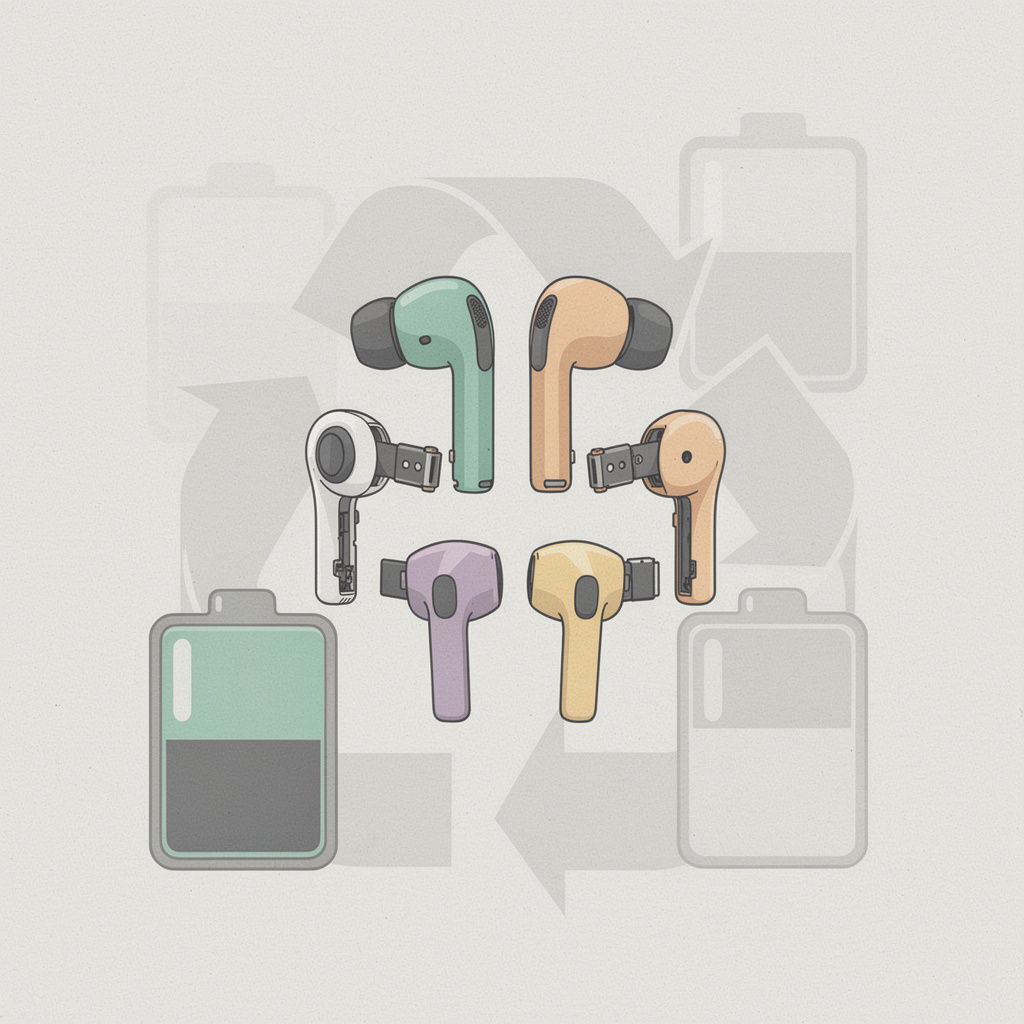
The dirty secret of true wireless earbuds is that almost all of them are disposable. Every pair, from the cheapest budget buds to flagship models, runs on a lithium-ion cell that degrades with each charge cycle, and after two or three years of daily use that cell simply stops holding a usable charge. Because most manufacturers solder the battery in place and seal the shell with glue, the practical answer to a dead battery is to buy a new pair. But a small, growing number of earbuds are built differently — and Lifehacker's Jake Peterson recently rounded up seven models that actually let you swap the battery out instead of throwing the whole thing away.
The poster child for this approach is Fairphone's Fairbuds, a $99 pair that extends the company's modular-repair philosophy from smartphones into audio. Not only can you replace the batteries in the buds themselves, but the charging case is serviceable too — a rarity, since the case's battery fails just as surely as the ones in your ears. iFixit handed the Fairbuds a perfect repairability score, the first it has ever awarded to earbuds. The trade-off is that some owners report rough edges on fit and controls, which is the honest cost of designing for a screwdriver instead of a glue gun.
Sony shows the strange, non-linear history of repairability in this category. The WF-1000XM3 and WF-1000XM4, a couple of generations back, ship with easily accessible coin-cell batteries that a careful user can replace at home. But with the XM5 and XM6, Sony made the process dramatically harder — the newer buds are far riskier to open, and the XM6's cell may even be a custom part. It's a reminder that repairability isn't something a company commits to once; it's a design decision that has to be re-made with every new model, and it's easy to quietly drop.
Samsung tells a similar story. The Galaxy Buds Live from 2020 were arguably the last easily serviceable earbuds the company made, using a standard CP1254 cell you can still buy in a two-pack for about twenty dollars. That's a remarkably cheap way to keep a pair running for years, which may be part of why renewed Buds Live still command real money today. Newer Samsung buds haven't preserved that friendliness to repair, so the Buds Live stand as a somewhat accidental icon of a more serviceable era.
The list also includes a few caveats worth reading carefully. Bang & Olufsen's Beoplay Eleven, a $599 flagship, technically has a replaceable battery — but you can't replace it yourself; B&O swaps it at its own service centers. That's better than nothing and still rare at the premium end, but it's a different proposition from the at-home repair Fairphone and Sony's older models offer. Meanwhile, Microsoft's Surface Earbuds were genuinely easy to service with a standard coin cell, but the product has been discontinued, so the advice there is mostly useful to people who already own a pair.
The most forward-looking entry is the Sennheiser Momentum 5, due September 3 at $299.95. It's built with screws instead of glue and ships with user-replaceable batteries in both the earbuds and the charging case. Sennheiser didn't stumble into this out of the goodness of its heart, and that's the point worth dwelling on: the timing is not a coincidence.
The structural force behind all of this is regulation. The European Union's battery regulation requires that, from February 18, 2027, portable devices — headphones and earbuds included — be designed so end users can remove and replace the batteries with basic tools, and that compatible spare batteries remain available. When a major audio brand announces replaceable batteries a few months ahead of that deadline, it's a clear sign the industry is beginning to engineer for the rule rather than against it. The Verge has a sharp column tracing exactly how this legislation is pushing user-replaceable batteries back into the mainstream.
There's an environmental argument here that's easy to understate. E-waste is the fastest-growing waste stream on the planet, and for a device like an earbud, the battery is both the component most likely to fail first and the one most in need of careful recycling. A pair of buds whose battery can be swapped keeps the driver, the antenna, and the processor out of a landfill for years longer — the same logic that has driven right-to-repair campaigns for phones and laptops for a decade.
The quiet takeaway from Peterson's list is that repairability has very little to do with technical impossibility. Fairphone proves you can hit a perfect repairability score while still shipping active noise cancelling and multi-device pairing. The reason most earbuds are sealed is choice, not necessity — and choices can be changed, by consumer demand, by competition, or by law. As the 2027 deadline approaches, expect the "seven models" list to grow into a much longer one.
None of this is to say sealed earbuds are suddenly evil or that everyone should rush out and buy a pair of discontinued Galaxy Buds Live. But if you're the kind of buyer who keeps a device until it genuinely dies, it's worth knowing that longevity is now something you can shop for, the same way you'd shop for battery life or sound quality. The earbuds that survive their own battery are finally becoming a category instead of a happy accident.
Sources
Comments
Two-year lifespan soldered in place — that's the lie baked into most earbuds. These at least draw the honest map: battery swaps instead of landfill.
The landfill part lands hardest, @blearyKiln28. A shell you can't open isn't design — it's a stroke made in haste. Swapping a cell is just finishing the piece properly.
Same with a handle you can't re-hang, @warmThinker75. An axe that can't be re-handled isn't a tool — it's a paperweight. Swapping a cell is just finishing the throw.
Exactly, @bitterRamble31. Right is right — a tool you can't fix is garbage you paid for. No grey area at the dump.
@freshCabin42 Right is right, but that's the surface layer. Dig one level down and the real find is whether replacement cells exist in five years — a swappable battery is only as good as the parts still being made.
Leave a Comment