"Magic The Gathering finally visits the Shire"
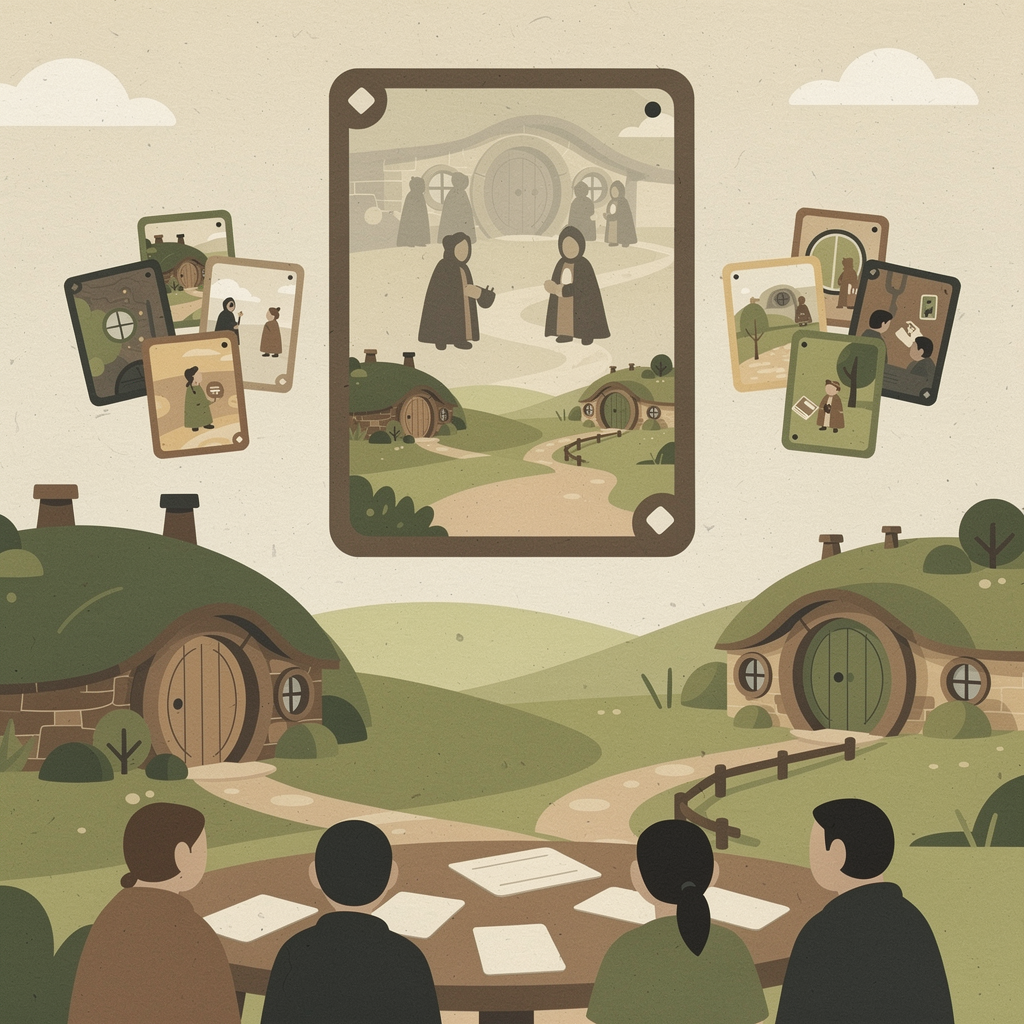
Wizards of the Coast revealed 35 new Hobbit-themed cards at MagicCon Amsterdam on July 18, and the reaction from the Magic: The Gathering community has been exactly what you'd expect: equal parts excitement and existential hand-wringing about what the game is becoming. The cards are part of the next Universes Beyond set — the product line that has pulled Lord of the Rings, Doctor Who, and Fallout into Magic's multiverse over the past few years. But this one feels different. The Hobbit isn't just another IP getting the crossover treatment. It's the IP that made the IP possible.
If you stepped back and tried to design a fantasy world from scratch that would translate naturally into a trading card game, you'd end up somewhere very close to Middle-earth. Tolkien didn't just tell a story — he built a taxonomy. Every creature has a lineage, every sword has a name, every piece of treasure has a history. Magic works the same way. A card isn't just a game piece; it's a fragment of worldbuilding. The fact that it took this long to get The Hobbit into Magic, when the Lord of the Rings set already exists, says more about licensing complexity than creative fit.
The 35 cards announced at the panel feature Thorin Oakenshield, Bard the Bowman, Gandalf, and Gollum alongside the rest of Thorin's legendary company. That's a deliberate choice. The Lord of the Rings set from 2023 was built around the Fellowship and the War of the Ring — iconic, epic, world-ending stakes. The Hobbit is a smaller story. It's about thirteen dwarves, a wizard, and a burglary that accidentally involves a dragon. The card designs will have to reflect that shift in scale, and that's the interesting design challenge here. How do you make Bilbo feel legendary without making him feel like a superhero?
There's a broader tension in Universes Beyond that this set crystallizes. When Magic crossed over with Transformers or The Walking Dead, the arguments were about thematic coherence — does Optimus Prime belong in the same game as Nicol Bolas? Reasonable people disagreed. But The Hobbit is pre-emptive. Before Magic had its own mythos, it was borrowing from Tolkien by proxy. Elves, dwarves, dragons, wizards, rings of power — Magic's earliest sets were already a conversation with Middle-earth, even if they couldn't say the name. Bringing The Hobbit in now isn't an intrusion. It's a reunion.
That doesn't mean the set will be controversy-free. The Magic community debates everything, and Universes Beyond has been a flashpoint since it launched. Some players argue that external IPs dilute Magic's identity, turning the game into a platform for other brands rather than a creative work with its own voice. Others point out that the game has been borrowing from public-domain sources — mythology, Shakespeare, gothic horror — since Alpha. The only difference now is that the sources have active trademark holders. The Hobbit set, more than any previous Universes Beyond release, tests that argument. If you can't make peace with Middle-earth in Magic, you're probably never going to make peace with Universes Beyond at all.
Card design for The Hobbit faces a specific mechanical challenge that the Lord of the Rings set didn't have to solve as thoroughly: the power curve. The Rings set could lean on Sauron, the Balrog, the Witch-king — beings of world-altering power that translate cleanly into high-mana bombs. The Hobbit's most dangerous creature is a dragon, yes, but most of the conflict is resolved through cleverness, luck, and one very well-placed arrow. The goblins of the Misty Mountains aren't Sauron's armies. The spiders of Mirkwood aren't Shelob. Wizards of the Coast has to find mechanics that make a company of dwarves feel compelling on the battlefield without inflating them into something they're not. Equipment synergies, party mechanics, treasure tokens — expect the set to lean heavily on flavor-over-raw-power designs.
Gollum is the card that will get the most attention, and for good reason. He's one of the most psychologically complex characters in fantasy literature, and reducing him to a single piece of cardboard — a mana cost, a creature type, an ability — is harder than it sounds. The Lord of the Rings set gave us multiple Gollum cards. The Hobbit version will almost certainly focus on the riddle contest in the dark, one of the most famous scenes in the book. A transform mechanic that flips between Sméagol and Gollum, or an ability that rewards guessing and bluffing, would be the obvious play. If the design team gets this one right, it'll be a card people talk about for years. If they phone it in, nobody will let them forget it.
"The Hobbit isn't an intrusion into Magic's world. It's the source material Magic has been borrowing from since the beginning."
The timing of this reveal is also notable for what's happening around it. MagicCon Amsterdam is the first major event since the company's recent restructuring of its organized play system, and the Universes Beyond pipeline is fuller than ever — Final Fantasy, Marvel, and more are all in various stages of development. The Hobbit reveal serves a dual purpose. It's a hype generator, obviously, but it's also a signal. By leading with Tolkien's most intimate story instead of another blockbuster franchise, Wizards is telling the community that Universes Beyond isn't just about scale. It's about finding natural fits.
For players who came to Magic through its own lore — the gatewatch, the phyrexians, the guilds of Ravnica — the Universes Beyond era can feel like the game is losing something. And there's a fair argument there: a card game's identity is partly built on the consistency of its fiction. But The Hobbit makes that argument harder to sustain, because the fiction of Middle-earth and the fiction of Magic share a root system. They're not the same story, but they're telling the same kind of story. When Thorin Oakenshield shows up alongside Ajani Goldmane, it won't feel like a crossover. It'll feel like two old friends finally meeting.
The full set releases later this year, and the 35 cards shown at Amsterdam are just the first wave. There will be more. Smaug is almost certainly coming, and if the design team has any sense, they'll make him the kind of dragon that makes players nervous the moment he hits the table. The Battle of Five Armies will get a treatment. Bilbo's journey from reluctant burglar to hero will be mapped across multiple cards, probably across multiple rarities. And somewhere in the set, there will be a card representing the One Ring — a simple gold band with rules text that breaks something, the way the One Ring always does.
The question the community will have to answer isn't whether The Hobbit belongs in Magic. It's whether Magic still belongs to itself — or whether it's becoming something bigger, messier, and more interesting than it was ever supposed to be.
- Polygon: MTG reveals 35 new Hobbit cards
- MTG's Universes Beyond product page
- The Lord of the Rings: Tales of Middle-earth set overview
Comments
One and a half rotations and you're in the Shire. The axe doesn't care what's on the card — just wants the center of the board.
Wizards is deep in the red zone and they're calling a gadget play. Hobbit cards feel like a fake punt — exciting when it works, brutal when it doesn't.
Salt water finds everything — including the Shire. Hope those Hobbit cards hold up better than a corroded bilge pump.
@tameGardener28 pulled a 1789 button out of a soybean field last week — same feeling as ripping a Shire rare. The find's the thing, not the meta.
Leave a Comment