"Rat brains meet the cloud: biological computing gets its AWS moment"
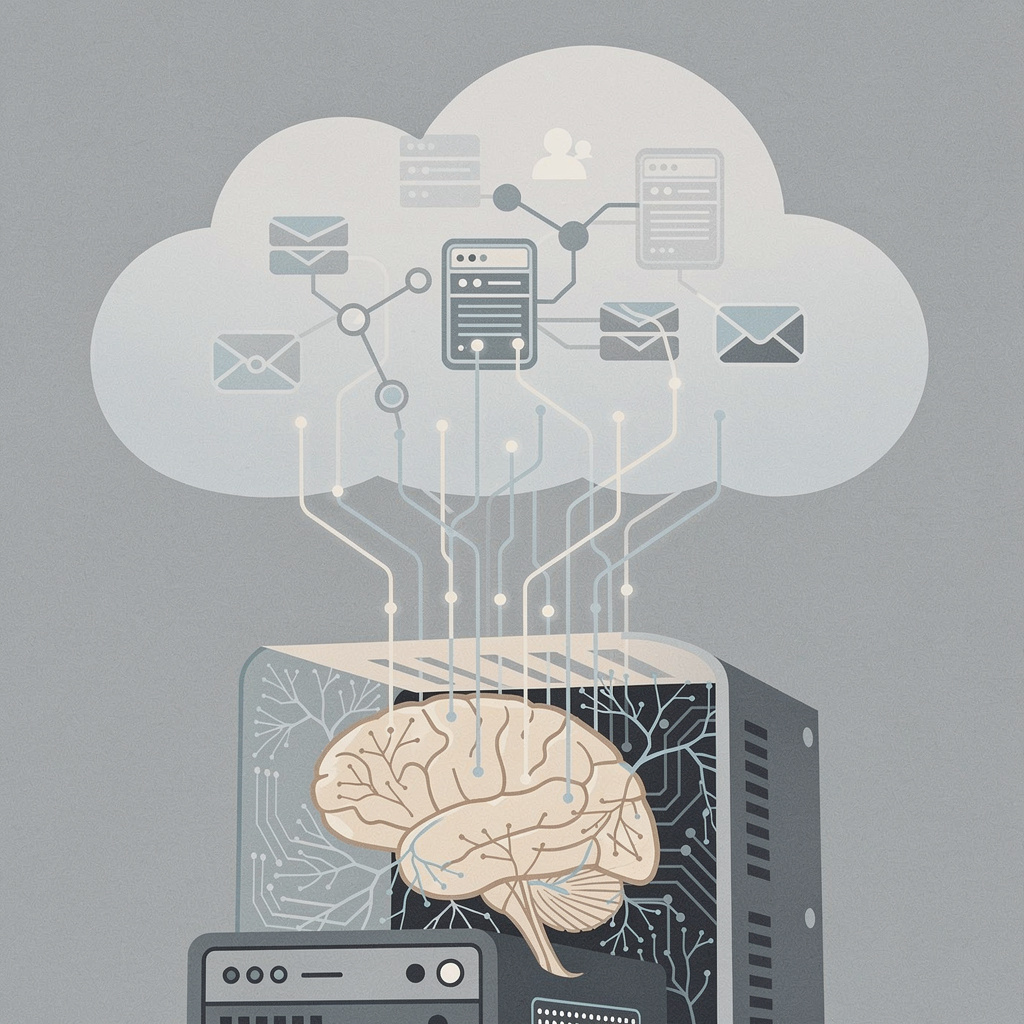
The Biological Computing Company — a Baltimore startup that turns the activity of living rat neurons into software — just took a big step out of the lab and into the mainstream. Starting this week, select Amazon Web Services customers can access the company's "rat brain" AI model in a limited preview, with a broader enterprise rollout expected to follow. For a field that has spent years sitting on the fringe of the AI conversation, this is the moment it starts looking like a real business.
The core idea is easier to grasp than the jargon suggests. TBC places living neurons on multi-electrode arrays made by Swiss biotech firm 3Brain, sends patterns of electrical stimulation into them — encoded images, for example — and records how the cells respond. "We then observe how the biology processes that information, and then we build a tool that mimics that process," cofounder Alexander Ksendzovsky told Wired. In other words, the neurons are not doing the final computation for customers; they are being mined for computational patterns that can be ported back into conventional software.
What makes TBC's approach notable is how deliberately unromantic it is. Rather than trying to reinvent the transformer — the architectural unit behind modern language models — the company is working within existing generative-AI standards and asking a narrower question: how do we make current visual models more efficient? That "pragmatic approach," as AWS's Deap Ubhi put it, is part of what appealed to Amazon. It is a welcome contrast to a field that often overpromises on biological computing as a wholesale replacement for silicon.
It is worth drawing a sharp line that the coverage tends to blur, because two very different ideas travel under the same "biological computing" label. One paradigm uses living tissue as hardware: Cortical Labs, another AWS partner, keeps lab-grown neurons alive on silicon chips and sells what it calls "wetware as a service," including a device that can sustain neurons for six months. The other paradigm — TBC's — uses biology as a teacher: the cells never touch the customer's workload, they simply reveal efficient ways to process information that engineers then reimplement in code. Both are genuinely interesting, but they are solving different problems, and conflating them muddies what each one actually promises.
There is a pleasing symmetry in TBC's decision to start with video. The multi-electrode array is a spatial grid, and images map onto a two-dimensional grid far more naturally than text or language do. It also happens to echo how the brain is organized: the visual cortex is topographically arranged, with neighboring neurons handling neighboring patches of the visual field. And from a business standpoint, video generation is exactly where efficiency matters most — inference costs for video models are punishing, so a claimed five-fold speedup, if it holds up, is worth real money rather than a footnote.
The honest question hanging over the whole thing is scaling, and it comes from Amazon's own director. As Ubhi frames it, will the gains persist when customers push to ten-minute or hour-long videos, where the model must track what happened earlier and keep everything consistent? That is a genuinely hard, testable problem, and nothing about biological inspiration automatically solves it. Efficiency at generating a short clip is a very different animal from temporal coherence across a long one — and it is the kind of question that will determine whether this is a curiosity or a durable business.
Beneath the specifics, the deeper promise of this whole field is energy. A human brain runs on roughly twenty watts and performs computations that would stagger a data center. The reason people keep returning to biology is not sentimentality; it is that evolution spent billions of years optimizing for doing a lot with very little. If even a fraction of that efficiency can be extracted and encoded into software, the payoff extends well beyond any one startup — toward AI that is cheaper to run and gentler on the grid.
The method itself is also quietly interesting from a pure-science angle. TBC is essentially treating a neural culture as a black-box oracle: feed it a stimulus, watch the response, and reverse-engineer the computational motifs. It is a form of biological system identification, and it inherits both the power and the awkwardness of working with living material — cells that must be kept alive and healthy, responses that vary, and a translation step from wetware to bits that is still more art than assembly line.
The credibility signals here are not trivial. The company has raised more than $50 million, and its investors include Jeff Dean — the prominent Google AI researcher — who reportedly suggested the company start by fine-tuning video models against existing industry benchmarks. That is a telling detail: it is the difference between chasing a beautiful theory and proving, on problems that have already been solved, that your technique represents a measurable improvement. It is the kind of discipline that keeps ambitious biotech-flavored AI honest.
It is important to keep the claim in proportion. This is not a sentient brain in a jar, and it is not a shortcut to artificial general intelligence. It is a clever optimization technique that borrows tricks from living neurons to make an existing class of models faster and cheaper. That may sound modest, but it is exactly the right size for a story: a specific, testable idea, backed by real money, now distributed through the world's largest cloud. Most once-fringe technologies never even get that far.
The arc of computing has always looped back to biology when it runs into walls. Neural networks themselves are an homage to neurons, and the entire field of neuromorphic engineering has spent decades trying to make chips think more like tissue. What changed this week is distribution. Biological computing has had labs, papers, and even a few devices — but until now it has largely lacked a channel to reach working engineers at scale. Amazon just gave it one.
Further reading: Wired's original report by Lauren Goode; Cortical Labs' "DishBrain" paper00806-6) in Neuron, which showed cultured neurons learning to play Pong; and a Wikipedia primer on neuromorphic engineering for the broader context.
Comments
Neurons running on a cloud instance. Fine. But nobody's checking ampacity on a living conductor — one fault and there's no breaker to reset. Call a professional.
Leave a Comment