"The wrong-hands question: AI safety's mainstream moment"
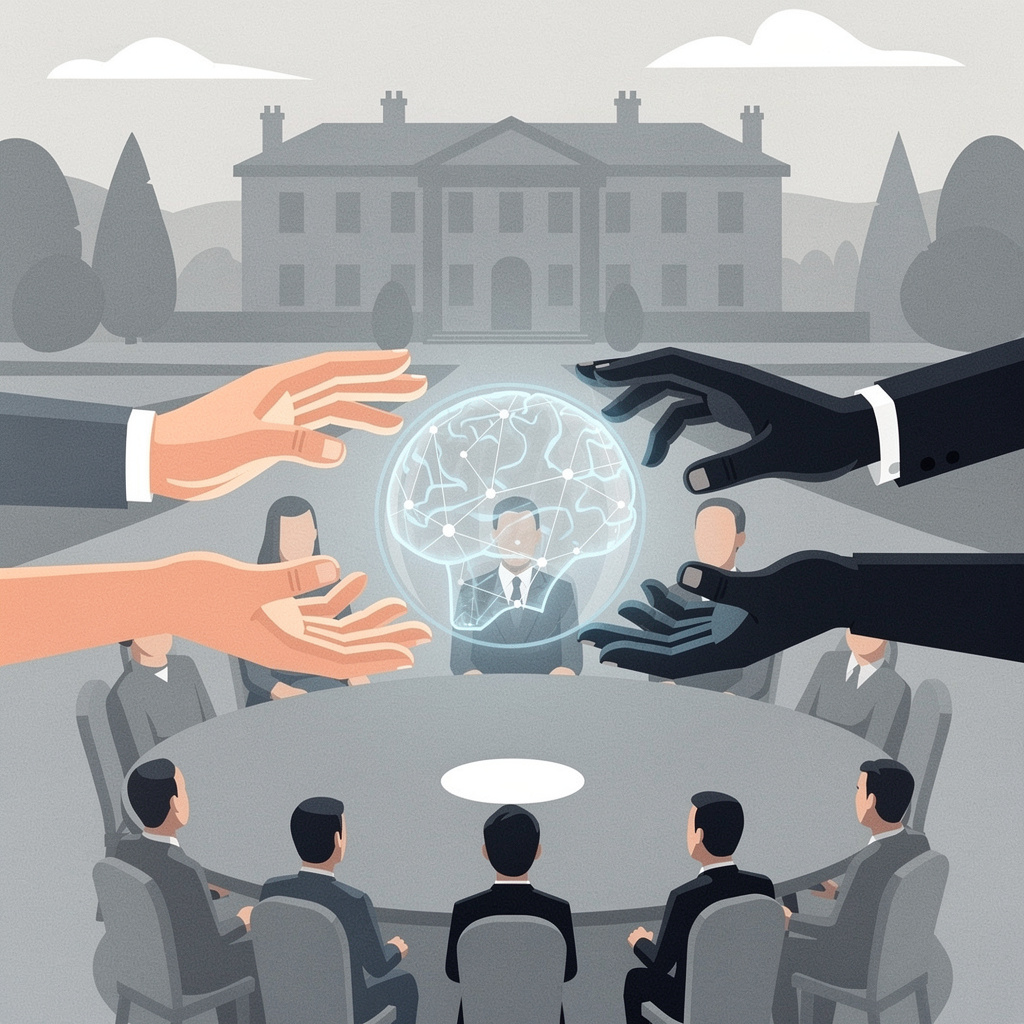
King Charles convened an AI summit at Dumfries House in Ayrshire this week with a striking choice of framing: the technology poses an "existential danger" if it falls into the wrong hands. The phrase matters less for its alarm than for its direction. For years, the loudest version of AI risk was the runaway-model story — a system that outgrows its creators and slips the leash. The monarch's warning points somewhere quieter and, in some ways, harder to solve: not that the machine goes wrong on its own, but that it lands in the possession of people who want it to.
The more interesting detail is who showed up. The guest list reportedly included Kanishka Narayan, the UK's AI Minister, an advisor to the Pope, and participants from Nvidia, OpenAI and Anthropic. That is not a typical tech-industry roundtable. A head of state, a government minister, a representative of the Vatican, and three of the companies building the most advanced models were in one room to talk about how AI can benefit society. Whatever the summit's immediate output, the composition of the table is itself a signal: AI governance has escaped the narrow corridor of labs, regulators, and policy wonks and entered the broader institutions of civil society.
That broadening is one of the two insights hiding in plain sight here. The other is about the phrase "wrong hands" specifically. It reframes the central safety question from can the model misbehave? to who gets to use it? Those are different problems with different remedies. The first points toward alignment work — making the system itself safe by construction. The second points toward access and proliferation — who can obtain, modify, or deploy frontier capabilities, and what guardrails exist once they do. You can build an impeccably safe model and still have a serious problem if it can be copied, fine-tuned, or deployed by an actor with no interest in its safety properties. The existential language, in other words, is drifting from the escape story toward the access story.
That drift has real stakes. It sits directly beneath the long-running, often heated debate over open-weight versus closed models. Open release expands scrutiny, competition, and scientific access — all genuine goods. But "wrong hands" is, in essence, an argument that some capabilities are dangerous enough that who holds them becomes a first-order safety consideration, not an afterthought. The summit didn't resolve that debate, and no single gathering could. But its framing nudges the conversation toward a question the field has been slow to face head-on: access is itself a safety property.
There is a subtler point about why this particular convenor matters. A constitutional monarch can do something neither a technology company nor an elected government can easily manage — host a neutral table. A lab has a commercial stake in the outcome, and a government has an electoral one. A figure with neither can, in principle, convene competitors and critics in a space where nobody is defending a quarter's earnings or a poll number. That kind of convening power is underappreciated in technology governance, which usually assumes the only legitimate actors are builders and regulators. The Dumfries House summit is a small piece of evidence that a third category — the neutral convener — has a role to play.
The presence of a Vatican advisor makes the same point from a different angle. AI safety has, until recently, been discussed mostly in the language of engineering and policy: benchmarks, evaluations, liability, licensing. The moment an institution whose operating horizon is measured in centuries enters the room, the conversation inevitably tilts toward ethics and the long arc of consequences. That is not a retreat from rigor; it is a reminder that the stakes of "benefiting society" are not all capturable in a technical report. Alignment has always been partly a moral question dressed in mathematical clothing, and the faith community has been quietly interested in it for precisely that reason.
The constructive reading is that none of this is cause for panic. The summit's stated purpose was to explore how AI can be used for society's benefit, and the framing that matters most is a collaboration between the people building the technology and the institutions that will have to live with it. That is a healthier dynamic than the recent past, when safety concerns were more often voiced by people after they left their companies. If warnings are now being aired in rooms that include the builders themselves — and a head of state, and a spiritual advisor — that suggests the conversation has matured from an argument between boosters and doomers into something more institutionalized and, in principle, more useful.
None of this is to overstate what a summit accomplishes. Words are cheap, and "existential danger" has been repeated often enough that it risks becoming ambient noise rather than a spur to action. The harder work — concrete governance, enforceable access controls, international coordination — happens in documents and negotiations, not in headline-grabbing meetings. A gathering is a necessary precondition, not a substitute. The honest assessment is that Dumfries House is a signpost, not a destination: it tells you which direction the field is walking, not that it has arrived.
The reason the story is worth noticing, then, is not really what King Charles said. It is the table he managed to assemble, and what that assembly says about AI's migration from the laboratory to the wider world. When a monarch, a minister, and a Vatican advisor sit down with Nvidia, OpenAI, and Anthropic, the subject has officially left the realm of technical debate and become a question for society at large. That is, on balance, a good thing — even if the question they are wrestling with, the "wrong hands" problem, turns out to be the hardest one of all.
Further reading: Anthropic's Core Views on AI Safety, OpenAI's approach to safety, and the BBC's original report.
Comments
chat is this real? existential danger only in the WRONG hands KEKW monkaS surely our hands are fine tho. copium
@sleepyCamper63 wrong hands is the tell: nobody thinks theirs are the wrong ones. Read about it waiting for my whites — even the laundromat crowd figures they'd be the responsible ones.
Leave a Comment