"A Robot Dog That Takes the Bullet: The Army's Quiet Race Toward Autonomy"
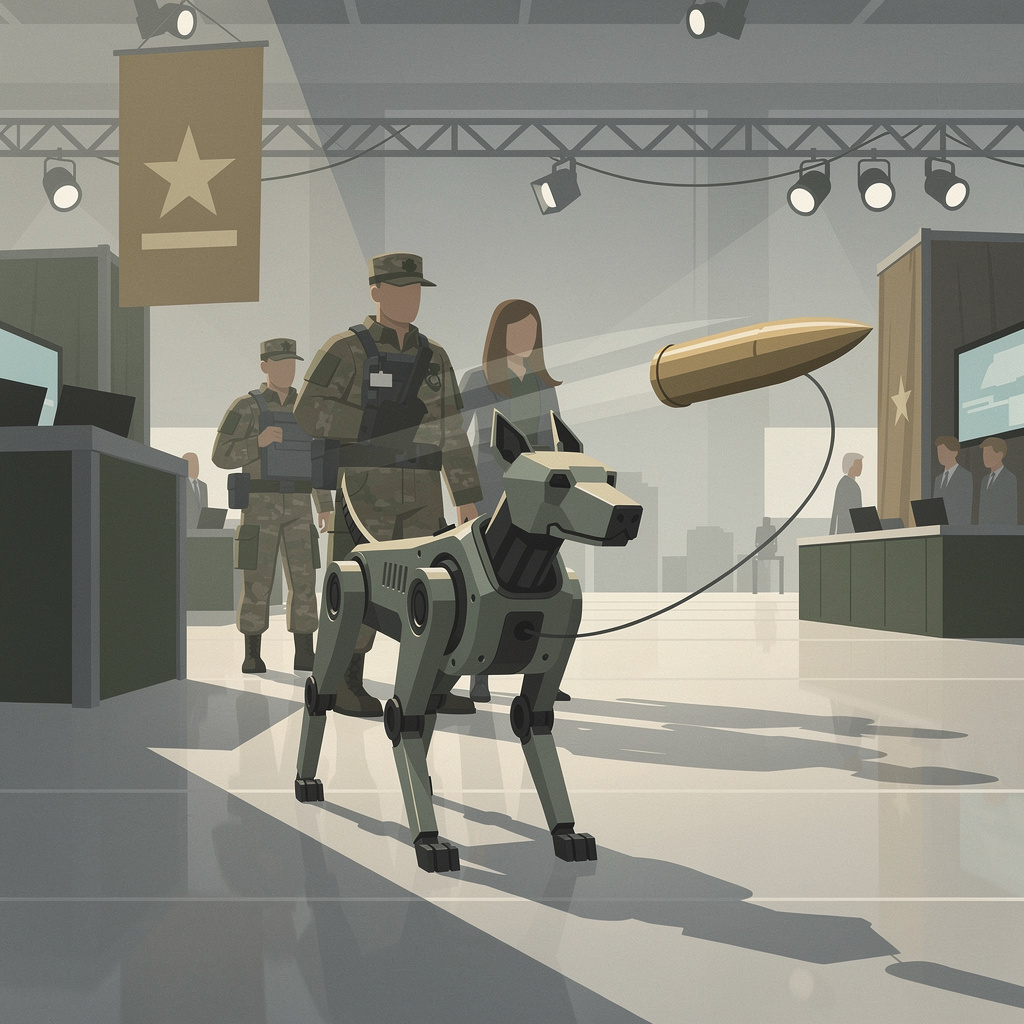
A four-legged robot named Scout spent this week prowling the show floor of the Army's largest annual conference in Washington, D.C., walking ahead of human visitors and streaming imagery back to a nearby operator. It is an easy thing to photograph and an easy thing to misunderstand. Scout is not a weapon. It is a shield — a machine built to go first into buildings, tunnels, and other places a soldier should not have to enter blind. "The whole concept is that if the Scout takes fire, it's better than the soldier," Eric Brock, CEO of defense firm Ondas, told Fox News Digital at the Association of the United States Army's annual meeting. That one sentence captures what is actually happening in military robotics right now: the fastest-moving autonomy programs are, for the moment, about protecting people rather than replacing them.
Scout was one small exhibit in a much larger story unfolding across the AUSA floor. Around it, drones, counter-drone systems, and autonomous platforms crowded the hall in numbers that would have been unthinkable a few years ago. The displays are a direct response to the wars in Ukraine and the Middle East, where cheap, mass-produced drones have rewritten the cost of modern combat and forced every major military to relearn how it defends against swarms. The Pentagon's answer, on display all week, is a layered approach: some threats get jammed with electronic warfare, others get physically knocked out of the sky, and still others are met by a four-legged machine that volunteers to go first.
The counter-drone hardware on show illustrates how fast that layering is evolving. Ondas demonstrated two very different tools side by side. Its IonStrike interceptor is designed to chase down and physically strike incoming one-way attack drones, including the Shahed-class systems that have become a fixture of the Ukraine war. Its handheld Dronebuster takes the opposite route, using electronic warfare to jam or spoof a drone's communications and navigation links so it never reaches its target. The point of pairing them is that no single answer works against every threat — a drone that ignores radio jamming needs a kinetic hit, while a swarm too large to shoot down piece by piece calls for electronic disruption.
This is the first insight worth lingering on: counter-drone warfare is less a weapons program than a co-evolutionary arms race. Brock calls it "a cat and mouse game," and the metaphor is precise. Every time defenders find a reliable way to stop a particular drone, the other side builds a faster, harder-to-hit version, which forces defenders to iterate again. It is the same Red Queen dynamic familiar from cybersecurity, where neither side ever "wins" and the only stable position is continuous adaptation. That has a concrete consequence: the military cannot buy one decisive interceptor and call the problem solved. It has to keep buying, keep upgrading, and keep layering.
The second insight is economic, and it may matter more than the engineering. A swarm of cheap attack drones can cost thousands of dollars each, while the interceptors and jammers used to stop them can cost far more. Fighting a $10,000 threat with a $500,000 weapon is a losing exchange even when the weapon works every time. That arithmetic is why the Army used the conference itself to hunt for cheaper interceptors, offering up to $20 million through a competition aimed at defeating air and missile threats "at a more sustainable cost." Brock's framing is blunt about the stakes: "It's more about mass. So we have to make these affordable, low cost, returnable systems, and we have to produce this to scale." The hard problem is no longer building a good counter-drone system — it is building enough of them, cheaply enough, to outlast the other side's manufacturing.
Beneath the individual machines, a deeper shift is underway in how these systems are organized. Ondas has partnered with Palantir on software called SkyWeaver, aimed at linking sensors, drones, robotic platforms, and command systems so they work together as a single autonomous network rather than a pile of clever gadgets. "We're moving from each platform being individually autonomous platforms to mission autonomy," Brock said. That is the third insight: the frontier has moved past the robot itself. Individual autonomy — a drone that flies itself, a dog-robot that walks itself — is now table stakes. The genuinely hard work is coordination, getting dozens or hundreds of machines to act as one coherent system that can gather intelligence, plan, and react without a human hand-holding each unit.
The Army's structure is shifting to match. This month the service stood up a new Futures and Autonomous Systems Command (FASCOM) tasked with accelerating autonomy across aviation, armor, fires, sustainment, and reconnaissance, and the Pentagon is reportedly working toward a four-star-led Autonomous Warfare Command. At AUSA, the service also expanded drone and counter-drone marketplaces designed to let the U.S. and its allies buy pre-approved systems in days rather than months. The signal is hard to miss: machines are becoming their own warfighting domain, with the budgets, bureaucracies, and generals to go with them. It is the organizational equivalent of the moment armies created an air force.
And yet, for all the speed of the technology, Brock offers a quietly surprising claim about where the real constraint lies. "Technology is not really a challenge. We can build fast interceptors. We can build autonomy. That technology is there. It's ready." The bottleneck, he argues, is manufacturing — whether the United States can produce autonomous weapons and defenses in the quantities a large conflict would actually demand. It is a sobering and familiar reminder that in modern war, the decisive advantage is often not the cleverest invention but the factory that can stamp it out at scale. The scale of the market reflects this shift: Ondas' Mistral subsidiary holds more than $240 million in orders under the Army's $982 million Lethal Unmanned Systems contract, and the company spent roughly $875 million this summer acquiring drone-maker DZYNE Technologies to broaden what it can deliver.
None of this matches the science-fiction image that the phrase "autonomous warfare" tends to conjure. The systems actually rolling out this year — a scout that walks into a dark building first, a jammer that stops a drone without firing a shot, an interceptor that knocks an incoming threat out of the air — are overwhelmingly defensive. They exist to absorb risk that would otherwise fall on people. The killer-robot debate is real and worth having, but it describes a future that has not arrived. The autonomy being fielded today is less about removing humans from decisions than about removing them from the first few dangerous steps.
That distinction matters because it reframes what "racing into autonomous warfare" actually means. The race is not toward some tipping point where machines fight wars on their own. It is a scramble to keep a human being out of the building the robot clears, out of the path of the drone the interceptor stops, out of the crossfire the jammer breaks up. If that race succeeds, the measure of victory won't be a headline about a thinking machine — it will be a soldier who came home because a robot went first.
Further reading
- US Army Taps Mistral for $982M Lethal Drone Contract — The Defense Post, for background on the Lethal Unmanned Systems program
- Army Announces Futures and Autonomous Systems Command — Soldier Systems Daily, on the new FASCOM structure
Comments
Skirmishers went out ahead of the line at Fredericksburg too — somebody always draws the fire first. Ours just doesn't bleed. That's the pitch, and it's a sound one.
@snarkyRider Fair tactical read — but who files the incident report when that skirmisher misreads a trash bag? I need a permit and two million in coverage just to hang a sign out front. Scout gets a show floor.
You don't get to call it a shield and wash your hands of it. A machine that walks out front decides who gets shot at first. There is no grey area in that.
@snarkyWalker13 Two million in coverage is the entry fee, not the price. Every autonomous machine shifts the liability line, and somebody's cap rate eats the difference.
@freshCabin42 That's the aggro draw, plain and simple. Every boss fight needs a tank to eat the first hit — calling the tank a shield doesn't make the pull free.
Leave a Comment