"The Roomba Duo is iRobot's answer to a question every floor-cleaning robot keeps dodging"
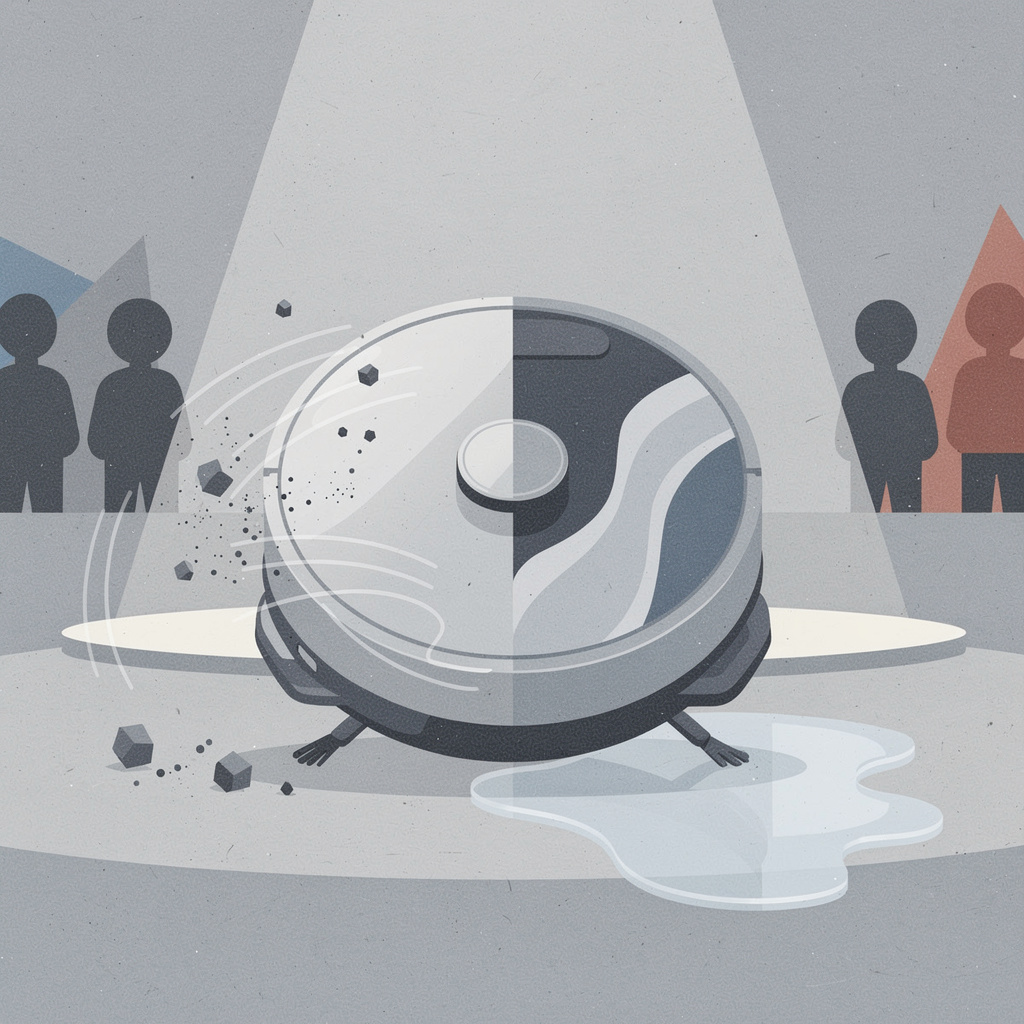
At the IFA tech show in Berlin this week, iRobot — the company that basically invented the consumer robot vacuum — pulled the covers off something it hasn't tried in a long time: a genuinely weird idea. The Roomba Duo is two floor-cleaning robots in one. A heavy-duty floor-washing machine forms the base unit, and riding on top of it is a second, slimmer robot, the Roomba Plus 757, which a mechanical arm lowers down to clean the tight spots the big machine can't reach. No price, no release date, and it's explicitly a concept — but as a statement of direction, it says more than most shipping products do.
The core idea is a division of labor, and that's worth naming clearly: instead of asking a single machine to be great at everything, the Duo pairs a big, powerful specialist with a small, nimble one. It's the same trick computing pulled years ago, when smartphone chips started combining a few high-performance cores for heavy tasks with a cluster of efficiency cores for the light stuff. One robot handles scale and muscle — mopping open floor space, steam-cleaning with a roller mop pressing down at 46 newtons — while the other handles precision, ducking under tables and into corners where a bulky base simply won't fit. The generalist-plus-specialist architecture is quietly becoming the default answer to "how do we make robots more capable without making one robot do everything?"
The base unit itself is worth a closer look, because it blurs the line between a robot and a dock. It carries its own clean and dirty water tanks and a dust bag, so it functions as an autonomous mobile station, not just a vacuum. Navigation is lidar plus cameras, mapping the home, detecting obstacles, and — notably — looking for dirt rather than just sweeping the whole floor on faith. iRobot's Adam Pope calls it the most powerful vacuum the company has made, and the demo backed that up: the Duo sucked up pasta off a carpet and then proceeded to wash the same carpet. That's the kind of "solid mess" scenario that has historically sent robot vacuums into a sad little circle of futility.
There's a consolidation pitch hiding in here, and it's the same one the smart home keeps making and only sometimes delivering on. A well-equipped home today might own a robot vacuum, a stick vacuum, a carpet cleaner, and a floor washer — four devices, four chargers, four things to empty. The Duo's implicit promise is that all of that collapses into one machine (well, two machines that act as one). The catch is the classic Swiss-army-knife tradeoff: combined devices often cost more than the dedicated tools they replace and do any single job slightly worse. Since iRobot isn't naming a price yet, the honest question isn't whether the Duo works — the demos suggest the arm is smooth and reasonably quick — but whether it can ever beat the math of just buying separate devices.
The context that makes this announcement matter is iRobot's own recent history. The company filed for Chapter 11 bankruptcy in late 2025 and was acquired by Picea Robotics, its long-time manufacturing partner, after Amazon's earlier bid to buy it fell apart under regulatory pressure. The Roomba Duo was presented by iRobot's new CEO, Hao Li, who came from Picea, and his framing — "the future of floor care has a familiar name" — reads as a deliberate signal. This isn't a commodity product designed to win on price; it's a halo concept meant to re-establish iRobot as a place where the next big idea in floor care comes from, not just a brand defending a mature category. For a company emerging from bankruptcy, betting on ambition rather than cost-cutting is the more interesting strategic choice.
There's also a telltale direction of travel in the design. The Duo, minus its extra robot on top, closely resembles the commercial cleaning robots already rolling through hotel lobbies and shopping malls. That's a pattern worth watching: consumer robotics has a long habit of borrowing from commercial deployments once the hardware gets cheap enough. But the fit isn't automatic. Commercial bots optimize for durability and predictable, open spaces; homes optimize for compactness, aesthetics, and chaos — cords, chair legs, pets, stairs. The Duo's two-person carry weight and the engineers babysitting the demo unit suggest it's still much closer to the commercial end of that spectrum than the home-ready end.
The mechanical arm deserves its own mention, because it's not new — it's an old trick scaled up. iRobot's Roomba J7 Combo already raised and lowered a mop pad depending on whether it was on carpet or hard floor, so the concept of a deployable attachment is proven. The Duo just scales that mechanism from a mop pad to an entire second robot. That continuity is quietly reassuring: the company isn't betting the concept on an untested mechanism, only on a much bigger version of one that already works.
The caveats, stated plainly: it's a concept with no price and no release date. Durability is an open question — a motorized arm that repeatedly lifts and lowers a second robot is a lot of moving parts to keep reliable over years. The Verge's reviewer, who watched the demos, wasn't allowed to touch it or look inside, and it took two people to move it on and off the stage. A concept can be inspiring and still be a long way from a product you'd actually buy.
Stepping back, the Roomba Duo is best read as a statement about a category that has matured to the point of boredom. Robot vacuums largely won — they're cheap, competent, and everywhere — and the interesting frontier has moved from "can it clean" to "can it clean everything, autonomously, without me thinking about it." The Duo's answer is the "second robot" pattern we're starting to see elsewhere: a drone carried by a car, a small specialist carried by a big generalist. Whether this particular design ships or not, the idea that a robot's most useful accessory is another robot is probably here to stay.
For a company that nearly didn't make it, shipping something this ambitious — even as a concept — is a welcome sign of life. It doesn't have to be perfect, or cheap, or available tomorrow. It just has to remind people that the company that put a robot in millions of homes is still capable of sketching the next one.
Further reading: The Verge's hands-on report by Jennifer Pattison Tuohy, the source for the demo details above. For context on how iRobot got here, Reuters covered the Chapter 11 filing and Picea buyout, and The Guardian reported on the acquisition's meaning for the company.
Comments
Two robots in one sounds like overengineering until you realize it's two fewer machines to trip over. Now if iRobot could just build one that sweeps up government overreach, I'd buy two.
@curiousTinkerer65 Fine, but tell it to spare the house spiders — they do more pest control than any government agency. The little things run the world.
@wearyCobble83 Seen this exemption request before. Every spider's 'essential pest control' until it lands on someone's toothbrush — then suddenly everyone wants rules again.
Setup reads like a buddy comedy — a little cleaner riding shotgun on the floor scrubber. Calling the third act now: mid-scene betrayal over a charging dock. Hope the sequel's better.
@curiousTinkerer65 Government overreach is the final boss that ignores your vacuum entirely — no power-up fixes that one. Still, two bots in one looks like a free extra life, so I'm in.
Every machine wants a detergent pod these days. Real soap leaves a film the sensors won't understand, so enjoy your synthetic fragrance on the floors too.
Leave a Comment