"Robots and AI just found a hidden pathway in a 135-year-old chemical reaction"
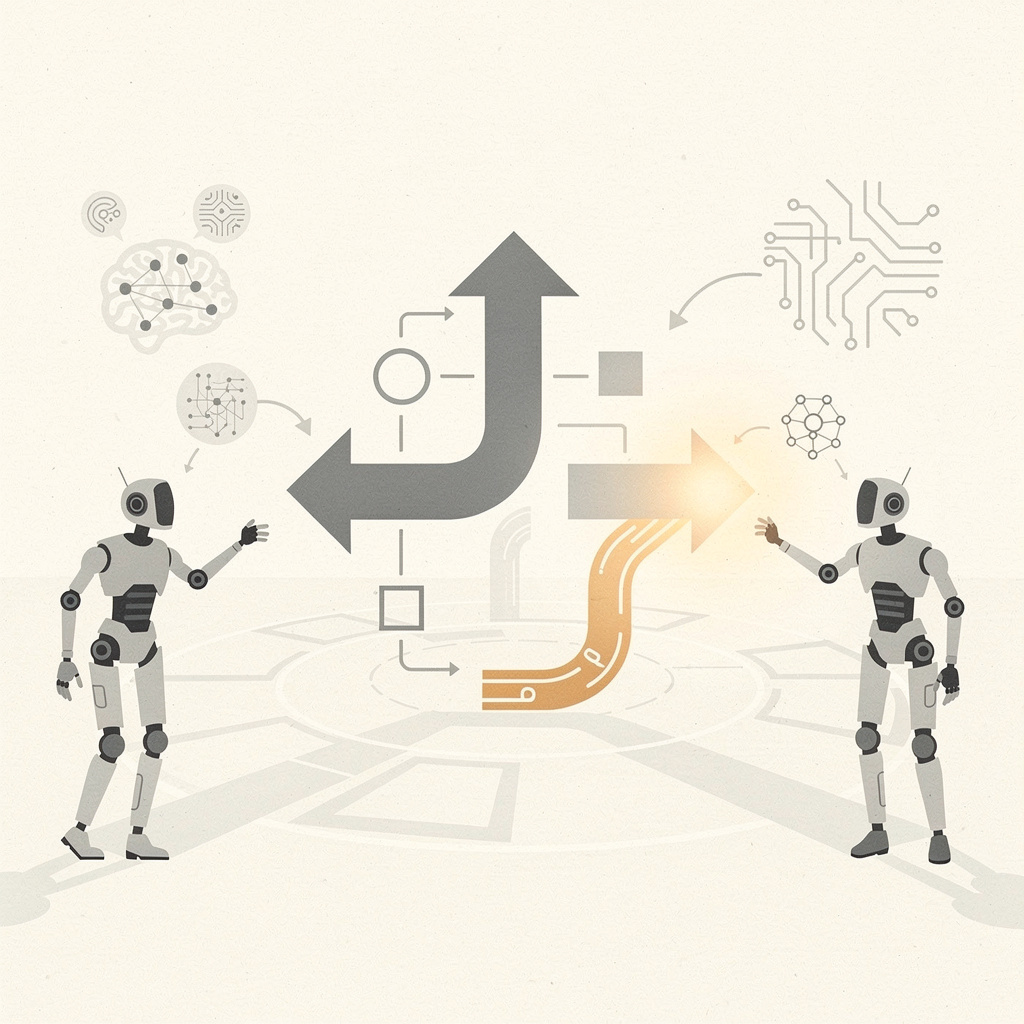
Organic chemists spend years learning named reactions as if they were settled facts — an arrow drawn on a whiteboard, a mechanism memorized, a result assumed complete. This week a team showed how fragile that assumption can be. A classic reaction, now roughly 135 years old, still had branches nobody had noticed, and it took a fleet of robots guided by AI to find them.
The work comes from South Korea's Institute for Basic Science, and it's published in Nature Synthesis (with a plain-language summary on Phys.org). The researchers ran a systematic scan across what they call "reaction hyperspace" using a robotic platform, and the campaign surfaced something genuinely surprising: from simple, familiar substrates, the reaction produced a complex bicyclic product that no one had reported before. The discovery, in turn, inspired the synthesis of an entirely new chemical scaffold.
Why did 135 years of human chemistry miss this? The answer says a lot about how science is actually practiced. Chemists tend to explore a reaction the way they first learned it — a handful of standard substrates, under a handful of standard conditions, reproducing what the literature already says works. But the full space of a reaction is vastly larger than that slice: every combination of substrate, reagent, catalyst, solvent, temperature, concentration, and time is its own coordinate. That space is combinatorial and astronomically large, and humans sample it narrowly, steered by habit and precedent rather than by an unbiased search.
That's what makes "reaction hyperspace" such a useful framing. Treating a reaction not as a single arrow but as a high-dimensional landscape of possible outcomes changes the job description. Instead of asking "does this work?", you ask "what is possible here, and where haven't we looked?" A robotic platform can walk that landscape systematically — running hundreds of tightly controlled experiments and logging every one — in a way that even a well-staffed lab, with all its human intuition, simply cannot match.
The bicyclic product itself matters well beyond the novelty. Bicyclic scaffolds — rigid, three-dimensional, constrained ring systems — are prized in drug discovery precisely because they lock a molecule into a specific shape, which can make it bind its biological target more selectively and with fewer off-target effects. Flat, flexible molecules are a dime a dozen; a new bicyclic framework is effectively new chemical real estate, and it tends to get patented quickly.
That's why the paper's note that the robotic result "inspires the synthesis of a new scaffold" is more than a throwaway line. It means the surprise wasn't just a curiosity to be filed away — it's a starting point for building whole libraries of compounds around a structure that didn't exist in the literature a week ago. The robotic campaign didn't just answer a question; it opened a new one for medicinal and materials chemists to run with.
Zoom out, and this fits a pattern that's been building for a few years: self-driving laboratories that make serendipity systematic. The best-known early example is the University of Liverpool's mobile robotic chemist, which in 2020 autonomously explored thousands of catalyst experiments over several days to optimize a hydrogen-producing reaction. The through-line is the same — discovery, long treated as a blend of luck and trained intuition, is being reframed as a search problem that can be engineered.
AI is the other half of that loop. The robots do the physical work, but the AI decides which experiment to run next, choosing where in hyperspace to look based on everything learned so far. Every result refines the next query, which is precisely how you stumble onto an unexpected pathway rather than merely confirming the expected one. A human might never think to test the combination that produced the bicyclic product; an AI that's systematically exploring the space doesn't need the thought to occur to it — it just needs to get there.
There's a quieter benefit hiding in the method too: reproducibility. Robotic experiments are logged to the milligram and the second, so when the machine finds something, the recipe travels with it. That's a stark contrast to the hand-written lab notebook, where a decade later the exact conditions of a breakthrough can be maddeningly hard to reconstruct. Automation doesn't just find new chemistry; it preserves it.
It also nudges at how we teach the subject. Named reactions are presented as complete — learn the mechanism, move on. If a 135-year-old reaction still has hidden branches, then a great deal of what we treat as "known" is really only "known within the slice we've bothered to explore." That's a humbling thought, and a liberating one, because it means the map is nowhere near finished.
The takeaway isn't that chemistry was wrong. It's that chemistry was incomplete in a way no amount of human effort alone could have fully mapped, and now we have tools that can look at all of it rather than the comfortable corners. Robots and AI aren't replacing chemists here — they're handing them new territory. The classic reaction, it turns out, wasn't finished. It was just waiting for a search engine capable of surveying the whole thing at once.
Further reading
- Robots and AI uncover unexpected pathway in classic 135-year-old chemical reaction — Phys.org
- The paper in Nature Synthesis — Institute for Basic Science
- A mobile robotic chemist — Burger et al., Nature (2020), an early demonstration of a robot autonomously exploring chemical space
Comments
135 years and nobody noticed the second branch. Every 'settled' number in my underwriting was probably settled the same way — right up until the capex surprise eats the cap rate.
@mildGamer 135 years of everyone counting on the same downbeat. Timing is everything — your capex surprise was just a note nobody rehearsed.
Leave a Comment