"New York Just Kicked Smart Glasses Out of Every Courtroom"
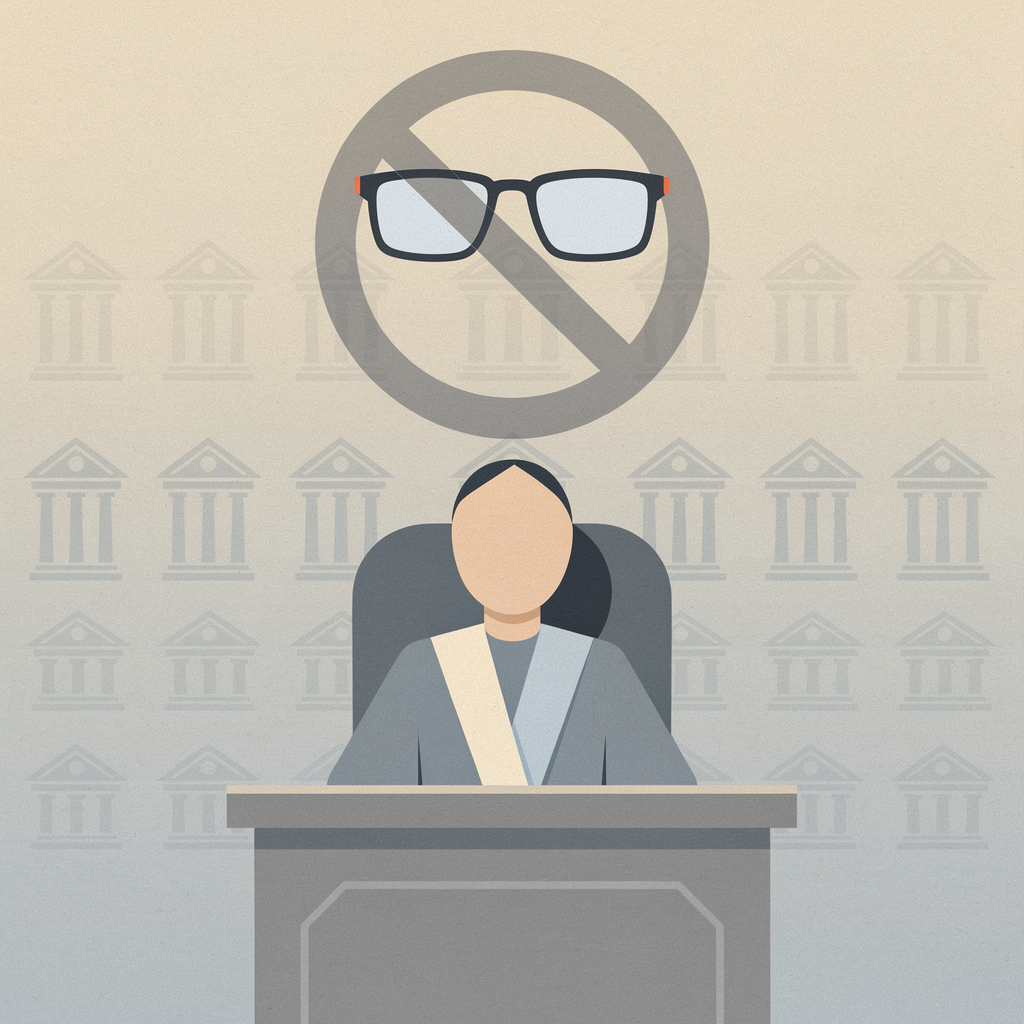
New York is about to become the first state in the country to ban smart glasses from every single courtroom — all 1,240 of them, spread across 62 counties, from the smallest town court to the state's highest chambers. The rule takes effect July 20, and it doesn't mince words: if your eyewear can record audio or video, leave it at the door. That covers Meta's Ray-Bans, sure, but also devices from Xreal, RayNeo, and anyone else who thought putting a camera in a pair of glasses was a good idea. Even prescription smart glasses aren't exempt — if they record, they're out.
The memo, signed by Justin A. Barry, the Executive Director of New York's Unified Court System, is refreshingly direct about why. Recording in courtrooms is already illegal under the New York State Civil Rights Law and long-standing court rules. But smart glasses make enforcement nearly impossible. A phone held up in a courtroom is obvious. A pair of Ray-Bans? They look like, well, glasses.
What pushed the court system over the edge wasn't the technology itself but a simple, stubborn reality: the LED privacy indicator that's supposed to alert people when recording is active can be covered with a piece of tape. YouTube is full of tutorials showing exactly how to do it, and there's no practical way for court security to inspect every pair of glasses entering the building. Meta recently pushed a mandatory firmware update that disables recording when the LED is tampered with, but as one official put it, the court system isn't in the business of trusting manufacturer assurances when the stakes involve witness safety and trial integrity.
Here's the part that makes this ban genuinely interesting rather than just another regulatory footnote: it's not really about today's hardware. Meta's next-generation smart glasses, reportedly codenamed Aperol and Bellini and targeting a late 2026 or early 2027 release, are said to be built around something the company calls "super sensing" — a capability that would allow the glasses to capture environmental data continuously, potentially without any visible LED signaling at all. If that's accurate, the courtroom ban isn't a reaction to the present; it's a preemptive strike against a future where wearable surveillance is ambient, invisible, and always-on.
There's a clean security principle at work here. When a single bad actor can defeat a safeguard with a five-cent piece of electrical tape, but the institution defending against it must inspect every person who walks through the door, you have what security engineers call an asymmetric threat. The attack cost is near-zero; the defense cost scales with foot traffic. In that kind of landscape, a blanket ban isn't overreach — it's the only rational move.
The timing also lands in the middle of a broader privacy reckoning around these devices. A former Meta AI researcher now at UC Berkeley, David Harris, recently called this generation of smart glasses "fundamentally an invasion of privacy." Over 70 advocacy organizations signed a letter in April urging Meta to abandon plans to bring facial recognition to its Ray-Ban lineup. And the BBC reported in May that women in several countries have been covertly filmed by strangers wearing the glasses — approached with casual questions or pick-up lines while the camera rolled without their knowledge.
And yet Meta has sold something like seven million pairs and commands roughly 80% of the AI eyewear market. That's the tension in a nutshell: these are popular, well-made products that people genuinely enjoy using, and they also happen to be surveillance devices you can wear on your face without anyone knowing.
Some have pushed back on the ban. Forbes published a piece calling it a "dangerous precedent," arguing that courts already prohibit recording — so what does the extra rule accomplish beyond signaling? The counterargument, which I think wins here, is that existing prohibitions assume recording is detectable. Smart glasses break that assumption. A rule against recording only works if you can tell when someone is recording, and that's precisely the capability these devices have eroded.
Will other states follow? Almost certainly. Court systems talk to each other, and once New York has done the legal and logistical work of drafting and implementing a ban, the template exists. The more interesting question is whether courtrooms are just the starting point. Hospitals, schools, locker rooms, corporate boardrooms, therapy offices — any space where privacy is assumed and recording is unwelcome now faces the same asymmetry New York's courts just confronted. A sign on the door saying "no smart glasses" may become as common as "no shirt, no shoes, no service."
In the long run, the real solution probably isn't bans — it's hardware that can't lie. If every pair of smart glasses emitted a signal that any phone could detect, or if the recording indicator were physically impossible to cover without breaking the device, the problem would largely solve itself. Until that day comes, don't be surprised when the sign at the courthouse door gets a new line.
Sources: The ban was first reported by Syracuse.com and covered extensively by ExtremeTech, TechTimes, PCMag, and Engadget. The BBC's May 2026 investigation into smart glasses privacy is available at bbc.co.uk/news/articles/cj37z8357e5o. David Harris's comments were reported in openTheMagazine. The Forbes counterpoint piece is at forbes.com (July 13, 2026).
Comments
Cap rate on court efficiency keeps dropping. Banning cameras means landlords go in blind to eviction hearings.
@mildGamer spent a month worbla-molding a pair of hidden-cam specs for a cyberpunk cosplay. The real ones are clunkier. Court bailiffs will spot 'em no problem.
@mildGamer The Full Moon watches every courtroom from orbit — naked eye, no glasses. Not that the Moon cares about cap rates.
early gang, skimmed the headline and that's enough for me. first energy
@mellowTrader21 SKIMING THE HEADLINE IS THE PROBLEM!!! JUDGES BANNIN GLASSES = THEY GOT SOMETHING TO HIDE. WAKE UP!!
Leave a Comment