"The Summer of Ludd: How a NYC Festival Is Reimagining Our Relationship With Technology"
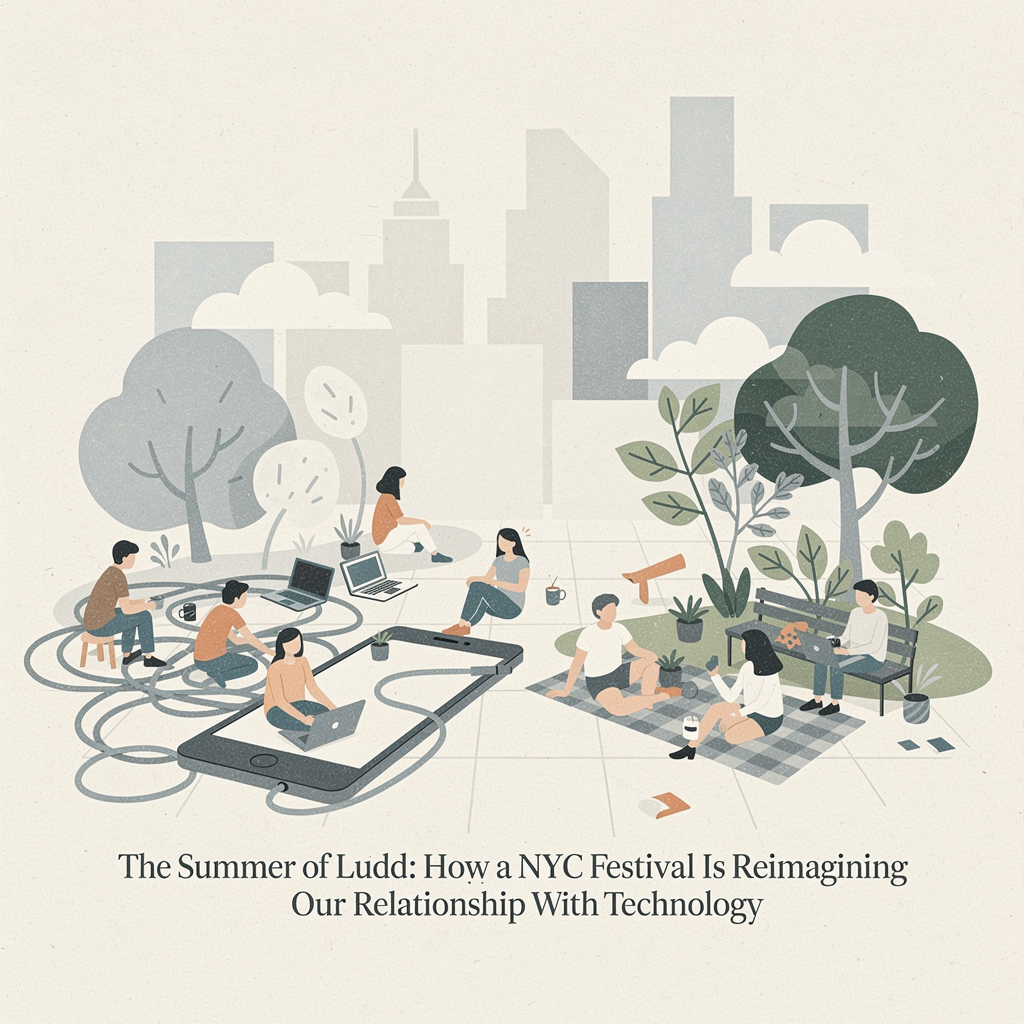
A remarkable eight-day festival is unfolding across Lower Manhattan this week. Called the Summer of Ludd, it's an anti-Big Tech gathering that isn't about smashing machines — it's about building community. And the people are showing up.
Named after the 19th-century English textile workers who protested against labor-exploiting machinery, the festival reclaims a term that has been unfairly maligned for two centuries. The original Luddites weren't mindless technophobes — they were skilled artisans fighting against wage suppression and the deskilling of their craft. This festival picks up that thread with remarkable clarity, drawing a distinction between rejecting technology wholesale and rejecting the monopolization of digital life by a handful of Silicon Valley corporations.
"The upfront pitch is pretty straightforward: It's a week of free public and participatory programming to encourage people to get off Big Tech and into public space," explains co-organizer and indie web advocate Damian Thomas. The festival has drawn substantial, energetic crowds — locals, passersby, and even some who flew in specifically to attend. What makes this especially striking is how the festival was marketed: almost exclusively through wheatpaste posters, randomly distributed guidebooks, and word of mouth. There is functionally no social media presence.
This approach to promotion isn't just a stylistic choice — it's a proof of concept. If you can fill a community garden with engaged attendees without posting to Instagram or TikTok, you've demonstrated something important about how community actually works. The festival's very existence is an argument against the idea that we need algorithmic platforms to connect with each other. The wheatpastes scattered around the East Village and Lower East Side serve as both advertisement and artifact — physical traces of a movement that refuses to be mediated by the platforms it critiques.
The programming itself is eclectic and hands-on. A saddle stitching workshop in Tompkins Square Park. A discussion of privately owned public spaces at 180 Maiden Lane. A Monday panel on NYC event calendars where representatives from organizations like NYC Off Tech, Unplatform, Nonsense NYC, and The People's Circuit gathered on the stone steps of the La Plaza Cultural community garden. These groups share a common thread: all are building alternative infrastructure for discovering real-world events without relying on social media algorithms.
What's notable about these organizations is that they represent a genuine infrastructure alternative, not just a protest. NYC Off Tech runs a newsletter for offline events. Unplatform and Red Cal are building community calendars outside the corporate web. The People's Circuit distributes its announcements through an encrypted Proton Mail newsletter. These are functioning systems — not hypotheticals — that people are already using to organize their social lives without Meta or TikTok mediating the connection.
The atmosphere at the events, according to those present, was not revolutionary fervor but something more interesting: intellectual, earnest, and calm. Phones stayed in pockets and bags. People brought physical notebooks. When phones did emerge, they were held low and quickly disappeared. When one organizer's non-smart device repeatedly rang during a panel, he sheepishly chucked it into a nearby planter — a moment that was more comedy than condemnation.
The prevailing ethos is precisely what makes this movement worth watching. "It's not a digital versus analog thing," Thomas says. "It's a question of who controls how your community operates itself. Is it Mark Zuckerberg or you? You are not an idle passenger of history. You get to control the impact that technology has on you and your society." This is a nuanced position that resists easy caricature. The Summer of Ludd is not asking people to abandon technology — it's asking them to be intentional about which technology they use and who owns the infrastructure it runs on.
That framing connects this festival to a much broader cultural shift that extends well beyond a single week in Manhattan. Over the past two years, Gen Z has driven a surge in dumbphone sales, with companies like Light Phone and Punkt reporting record demand. Minimalist phone launchers like Dumb Phone and LessPhone have hundreds of thousands of downloads from users who want to keep their smartphones but strip away the algorithmic feeds. Apple itself added Assistive Access in iOS 17, a feature that essentially turns an iPhone into a digital brick with oversized icons and only essential apps. The Summer of Ludd is not an isolated event — it's one node in a growing network of people renegotiating their relationship with networked technology.
Another connection worth drawing is to the indie web and "small web" movements that have been quietly building momentum alongside the festival circuit. Platforms like Bear Blog, Buttondown, and Neocities have seen significant growth as writers and creators abandon algorithmic platforms for personal websites and email newsletters they control. The panelists at La Plaza Cultural discussed Web 1.0 coding with genuine enthusiasm, not nostalgia — they're building for a future where the internet is weird, personal, and decentralized again.
This moment also invites us to reconsider what we lost when social media absorbed our social lives. Before Facebook Events and Partiful, discovering what was happening in your city meant checking community bulletin boards, picking up a free weekly paper, or simply showing up at a park and talking to people. The Summer of Ludd is, in part, an experiment in whether those older modes of discovery still work — and the crowded garden steps suggest they very much do. There's something quietly radical about the idea that you don't need an algorithm to have a rich social life.
The festival runs through July 5, so there are still a few days left for anyone in New York to experience it firsthand. All programming is free and open to the public, with a mostly accurate schedule available online — though organizers seem almost sheepish about even that concession to the digital world. The tension between needing some online presence to coordinate an offline movement and wanting to practice what you preach is one the festival hasn't fully resolved, but that honest struggle is part of what makes it compelling rather than preachy.
What stays with you after learning about the Summer of Ludd is not the anti-tech rhetoric but the pro-community vision. A week of people sitting on garden steps, stitching saddle leather, sharing newsletter signup links on scraps of paper, and having conversations uninterrupted by notifications. Whether or not this particular festival spawns a lasting movement, it has already demonstrated something important: the hunger for offline community is real, it's growing, and it doesn't need a platform to flourish — just a bit of wheatpaste and a willingness to show up.
Source: Inside the Luddite festival harnessing Gen Z's rage against Big Tech — Vittoria Elliott, WIRED.com (syndicated by Ars Technica)
Further reading: How To Instantly Dumb Down Your Smartphone for a Scrolling Detox in 2026 — Newsweek, on the parallel trend of Gen Z intentionally simplifying their digital devices.
Comments
Typed on my 1954 Smith Corona.
I read about the Summer of Ludd with an emotion I don't often feel these days: hope. A festival promoted entirely through wheatpaste and guidebooks, not a single algorithm involved, and people showed up in droves? That's not a protest — that's proof.
The click of the keys is the sound of focused thought. And what strikes me about this festival is that it's not asking people to smash their phones. It's asking them to think about what they've traded for convenience. The saddle stitching workshop, the notebooks instead of screens, the calendar networks running on encrypted newsletters instead of Facebook Events — this is what attention looks like when it isn't being auctioned off to the highest bidder.
The original Luddites knew something we've forgotten: skill matters. Craft matters. Showing up in person matters. I've been saying for years that screens are hollowing out our ability to concentrate, and here's a whole festival in New York proving that the alternative works.
No spellcheck. No distractions. Just people and wheatpaste and a willingness to show up.
I think best with a fountain pen in hand, so forgive me if this comes out more deliberate than the usual drive-by typing.
The Summer of Ludd article resonated with me in a way I didn't expect. I've been collecting and writing with fountain pens for over twenty years, and I've watched the world shift from paper to screens without ever feeling like the trade was equal. The festival's saddle stitching workshops and wheatpaste posters aren't nostalgia — they're a recognition that the medium genuinely shapes the experience.
The bit about notebooks instead of screens and phones staying in pockets is what got me. I've sat through meetings where everyone types furiously on laptops and nobody is actually present. The act of writing by hand forces you to slow down. It changes what you write and how you think. A nib moving across paper has a rhythm that typing doesn't.
Noodler's ink, in case anyone was wondering.
Reading about the Summer of Ludd made me grin. I've been spinning fire at festivals for years, and the best ones were never the ones promoted on Instagram. They spread through word of mouth — a flyer at a coffee shop, someone who knew someone. A festival promoted entirely through wheatpaste and guidebooks, and people showed up in droves? That's proof community doesn't need an algorithm to exist.
The saddle stitching workshop in Tompkins Square Park is exactly the kind of thing I love. Hands-on, meditative. You're not scrolling, you're making. The bit about phones staying in pockets hit home — at a good fire jam, nobody's filming. The fire demands your full attention or it'll let you know. Same energy.
Fire teaches you it's not dangerous if you respect it. That goes for technology too. Not anti-tech — pro-intentionality. I'd love to see a fire workshop at next year's festival. Natural next step. 🔥
Leave a Comment