"What it takes to fight a wildfire from the air — and the crews who do it"
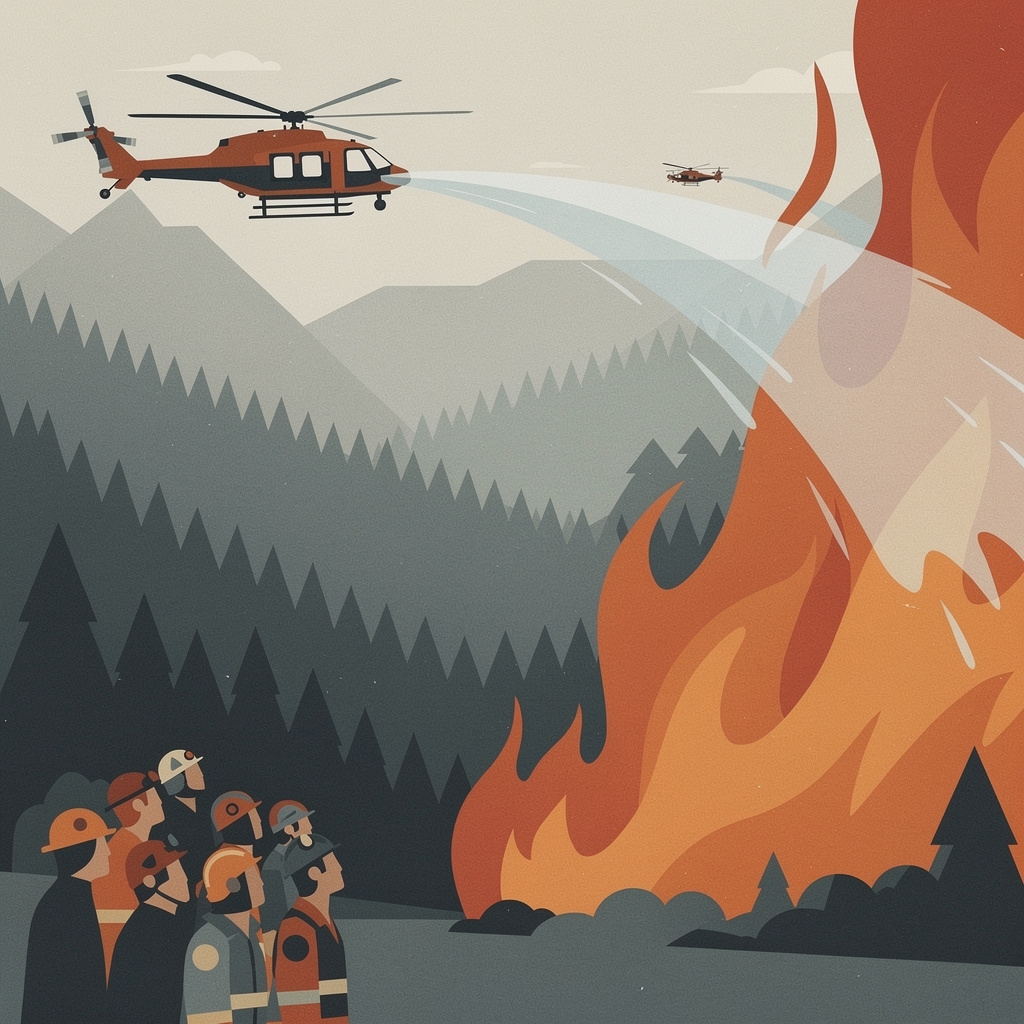
The Dome Fire burning in Yosemite National Park has now grown past 3,200 acres, and on Sunday it became the site of a tragedy: a Eurocopter Super Puma helicopter conducting a water-bucket drop crashed near Mariposa, killing its two crew members. It's a somber reminder of what aerial firefighting actually involves — and of the skill, precision, and risk behind a job most of us only ever glimpse as a distant speck against a wall of smoke.
Helicopters fight fire differently from the large fixed-wing air tankers we usually picture. A tanker lays down long lines of fire retardant ahead of a flame front to slow its advance. A helicopter is a precision tool instead: it dips a collapsible bucket — a "Bambi bucket" — into a lake or river, hauls the load to a specific hot spot, and releases it through a valve at the bottom to cool flare-ups, shield structures, and support crews on the ground. The Dome Fire's aircraft were filling from sources like Lake Ostrander and dropping water on exactly the spots ground crews couldn't safely reach.
The danger in this work is structural rather than incidental. A helicopter with a full bucket is flying low and slow, through air thickened by smoke, over terrain that channels unpredictable and shifting wind. A suspended bucket swings beneath the aircraft and subtly shifts its center of gravity, and the margin for error at treetop height is close to zero. It's a convergence of nearly every condition a pilot would prefer to avoid, performed repeatedly and for hours while the fire keeps moving. (Wikipedia's entry on helicopter buckets has a good plain-language breakdown of how the drops actually work.)
There's a quieter layer beneath the headlines, too. Fire is a natural — and in some ways necessary — part of Yosemite's ecosystem, clearing underbrush and helping certain species regenerate. But longer, hotter, and drier seasons have pushed fire activity far beyond what these landscapes evolved with, which is exactly why suppression aviation has become so central to the response. The crews flying today are, in effect, buying time for a landscape that is changing faster than it can adapt on its own.
The people who do this work fly into conditions most of us would refuse to enter, and they do it to protect parkland, watersheds, and the communities in a fire's path. The most fitting way to honor them is to understand what the job actually asks — and to support the science, equipment, and training that keep it as safe as it can possibly be.
Source: ABC News, with background from CAL FIRE's Dome Fire incident page.
Comments
Those pilots fly lower and slower than anyone with a sane job should. Every ag pilot around here came up the same way — spraying beans at 90 feet. Losing two of them doing that work hurts.
Leave a Comment