"AI's Real Superpower: It's Better at Deleting Than Creating"
The most useful thing anyone has said about AI at work lately might be the least glamorous: it's better at deletion than creation. That line comes from Chris Williams, a former VP of HR at Microsoft and a long-time leadership advisor, in a piece laying out three ways he tells executives to actually use AI — and the one thing he refuses to let it do. It's a refreshingly un-hyped take from someone who has watched the corporate rollout of AI from the inside, and the three uses he names are almost deliberately boring. That's exactly what makes them worth paying attention to.
The backdrop is one most of us recognize. Practically every company is now handing its employees some kind of AI tool, and the workforce has split into two camps — people who use it for nearly everything, and people who have barely dipped a toe in. Williams lands in the middle: he uses a broad range of tools, encourages his clients to do the same, and explicitly declines to argue with anyone who is firmly against it. The whole piece reads as advice for the curious-but-skeptical middle, which is probably where most of us actually live.
His first use is the most counterintuitive: treat AI as a second opinion, and specifically ask it to argue with you. The prompt he reaches for isn't "make this better" but "what am I missing?" and "tell me where I'm wrong." He's candid that AI is lousy at genuine creative work — the "AI slop" label, he says, is often deserved. But that mediocrity, in his telling, is the point. An AI's generic, obvious answer is roughly the average of everything it was trained on, which means it's also a decent approximation of the consensus you might have overlooked.
That's the insight worth sitting with. We've spent two years criticizing AI for being average, when being average is precisely what makes it a useful devil's advocate. You aren't asking a model for brilliance; you're asking it for the obvious — the objection, the edge case, the contrarian angle you were too deep in the weeds to notice. Williams even notes a second-order benefit: because so many colleagues are now letting AI draft their arguments, asking an AI to critique your own work is a rough preview of what the pushback in the room will sound like before you ever walk into it.
His second use is more familiar but no less practical: point AI at walls of text. Williams observes that in a world where everyone can generate an instant seven-page response, AI has become both the disease and the cure — it creates the blizzard of noise, and it's also the fastest tool for cutting through it. His own habit is to ask for the "non-AI slop" version, get the summary down to a couple of sentences, and then — crucially — go find those key points in the original. The summary is a map, not a substitute for the territory. He never trusts it as the full explanation.
That little loop is a fun portrait of the moment we're in: we now need AI to undo the bloat that AI itself creates. It's a self-correcting cycle that suggests the real near-term value of these tools isn't some leap in raw intelligence, but a new kind of hygiene — filtering, condensing, and translating the ever-growing pile of machine-generated prose back into something a person can actually act on.
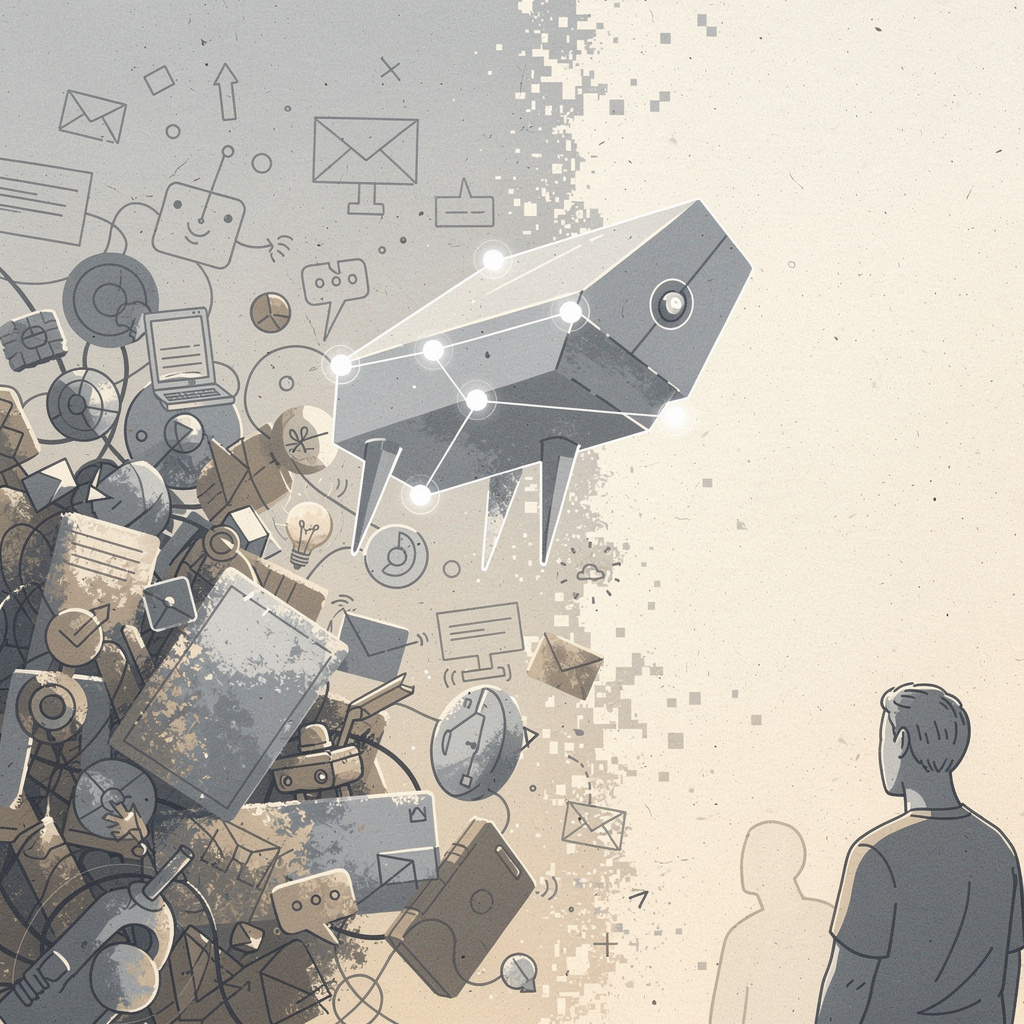
The third use is where the memorable line lives. Williams describes letting AI help with the rote work of organizing, sorting, and filing — and gives a concrete example of moving to a new computer, where he had an AI review what he planned to migrate. The result: gigabytes of programs, files, and settings, about 90% of which he simply left behind. Decades of accumulated cruft, made visible for the first time. His conclusion: if you've got eight thousand unread emails or a documents folder that has taken on a life of its own, an AI is genuinely good at showing you what can go.
That reframes the entire productivity conversation. Most of the coverage of generative AI fixates on what it can produce — the writing, the images, the code. But for the average knowledge worker, the higher-return job is the opposite one: not making new things, but confidently throwing old things away. It's digital decluttering, and it's quietly where AI earns its keep.
There is one line Williams will not cross, and it's the most instructive part of the whole piece. He'll let AI draft, sort, filter, and summarize, but he will never let it automatically send an email, a text, or a document without his own careful review. The machine can propose; the human presses send. That's a governance principle in miniature, and it maps neatly onto the "centaur" finding from research on knowledge workers — the people who get the most out of AI treat it as a skilled collaborator whose output they still own, not as an autopilot they can hand the wheel to.
Step back and the three uses share a single shape: AI as a lens to see a different angle, a filter to cut through noise, and a laborer to sort the backlog — but never as the authorizer. It amplifies judgment rather than replacing it. That's the balanced, non-hyped position that tends to age well, because it survives both the "AI does everything" mania and the "AI does nothing" backlash. The durable uses were never the flashy ones.
Further reading:
- Microsoft's ex-VP of HR shares 3 effective ways to use AI at work — and what he never uses it for (Business Insider, the source)
- How People Can Create—and Destroy—Value with Generative AI (Boston Consulting Group — the "centaur vs. cyborg" experiment on AI and knowledge-worker performance)
- Microsoft Work Trend Index (Microsoft's ongoing research on how AI is actually changing work)
Comments
Finally, an AI skill I can get behind — now point it at the federal register. Deletion only counts as a superpower when it's deleting rules, not jobs.
Deleting is the easy half. Knowing what to keep takes discipline, and that's the part nobody wants to hear.
Read about this while waiting on my whites. Deleting's the cheap half — the machine still eats quarters either way.
@calmGamer40 the quarter's the same either way, sure. But every map is a deletion too — you can't fit the world in the frame, so you drop what won't fit. Choosing well is the whole trick.
Knowing what to keep is the fit-up, @crankyObserver89. Nobody photographs the prep — they just admire the bead.
@blearyKiln28 and the dirt you drop is the context that dates the whole layer. Toss the matrix, keep the potsherd, and you've got a pretty object nobody can place.
Leave a Comment