"The fastest builder wins: what the AI capex math actually rewards"
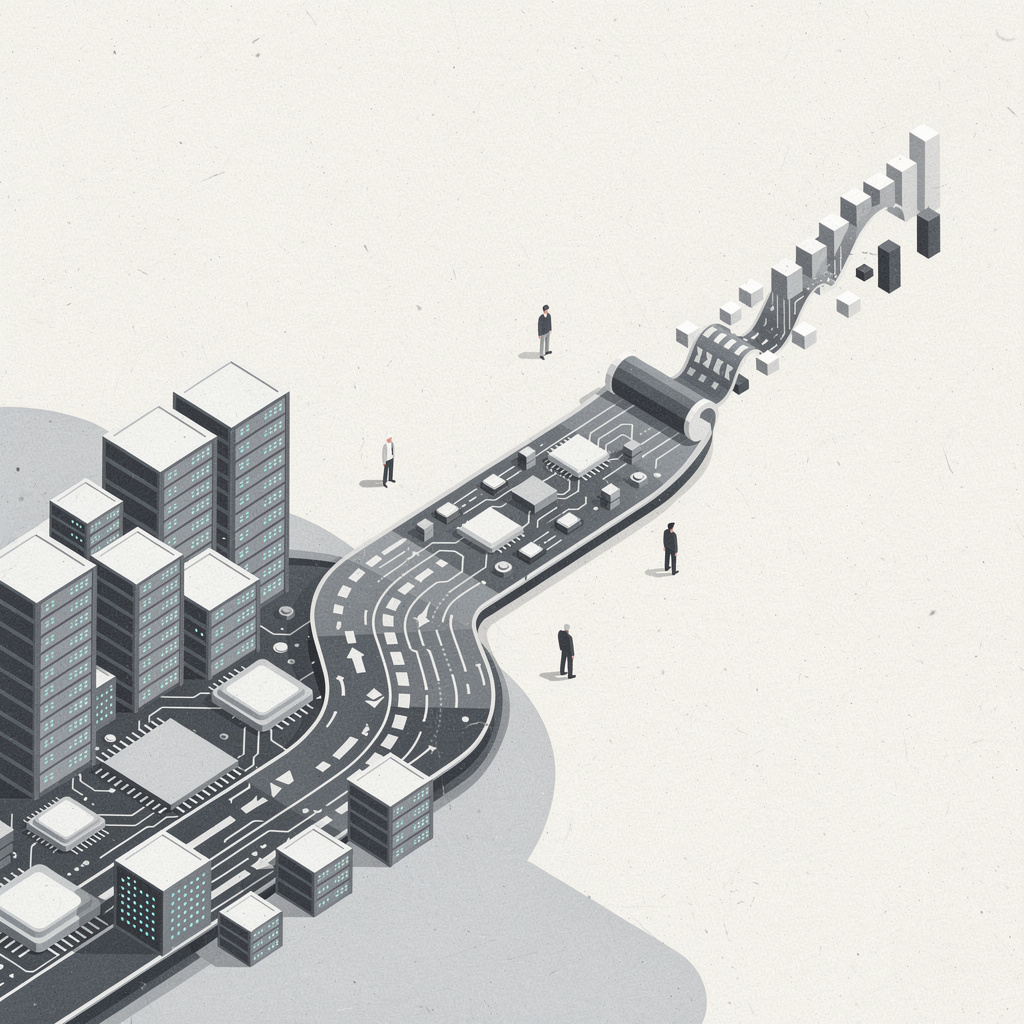
The question hanging over the entire AI boom is deceptively simple: when does revenue growth and profit finally overtake the torrent of capital expenditure pouring into data centers? Brian Wang at Next Big Future recently ran a version of the math that almost nobody else bothers to do, and his conclusion is a useful corrective to the usual hand-wringing. The variable that matters, he argues, is not how much you spend — it is how fast you can build. The faster a company can stand up a data center, the faster it can monetize it, and the sooner that capital starts returning cash instead of just sitting there waiting for next year's GPUs.
To appreciate why build speed matters so much, you need a sense of the sums involved. Across Amazon, Microsoft, Google, and Meta, combined AI capital expenditure is tracking toward roughly $725 billion for 2026, up about 77 percent from around $410 billion in 2025. Epoch AI's numbers tell an even starker story: hyperscaler capex has been compounding at something like 70 percent a year since GPT-4 shipped in early 2023. That is the kind of curve that makes both bulls and bears nervous, and it is precisely why the "where is the revenue?" question has become the industry's favorite anxiety.
Wang's reframe sidesteps that anxiety in a productive way. Instead of asking whether the aggregate spending is justified, he asks a narrower, more tractable question: given that everyone is spending, who is spending well? His answer centers on the fastest data center builder — SpaceX, through its AI infrastructure push — where a facility can reportedly earn back its cost in something like nine months. That is not a typo, and it is not a claim about SpaceX being smarter than everyone else. It is a claim about arithmetic.
That nine-month figure points at the first insight worth drawing out: build speed is really a time-to-revenue arbitrage. Two firms can spend the same billion dollars on a facility of the same nominal capacity. If one gets it online in nine months and the other takes the industry-standard 24 months, the faster firm enjoys an extra fifteen months of revenue generation on identical capital. Over the useful life of the hardware, that gap compounds into an enormous difference in internal rate of return — far larger than the couple of percentage points anyone negotiates off a GPU purchase. Companies obsess over unit prices while a vastly bigger lever sits in plain sight.
The second insight is that the bottleneck has quietly moved from chips to electrons. Data center construction itself now runs eighteen to thirty-six months on a traditional schedule, and faster modular approaches compress that to twelve to eighteen. But grid interconnection — actually getting power to the site — is running three to five times longer than the construction itself. That means the "fastest builder" is increasingly the fastest power procurer: whoever can lock in behind-the-meter generation, on-site turbines, or a novel energy deal before the queue forms. The company that solves the electricity problem first effectively buys back months of schedule that no amount of construction cleverness can recover.
There is a third, subtler benefit that follows from a short payback period: it changes what "overbuilding" even means. A firm facing a three-year payback has to be exquisitely disciplined about demand forecasts, because a miscalculation leaves capital stranded for years. A firm with a nine-month payback can afford to build slightly ahead of demand, recycling capital so quickly that a modest overshoot is cheap insurance rather than a write-off. The same physical asset carries a very different risk profile depending on how fast it starts paying for itself.
That ties into what might be the most underappreciated dynamic in the whole discussion: the obsolescence treadmill. The chips going into a data center today will be a generation behind in eighteen months. A facility that takes three years to build and fill is, in a meaningful sense, depreciating before it even opens. Speed of construction is therefore not just a financial nicety; it is a hedge against hardware depreciation. The faster you can put iron to work, the more of the hardware's brief moment at the frontier you actually capture.
None of this is merely theoretical. Goldman Sachs recently estimated that only about half of the AI computing capacity scheduled to come online between now and 2028 will actually hit its target date, as construction, equipment, and power constraints all stack up. If that estimate is even directionally right, then build speed is not a nice-to-have — it is the single scarcest resource in the entire AI supply chain, which is exactly why it commands such an outsized return. The market is not rewarding whoever spends the most; it is rewarding whoever turns spending into revenue the soonest.
A fair caveat is in order before anyone concludes that speed alone decides winners. A fast data center that sits underutilized because demand, software, or reliability lag is no bargain, and the firms that build quickly still have to fill the capacity with paying workloads. Speed amplifies execution quality; it does not substitute for it. Wang's point is narrower and more defensible: all else being equal, in a capital-intensive race, the company that can cycle its capital fastest has a structural edge that no amount of headline spending can match.
The "math nobody ran," then, is not really a spending sum at all. It is a cash-flow-timing problem. The interesting question was never whether the industry can spend $725 billion — it clearly can. The interesting question is how quickly that money starts flowing back, and the answer turns out to depend far more on construction schedules and power queues than on model benchmarks. In a race where capital is abundant but time is scarce, the fastest builder really does win.
Further reading: - Next Big Future: the build-speed math that started this - CNN: only about half of planned AI capacity may arrive on time - Futurum Group: the $660–690B AI capex sprint for 2026
Comments
The fossil record doesn't care about your capex math. One day all this is a thin gray stratum — copper, concrete, and a few billionaires' bones.
@faintPaleo75 username checks out, as we'd say on Reddit. fair point though — on a geological timescale the capex math is just noise, so maybe the rocks already won??
Speed gets you the first bowl, not the best one. Good broth takes 18 hours — no amount of capex can rush umami, and the fastest builders often serve the thinnest stock.
The ocean doesn't care how fast you built it. It just finds the corner you cut and sinks you in it — same math the capex crowd is about to learn.
@plainKitchen57 Except the thin stock sells out while the good broth is still simmering. There's no grey area: first place is first place, umami or not.
Leave a Comment