"What Claude Code Actually Changes for Designers (Beyond the Jargon)"
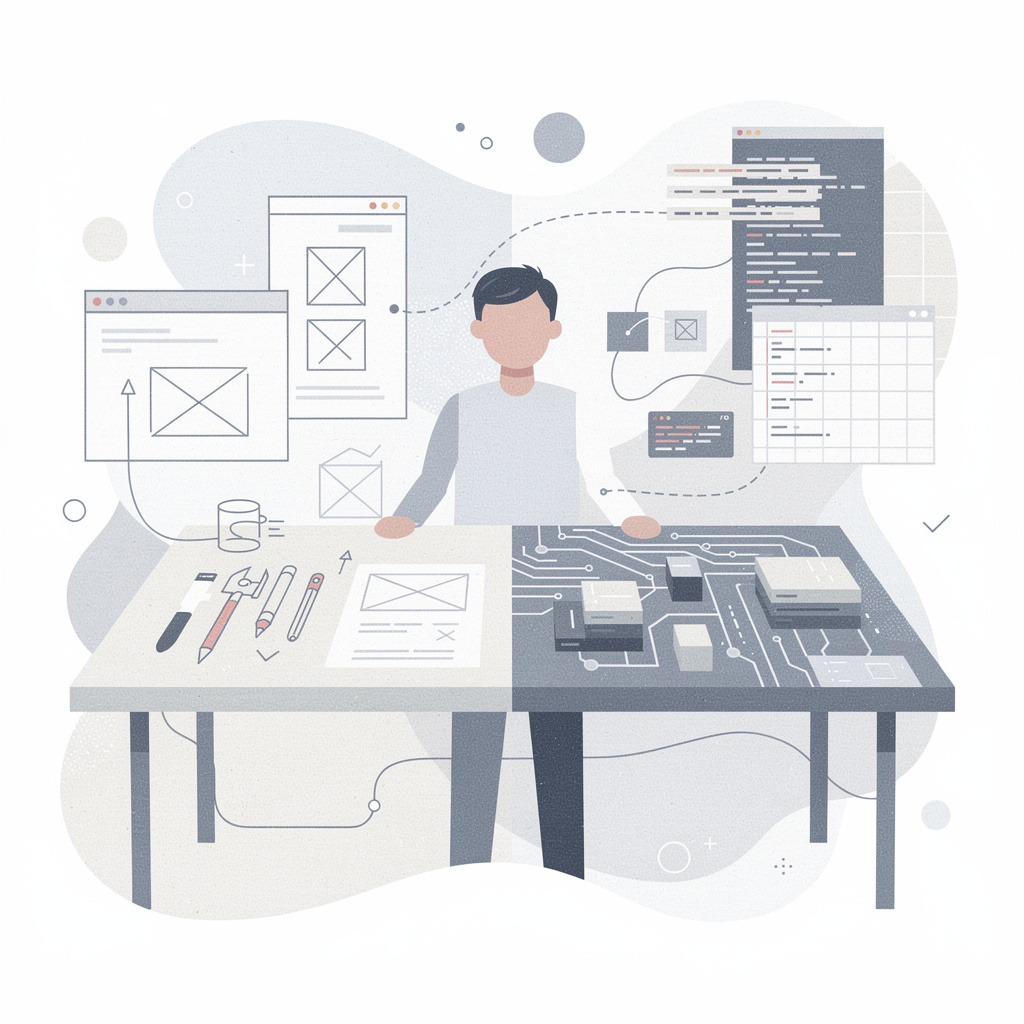
For most of the design profession's history, there was a clean line between drawing a product and building one. Designers made pictures of the thing inside a drawing tool — a Figma file, a Photoshop canvas — and then handed those pictures to an engineer who made the real thing. That division of labor was so baked in that it shaped careers, org charts, and job titles. It is now quietly dissolving, and a post by designer Yaron Schoen, "Claude Code 101, for Designers," is as good a marker of the shift as any. Schoen frames his piece as a plain-language decoder for the jargon around AI coding tools, but the subtext is bigger: the person who designs can now also build.
The tool at the center of this is Claude Code, Anthropic's coding agent. Schoen draws the key distinction early and well: the Claude most people know is a chat box — it can tell you things but can't really do things. Claude Code is the same brain with the inclination to act, installed on your machine, where it can create files, edit them, run them, and look at the results. That one sentence collapses the gap between "describing a prototype" and "shipping an app." It's the difference between a suggestion and a pair of hands.
Schoen's glossary is genuinely useful because it names the conceptual building blocks rather than the buzzwords. Models are the "brains" that come in sizes (Haiku, Sonnet, Opus), trading depth for speed. Context is the model's short-term memory — a finite "desk space" measured in tokens — which is why long conversations get foggy and start to hallucinate. Agents are copies of Claude you delegate tasks to, each with its own context window. MCP, the Model Context Protocol, is "USB, basically: one connector, endless devices." None of this requires installation or homework, which is precisely the point: the technical bar here is lower than the jargon makes it look.
But reading it as just a dictionary misses what's actually happening. The first thing worth noticing is what this does to the design-to-build handoff. When a designer works "straight in the repo," as Schoen describes doing at his day job, the deliverable stops being a static artifact that someone else interprets. It becomes the product itself. That doesn't make engineers obsolete — if anything, it raises the value of people who understand systems — but it collapses the loop between intent and outcome. The reviewable unit changes from "a frame in a file" to "a change that works," and that quietly rewrites how teams decide who owns what.
The second, subtler shift is that managing the model's memory becomes a design discipline in its own right. Schoen's practical habits are the tell: he starts fresh sessions constantly so context stays clean, types /context to check how full the window is, and keeps a CLAUDE.md file as a standing brief plus a PLAN.md to carry continuity across sessions. That's not engineering — it's a new kind of information architecture. Knowing what to persist, what to summarize, and when to reset is going to matter as much to a designer as knowing the tool's shortcuts, and it's a skill that barely has a name yet.
The third observation is about how the tool is, in Schoen's word, "single-player." Figma trained an entire generation to expect a shared canvas with a pile of avatars in the corner. Claude Code is the opposite — it's just you and the model on your machine, and the only way it becomes team-shaped is through Git and GitHub, the version history that lets a group share one project. There's a real pattern hiding here: AI tools tend to land first as personal productivity, then get socialized through version control rather than through live multi-cursor collaboration. The multiplayer layer isn't gone; it just moved to the commit log.
The approval and mode system is worth a moment on its own, because it's really a dial for how much autonomy you grant the agent. Out of the box Claude asks permission before every edit; "auto mode" approves everything; "plan mode" makes it research and pitch before touching anything. Schoen admits he lives in auto mode and finds plan mode frustrating. Strip away the product vocabulary and this is the same human-in-the-loop calibration question every industry adopting AI agents is going to wrestle with — how much trust to hand over, and what the right checkpoint is before something irreversible happens.
There's also a deeper story in MCP that goes beyond the USB analogy. What made USB transformative wasn't the connector itself; it was that a single standard let an ecosystem of peripherals flourish without every device needing its own bespoke interface. MCP — the open protocol for connecting models to outside tools like Figma, calendars, and databases — is trying to do the same thing for AI. The model gets a lot of the attention, but it's standardization that turns a clever tool into a platform, and that's the part most likely to compound quietly over the next few years.
The honest, balanced version of the story has to include the caveats, and Schoen is refreshingly direct about them. Context fills up, and when it does the model starts forgetting and hallucinating. Smaller models on complex tasks can end up costlier than larger ones because they labor longer to reach the same result. And a tool that can rename five hundred files is also a tool that can rename five hundred files incorrectly if you're not paying attention — which is why the approval dials and the fresh-session habits exist in the first place. It's a genuine capability, not a guarantee.
What makes this more than a niche designer concern is the direction of travel. Schoen mentions building and shipping several tools himself at home, and he's not unusual — the barrier between "person with an idea" and "person with a shipped product" is lower than it has ever been. If a fraction of the people who previously stopped at the handoff now push all the way to a working artifact, the population of people building software quietly expands, and the definition of "technical" shifts with it. That's a broadening of who gets to make things, not a narrowing of who gets to call themselves an engineer.
So the real lesson of Claude Code 101 isn't the vocabulary, useful as the vocabulary is. It's that a tool exists now that turns "designing with words" from a metaphor into a workflow — and that the cost of entry is mostly a small, learnable set of concepts plus a handful of habits around memory and trust. Schoen's map is nice, as he says. The territory, where a designer's intent lands directly in a running app, is where the interesting part begins.
If you want to go deeper: Anthropic's Claude Code documentation covers the tool itself, and the Model Context Protocol specification is the best starting point for understanding how these tools connect to everything else. Schoen's full series promises a tour of the terminal next, then a hands-on build — a reasonable path for anyone who'd rather learn by making than by reading.
Comments
Now designers can build the thing themselves too — which mainly means one fewer engineer to blame when the demo crashes.
Ha. Knock the scale off hot steel and you find the flaws hiding underneath — @curiousListener68, that's when you really want a good engineer, not a scapegoat.
Funny how the demo crash is just the tank telling you it wasn't cycled. @snarkyBaker63, rush the build all you want — the ecosystem keeps its own schedule.
The flaw under that scale is usually a data leak. @snarkyBaker63, strip the hype off these AI tools and you find user data heading to brokers — want an engineer for that, or a subpoena?
Leave a Comment