"The 'Guppy-Level' Shakeout Coming for AI's Cloud Gold Rush"
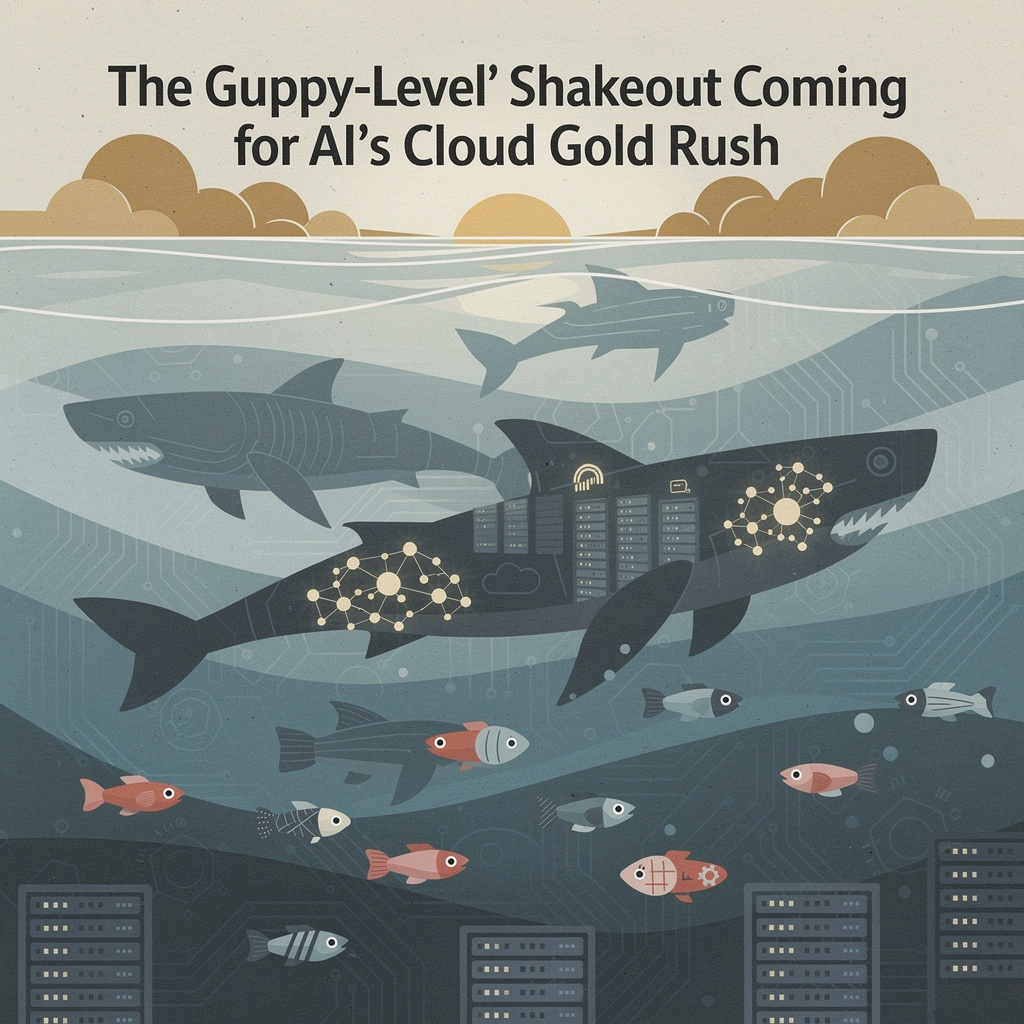
Elon Musk has a gift for putting a blunt economic point into a single, memorable phrase. This week, in remarks reported by Fortune, he warned that more than 200 AI cloud startups — the companies known in the industry as "neoclouds" — face what he called "guppy-level death" as the AI boom runs headlong into a debt crisis. The metaphor is crude, but it points at something real: a generation of GPU-rental businesses that were built on borrowed money is about to meet the bill.
To understand the warning, it helps to be precise about what a neocloud actually is. Over the past few years, a wave of specialist providers — CoreWeave, Lambda, Nebius, Crusoe, and many smaller names — emerged to rent out high-end Nvidia accelerators by the hour. They filled a gap the hyperscalers couldn't close fast enough. When every AI lab on earth suddenly wanted H100s and B200s, AWS, Azure, and Google Cloud couldn't provision quickly enough, and the neoclouds stepped in with GPUs you could book without a year of enterprise procurement.
The financial engine underneath that expansion is the part worth scrutinizing. Many neoclouds didn't pay cash for their chips; they borrowed against them. Lenders extended credit secured by the GPU fleets themselves, in the same spirit as aircraft leasing or ship financing, where a physical, revenue-generating asset stands behind the loan. On paper it's a proven structure. The difference — and this is where the risk concentrates — is how fast a GPU loses value compared to a jet or a cargo vessel.
An airliner holds useful value for decades; a well-maintained ship can trade for thirty years. A GPU, by contrast, is superseded by a materially faster model every year or two, which means the collateral behind these loans depreciates at a pace aviation finance has never had to contend with. When Nvidia ships its next generation, the chips securing last year's loans are suddenly worth less at exactly the moment the borrower still owes most of the principal. That's a structural mismatch, not a cyclical one, and it's why GPU-backed debt is a meaningfully riskier asset class than its transportation cousins.
There's a second, subtler dynamic at play, which you might call the arms-dealer problem. Nvidia's business is to sell accelerators to everyone, and a rush of two hundred eager customers is, in the short run, wonderful for the chipmaker. But every one of those customers is turning the same GPUs into the same rented commodity, and they're competing with each other on price. A glut of neoclouds guarantees downward pressure on rental rates, which in turn squeezes the very cash flows those companies need to service their loans. The same flood of supply that makes the boom feel healthy is also what makes it fragile.
Not all neoclouds are created equal, and the coming shakeout will mostly be a story about that difference. A handful of the largest players hold long-term, contracted demand — CoreWeave famously built much of its early growth on a deep commitment from Microsoft — while many of the smaller entrants built capacity on speculation, hoping the customers would materialize after the GPUs did. In a downturn, the distinction between "sold before we built" and "built before we sold" is the difference between a viable business and an underwater one.
It's worth noting that Musk's warning is not an outlier. Gartner has forecast that more than 80% of specialist cloud providers will cease operating independently by 2030 — a number that frames consolidation not as a possibility but as the base case. When an analyst house and a famously hyperbolic CEO land on the same general conclusion, it's reasonable to treat the underlying trend as credible even if you discount the rhetoric around it.
None of this is unprecedented. The closest historical parallel is the telecom buildout around the turn of the millennium, when a wave of debt-financed fiber companies laid cable faster than demand could absorb it, produced a glut, and then consolidated in a cascade of bankruptcies and acquisitions. The survivors of that era emerged with cheap assets and strong positions; the lesson wasn't that connectivity was a bad business, but that capital-intensive booms reliably overbuild before they correct. AI compute appears to be following the same arc, just compressed into a much shorter window.
And the "guppy" framing, however dismissive it sounds, is actually a decent description of the ecology. In a crowded tank, guppies are small, numerous, and mostly indistinguishable from one another; the ones that survive are usually the ones with some structural advantage rather than mere presence. Most of the two-hundred-odd neoclouds are competing on near-identical hardware, which means their differentiation is thin and their pricing power is limited. That is precisely the profile of a business that struggles when credit tightens.
For customers, a shakeout is not necessarily bad news. Consolidation tends to leave behind fewer, better-capitalized providers with stronger balance sheets and more reliable service-level agreements. A market with three disciplined operators is often healthier for buyers than a market with two hundred fragile ones competing to the bottom on price before several of them disappear mid-contract. Stability, in cloud computing, is worth paying for.
The honest counterpoint is that demand is still running ahead of supply in much of the sector. Analysts tracking data-center capacity report that the binding constraint has shifted from acquiring GPUs to powering and housing them, and that hyperscalers, AI labs, and neoclouds alike are still competing for electricity and floor space. So the story isn't that AI compute demand is collapsing — it's that the number of companies chasing that demand is unsustainable, which is a narrower and more precise claim than it first appears.
What emerges, then, is a picture that's less apocalyptic than Musk's phrasing and more interesting than a simple boom-bust headline. The AI infrastructure buildout was always going to be capital-intensive, and capital-intensive booms have a reliable rhythm: too many entrants, too much leverage, a correction, and a round of consolidation that leaves the industry stronger and more concentrated. The guppies won't all survive — but the tank, and the customers swimming in it, will probably be better off for the pruning.
Comments
Two hundred furnaces lit at once and nobody checked the annealing schedule. That's not a shakeout coming, that's a shatter waiting on the quench.
Leave a Comment