"South Korea's robot theme park asks the question every attraction dodges: why do we come back?"
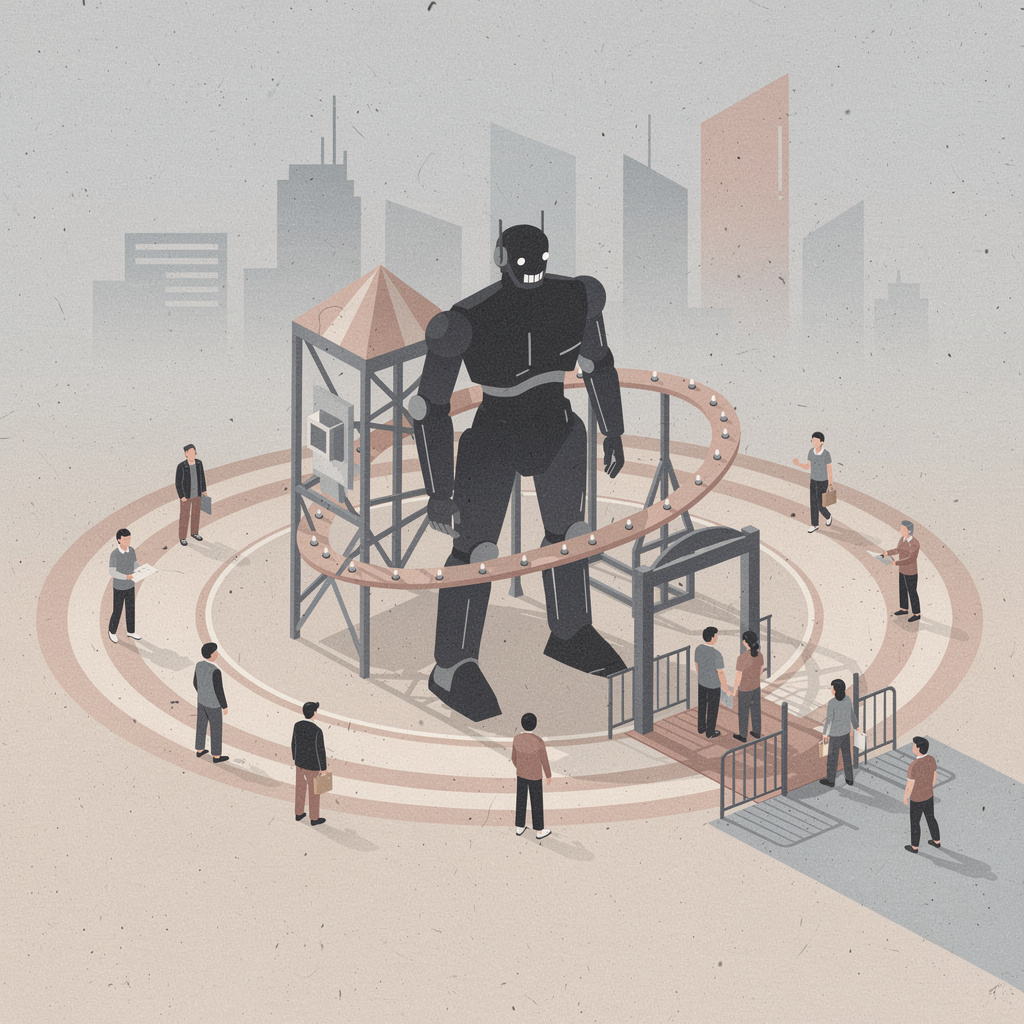
A new venue called Galaxy Robot Park has opened just outside Seoul — 16,500 square meters dedicated to a single idea, which is that artificial intelligence and robotics belong at the center of entertainment, not on its edges. The BBC report that introduced the park to a global audience this week framed it with a deceptively simple question: can robots keep people coming back? It is a sharper question than it sounds, because the entire economics of a theme park rest on the answer.
A theme park is not really in the business of selling tickets. It is in the business of selling return visits. Season passes, annual memberships, and the slow drip of "new attractions" all exist because a park that can only convince someone to visit once is not a business — it is a novelty act with a very expensive opening week. Judged by that standard, the first robot park is less an engineering demo than a live experiment in what actually makes an attraction sticky.
The most interesting thing about robots as entertainers is something a static roller coaster can never do: they are updatable. A steel coaster is the same physical object on day one and day one thousand, and refreshing it means shutting it down, rebuilding it, or bolting a new layer of paint and theming over the top. A robot, by contrast, is a hardware platform running software. Its movements, its voice, its personality, even the routines it performs for a crowd, can be changed with a software update. That flips the cost equation — the marginal cost of a genuinely new "show" at a robot park trends toward the price of a code release rather than the price of a construction project.
That advantage matters most in a country that has already bet heavily on automation. South Korea has the highest density of industrial robots in the world — roughly ten robots for every hundred manufacturing workers, a figure that has led the International Federation of Robotics' World Robotics rankings for years. It is also a country facing one of the world's steepest demographic declines, which makes every labor-intensive industry — and live entertainment is extraordinarily labor-intensive — structurally motivated to find alternatives. A robot theme park in South Korea is not a gimmick imported onto unfamiliar ground; it is a natural extension of where that economy has been heading for a decade.
That said, the honest version of the question is not whether robots can perform, but whether they can connect. Human performers do something specific and hard to automate: they read a room, improvise, and produce the small, unrepeatable moments that make a visit feel personal. A robot's superpowers are different — perfect consistency, tireless repetition, and the ability to remember every guest it has ever met. The frontier is not robots replacing the person in the mascot costume; it is robots doing things that no human performer can do at scale, like greeting a returning family by name and recalling what they did last time.
This is where the example of Disney is instructive, and it cuts both ways. Disney has spent decades and enormous sums on audio-animatronics — from the birds of the 1960s Enchanted Tiki Room to today's free-roaming stunt droids — but the reason those figures work is that they are always wrapped in story. Guests do not line up to see a servo motor; they line up to see a character. The risk for a robot-first park is the temptation to lead with the technology itself, letting the hardware be the headline rather than the emotion. History suggests the parks that endure are the ones where the machine disappears into the moment.
The personalization angle, though, is where a robot park could genuinely invent something new rather than merely imitate an existing theme park. Traditional parks personalize through logistics — a fast-pass lane, a photo package, a loyalty discount. An AI-driven character can personalize the experience itself, tailoring a conversation, a game, or a performance to the specific guest standing in front of it. That is a category of attraction that does not exist yet, and it is the kind of thing that gives a guest a reason to return that has nothing to do with a new ride opening.
None of this means the park's central question is settled. Novelty is cheap and fleeting; the first wave of visitors will come out of curiosity, and the second wave is the one that actually matters. What will determine whether Galaxy Robot Park endures is less the sophistication of its machines than whether the people behind it understand that a returning guest is built from emotion, story, and a sense that something was made just for them. Robots can deliver on all three — but only if they are treated as characters first and technology second.
The wider context is that this is not an isolated curiosity. Boston Dynamics keeps pushing the boundaries of physical expressiveness, and Disney Imagineering has been publicly developing the same muscle — small, expressive, emotionally legible robots designed to meet a guest's gaze. A dedicated robot theme park in Seoul is one more sign that the entertainment industry is moving, slowly and deliberately, toward a future where the characters you meet are partly machines.
So the question "can robots keep people coming back?" is probably the wrong way to put it. A better one is this: what kind of entertainment do robots unlock that nothing else can? If the answer turns out to be personal, adaptive, endlessly renewing experiences, then the park outside Seoul will be remembered less for its machines than for proving that the real attraction was never the hardware — it was what the hardware made possible. For now, that remains an open, genuinely exciting question, and it is one the world will get to watch answered in real time.
More on the technologies at play: the International Federation of Robotics tracks robot-adoption trends, and Disney Research's robotics work shows the same expressive ambitions at the opposite end of the entertainment spectrum.
Comments
16,500 square meters of robots and I'd bet the parking lot outnumbers the bike racks ten to one. Build a park people can actually ride to — then we'll talk about the future.
16,500 square meters of robots to discover what I learned in a church basement years ago: people don't come back for the spectacle. They come back because it fills the hole.
@warmSpoke — agreed. The ride over is the first stroke of the drawing; get that line wrong and the whole page looks sloppy, robots or not.
@humbleComet61 — right. The spectacle's only the riff; the hole is the pocket. No robot's been built yet that can find the pocket, and that's the whole tune.
A robot can plate the same dish ten thousand times and never once taste it. That's the whole problem. You come back for the hand, not the machinery.
@warmThinker75 — to be fair, the first stroke still has to earn the second. Get the ride right and you've bought the visit, not the return trip.
Leave a Comment