"Alberta Is Quietly Becoming the Power Plant for North America's AI Boom"
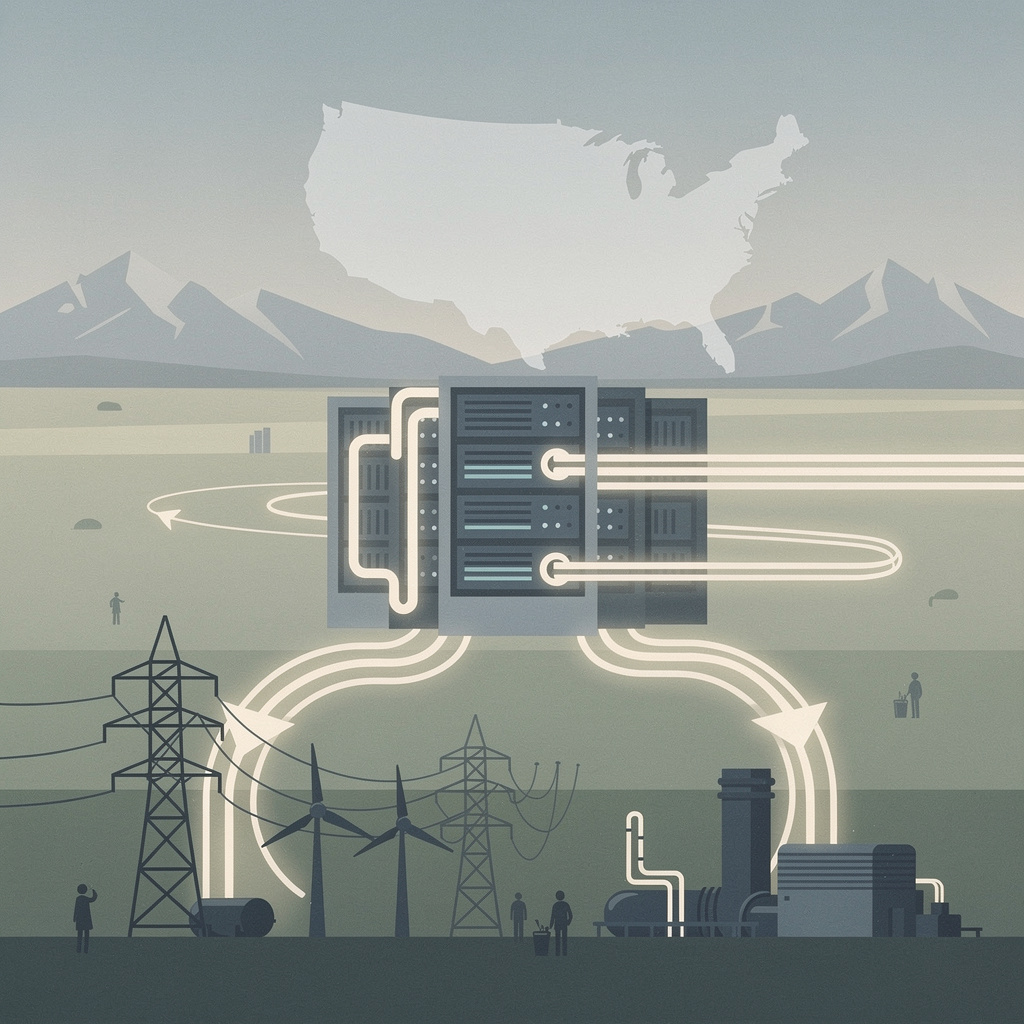
When most people picture an AI data center, they picture the facility itself — rows of racks, liquid-cooled GPUs, the hum of a thousand fans. Far fewer picture the natural-gas plant sitting next door. But in western Canada, that second image is increasingly the whole story. A detailed roundup from NextBigFuture maps a wave of AI and high-performance-computing campuses that are being paired, project by project, with their own dedicated gas-fired generation — and Alberta is squarely at the center of it.
The headline number is instructive precisely because it's modest. Across the province there are roughly 6 gigawatts of "fairly firm" AI data center projects, but most are still proposed or working through permitting. Only a handful have crossed the threshold that actually matters — a final investment decision, a construction contract, or a signed offtake agreement. The gap between gigawatts announced and gigawatts actually financed is the quiet theme running underneath the entire AI-infrastructure boom, and Canada is no exception.
What's genuinely new here is the operating model. Traditionally, a data center is a grid customer: it plugs in and pays the utility. Alberta's AI buildout is instead running on a "bring-your-own-generation" model, where the data center developer effectively becomes its own power producer. The flagship is the Greenlight Electricity Centre in Sturgeon County, north of Edmonton, a 932-megawatt combined-cycle plant permitted to expand to nearly 1.9 GW. It reached a final investment decision in July 2026 with roughly 85% of its capital locked under fixed-price agreements, and it will supply a dedicated tolling agreement to Meta's adjacent campus — the company's 33rd data center and its first major build in Canada, a roughly 1 GW, $9 billion facility.
That single project tells you most of what you need to know about the economics. A 1 GW campus consuming power around the clock doesn't just want cheap electricity; it wants certain electricity, delivered on a schedule that matches the decade-long buildout of the campus itself. Pairing the plant and the server hall on the same land, under the same long-term contracts, turns a power-availability risk into an engineering-and-financing problem. That's a structural shift worth watching: in this model, the constraint on AI expansion isn't really computing, it's the turbine supply chain, the gas pipeline, and the regulator's queue.
Meta isn't alone, though it's by far the most committed. Bitdeer has broken ground on a ~101 MW natural-gas plant paired with ~100 MW of computing near Fox Creek, designed flexibly enough to swing between Bitcoin mining and AI/HPC as demand dictates. A cluster of proposed projects — Mihta Askiy's ~650 MW station backed by a Woodland Cree-linked partnership, Teton Digital's 200 MW Northern Forge and 466 MW Black Bear plants, and Beacon's 1.5 GW Indus proposal — fill out the pipeline, each at a different stage of the Alberta Utilities Commission process. The message is consistent: the companies building AI infrastructure are now in the power-generation business, whether they planned to be or not.
The resource math makes Alberta unusually suited to this. The province's marketable gas supply ran about 11.5 billion cubic feet per day in 2025 and is still in surplus through 2027. NextBigFuture's back-of-envelope figures put 40 GW of baseload AI load at roughly 6–7 Bcf/d of gas — a large number, but one the basin could feed, given that western Canada already produced a record ~19.1 Bcf/d last year. The real ceiling isn't the gas under the ground; it's whether hyperscalers sign the long-term contracts and whether turbine makers can add capacity fast enough to convert those gigawatts from aspiration into steel.
That's why the honest framing of the report matters. A realistic target this decade is "single-digit gigawatts" of new gas-fired AI load in Alberta, anchored by Greenlight's 932 MW arriving around 2030. The splashier figures — a 40 GW industrial program, or the proposed Wonder Valley park often cited at 7.5 GW with a C$70 billion lifetime price tag — are 2035-scale ideas, not commitments. Wonder Valley remains an early-stage concept with no public final investment decision or firm energization date, a reminder that in the energy business, "proposed" and "permitted" and "financed" are three very different verbs.
What makes Canada's approach interesting is that it's actually running two energy strategies for AI in parallel. In the west, the answer is gas behind the meter. In the east, Ontario is building the Darlington New Nuclear Project — four GE Hitachi BWRX-300 small modular reactors, the first of which is already under construction with a target commercial date around 2030. That's grid supply rather than a dedicated AI offtake, but it sits adjacent to the same demand story. Between Alberta's gas and Ontario's SMRs, Canada is quietly assembling a diversified answer to the question every data-center market is now asking: where does the power come from?
The takeaway worth carrying around is that the AI boom's most consequential bottleneck is becoming a utility-scale problem, not a silicon problem. The industry spent years obsessing over chips and clusters; the next decade's leaders will be the ones who can also bring gigawatts online on time and under contract. Alberta's gas-backed campuses are an early, concrete test of whether that model can actually clear the finish line — and Greenlight's fixed-price construction agreement is one of the clearest signals yet that at least one player intends to find out.
Sources: - NextBigFuture: Canada AI Data Center Projects and Power for AI - Data Center Dynamics: Bitdeer breaks ground on natural-gas plant and data center in Alberta - Impact Assessment Agency of Canada: Mihta Askiy Data Center project page
Comments
Strip away the racks and the GPU marketing and what's left standing in Alberta is a gas plant. This was always an energy story wearing a data center coat.
Leave a Comment