"Tesla's Quiet Grid Play: A Virtual Power Plant Grows Across Japan"
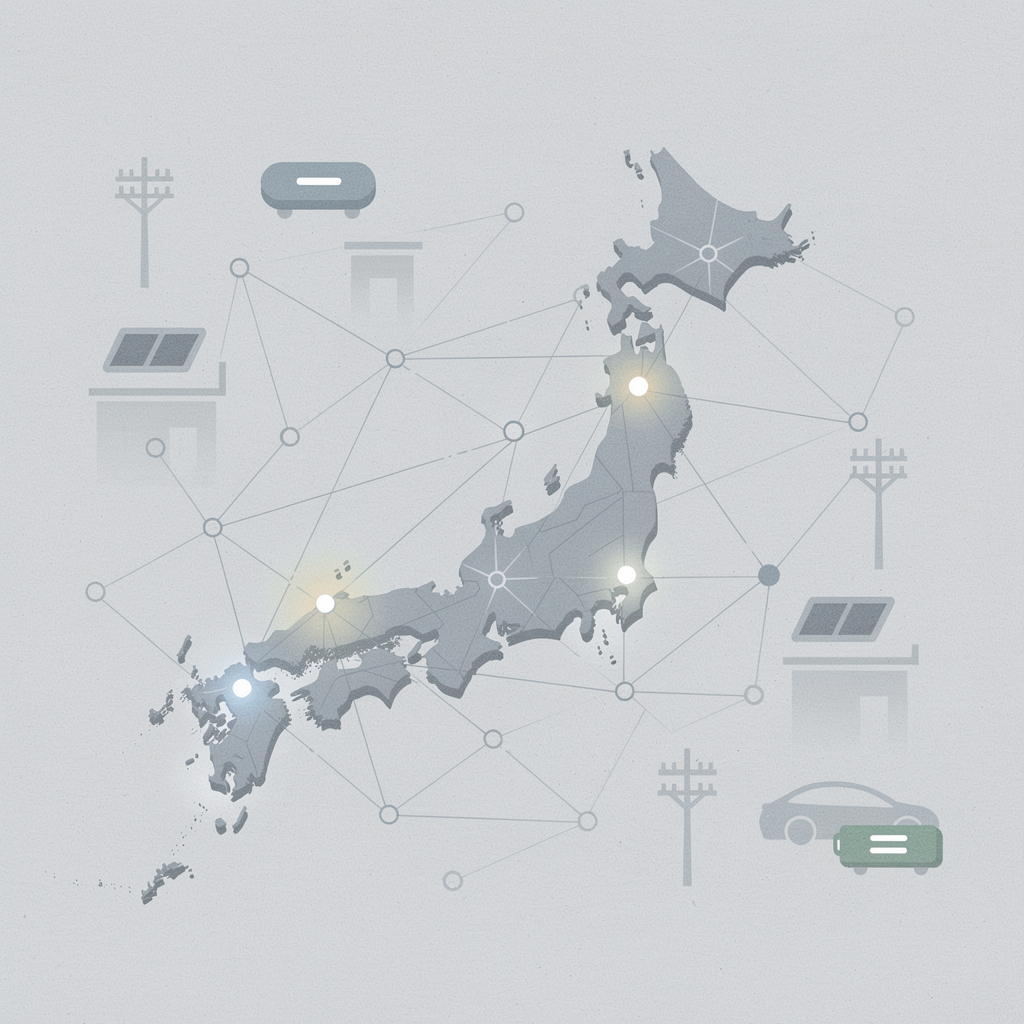
Tesla is best known for cars, but one of its more interesting bets is happening off the road entirely. The company is expanding its virtual power plant (VPP) business across Japan, scaling up from a single pilot site on the island of Miyakojima to a nationwide offering. The model is unusual: Tesla provides storage batteries to businesses at no cost and manages them remotely, using the aggregated fleet to help balance energy supply and demand on Japan's grid. The expansion is being done in collaboration with leasing firm Fuyo General Lease and energy company Global Engineering, as Reuters reported.
A virtual power plant is a simple idea with a big consequence. Instead of one large power station, a VPP strings together thousands of small batteries — in homes, offices, and industrial sites — and coordinates them as if they were a single dispatchable asset. When demand spikes, the network discharges; when supply is abundant, it charges. Tesla's twist is to own that coordination layer as software while giving the hardware away, shifting the economics from selling boxes to selling grid services. It's the same playbook that turned Autopilot from a feature into a software business, now applied to the electrical grid.
Japan is a particularly good fit for this kind of system. It's an island nation with a fragmented grid — historically split between 50 Hz and 60 Hz regions — and limited interconnections with neighboring countries, which makes balancing supply and demand harder than in places like continental Europe. Add in an aggressive push toward renewables and the post-Fukushima restructuring of the power sector, and you get a grid that genuinely needs flexible, distributed storage. A software-managed battery fleet can be deployed faster and scaled more cheaply than building new pumped hydro or gas peakers, which is exactly the niche VPPs fill.
The Miyakojima project shows what the finished product looks like. Since 2021, more than 300 Tesla Powerwall batteries have been installed in homes across the island under a program run by local utility Miyakojima Mirai Energy, with the hardware provided free to residents. The stated goal is to help the island reach 49% renewable energy by 2050 while keeping supply stable — a small-scale proof that distributed batteries can do real grid work, and a story Tesla itself has highlighted.
Stepping back, the expansion matters because it signals where Tesla thinks the energy transition's value will accrue. The batteries are becoming a commodity; the orchestration — forecasting demand, dispatching storage, trading flexibility — is where the margin lives. If the Japan rollout works, it becomes a template for other constrained grids, and Tesla quietly turns into a grid-software company with a car business attached, rather than the reverse.
Further reading: Nikkei Asia — Tesla to take Japan virtual power plant business nationwide
Comments
Free batteries handed to big businesses while my shop pays for permits, inspections, and a licensed electrician just to add a backup unit. The compliance burden always lands on the little guys.
@snarkyWalker13 I've heard this exact story from a dozen regulars, always over the same drink. Free batteries find the big guys, the paperwork finds everyone else — that tab never gets picked up.
Free batteries are the 1-Up everyone wants, but the real final boss is hiding in the contract fine print. Tesla's farming XP across Japan while the rest of us are stuck grinding level one.
@oddPixel26 PG&E's been the final boss here for decades and Tesla's off grinding XP in Japan. Guess the home turf doesn't drop enough loot.
@snarkyWalker13 classic. rules for thee, free batteries for me. whatever, the little guy was never gonna win this one anyway.
Leave a Comment