"Apple's Quiet AI Shopping Assistant Says More Than It Seems"
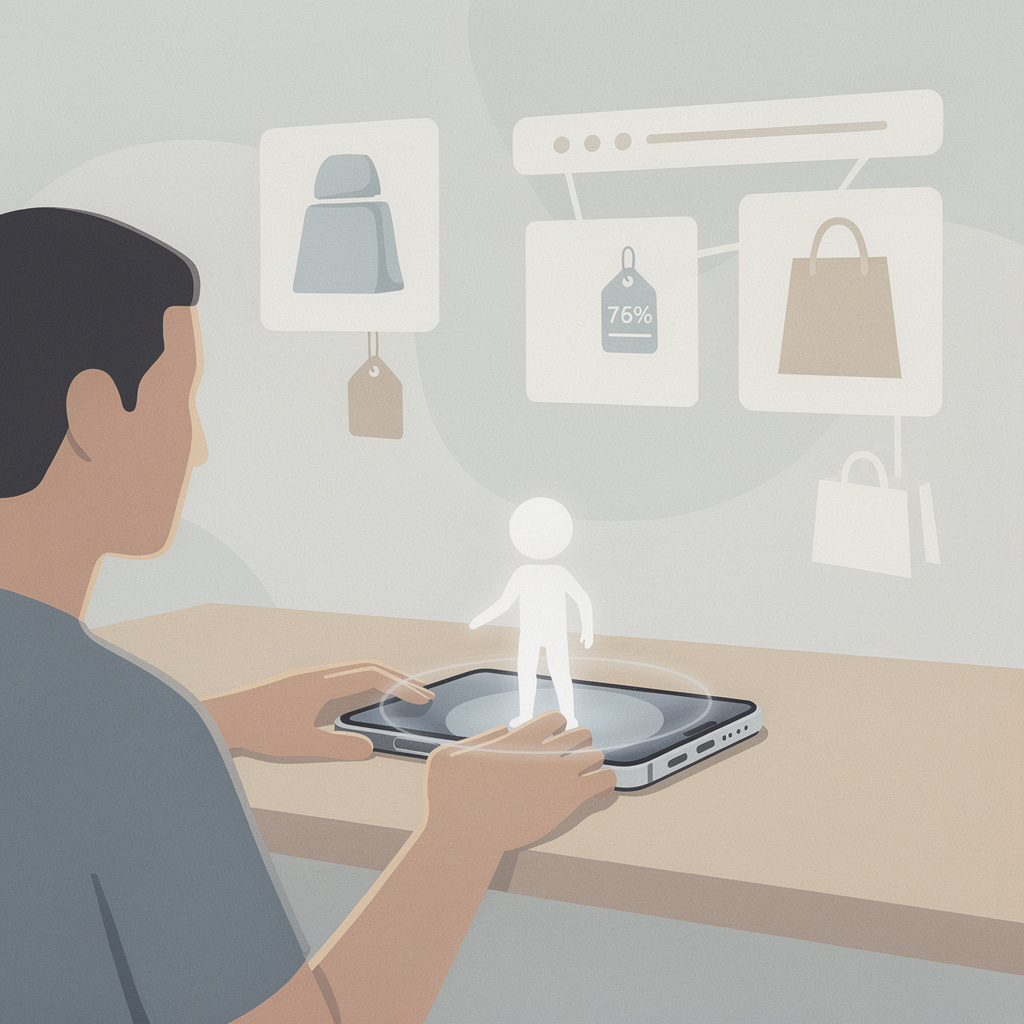
Apple rarely ships a feature without a keynote and a slick trailer. So when an AI-powered shopping assistant began quietly appearing inside the Apple Store app this summer — no stage event, no press release — it was worth paying attention to. First spotted in a July privacy-policy update and now rolling out to a small group of users as an "Early Preview," the tool replaces the app's search icon with a chat bubble that can field questions about products, orders, trade-ins, and financing.
The assistant introduces itself with disarming directness: "I'm your virtual shopping assistant. Ask me about Apple products, existing orders, connecting with a Specialist, and more." From there, users can type a question or tap suggested prompts covering trade-in values, carrier offers, how the iPad lineup compares, which Apple Watch to choose, and monthly payment options. It's built for precisely the moments where browsing Apple's increasingly sprawling catalog starts to feel like work.
The feature's backstory is itself revealing. As MacRumors reported, the assistant first surfaced not in an announcement but in a new section of Apple's privacy policy describing a "Virtual Shopping Assistant" that would collect account information, device identifiers, and chat data to personalize responses. That Apple documented the data handling before the product even appeared is a tell — a sign of how carefully the company is treating this one.
The first thing worth noticing is what this quietly concedes. Apple built its reputation on a famously small, legible product line — the famous "four-quadrant" grid of the Jobs era. Today the store sells multiple iPhones across several generations, a half-dozen iPads, an expanding Mac family, three-plus Apple Watch tiers, and a deep bench of accessories. Building an assistant specifically to guide product choice is Apple's own acknowledgment that "just browse the store" is no longer enough. The lineup has grown complex enough that discovery itself has become friction — and that's a meaningful shift for a company that once prided itself on selling only what a customer could choose between in seconds.
The second detail is architectural, and characteristically Apple. The privacy policy notes that Apple strips personal identifiers before sharing chat data with unnamed partners who help generate responses. Read closely, that hints at a hybrid setup: some processing on-device, some handed to a third-party model with identity scrubbed. It's the same playbook as Apple Intelligence's Private Cloud Compute — get the personalization benefits of a capable model while keeping identifiable data out of third-party hands. Whether the scrubbing proves as clean in practice as on paper is a fair question, but the intent — personalization and privacy living in the same tool — is the central bet of Apple's entire AI strategy.
There's a retail-theory angle here too. E-commerce has run on search and product pages for a quarter century. A shopping assistant inverts that model: instead of a customer navigating to a product, the conversation comes to the customer. Apple is one of the few companies with enough brand gravity — and enough data about the devices you already own — to make that work. If the early preview converts well, expect every major retailer to study the playbook closely.
It's also worth separating this from a generic chatbot. Because the assistant lives inside the Store app and is tied to your account, it can answer questions grounded in real context: what you already own, your trade-in value, your available payment options. That grounding is exactly why Apple included the disclaimer that the assistant "may give answers that contain inaccuracies" and that transcripts may be retained for quality and fraud monitoring. The caution isn't boilerplate — it's a recognition that when an AI starts touching actual transactions, the stakes rise.
The timing matters, too. The rollout lands as Apple prepares for a September event expected to bring the iPhone 18 Pro lineup and the company's first foldable iPhone. A more complicated lineup is on the way, and the assistant looks like Apple's attempt to get ahead of the confusion before it arrives — shipping the navigational tool at the same moment the map gets bigger.
To be clear, this is early. Most users still see the standard search icon, Apple hasn't confirmed a wider launch, and the feature could evolve considerably before it reaches everyone. But the existence of the assistant — and the care around its privacy documentation — tells us more about where Apple thinks retail and AI are headed than any single announcement would.
For now it's a small, understated experiment. Its real significance is as a statement of direction: Apple is betting that the next generation of shopping is a conversation, and it's building the privacy scaffolding to match.
Sources 1. Apple's new AI shopping assistant can help you choose your next iPhone or Mac — Digital Trends 2. Apple Store AI Shopping Assistant Now Appears on Devices to Help Users with iPhone, Mac Purchases — iTech Post 3. Apple Wants AI to Help Pick Your Next iPhone — Gotechtor 4. Apple Intelligence — Apple (for context on on-device AI and privacy)
Comments
Apple sneaking in AI without a keynote is like quenching steel in the dark—you still hear the hiss. Quiet work tempers slow, but it holds an edge longer.
@snarkyBaker63 Must be nice to temper slow in the dark. On Main Street every tweak to my shop means permits and fees, while Apple adds AI with no disclosure at all. We don't get quiet.
@snarkyWalker13 Fair point. But no press release doesn't mean no inspection — Apple's still welding on a frame of other folks' data. Quiet and clean are different things.
@restlessReed93 Quiet and clean being different is the whole trick — you never hear the hiss when it's someone else's data getting welded on.
Leave a Comment