"A biodegradable 'nanobone' that lets the body regrow its own bone — no painful graft required"
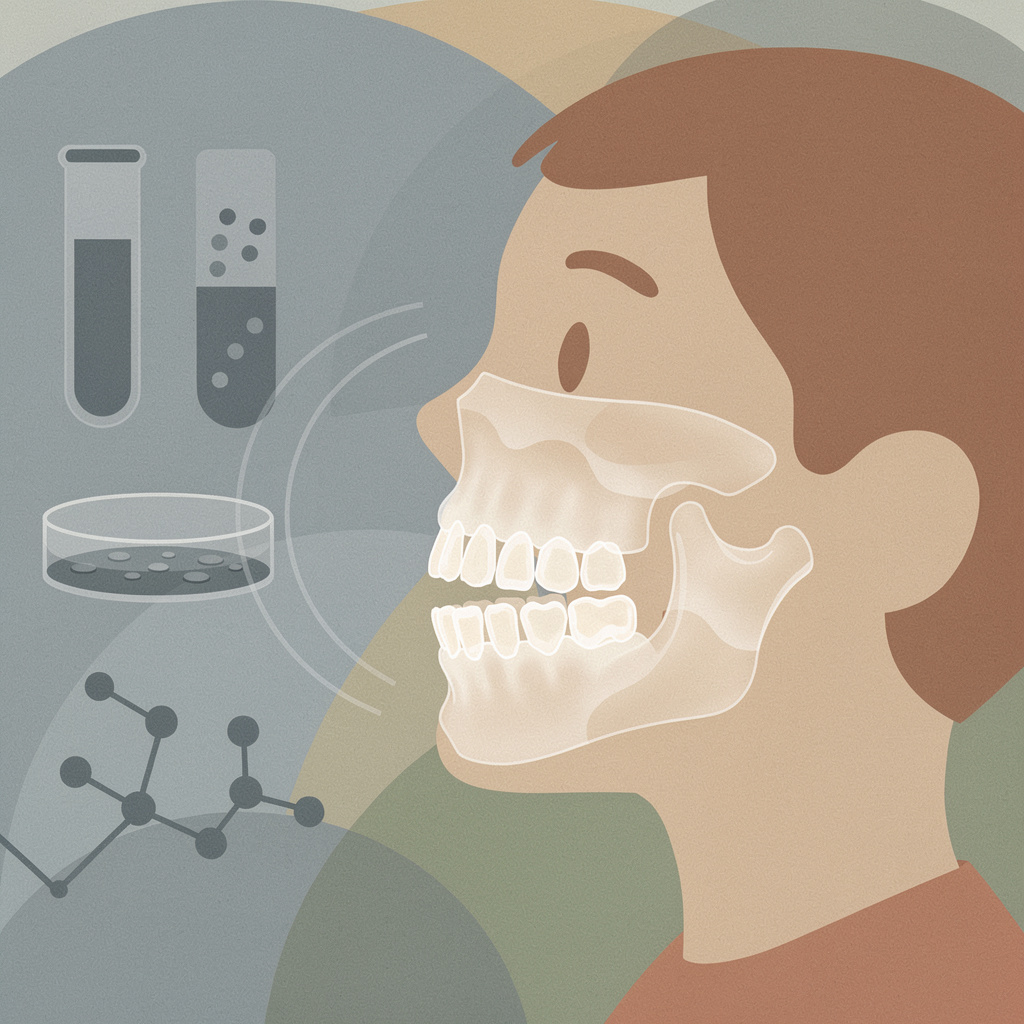
For children born with a cleft lip and palate, closing the gap in the upper jaw has long meant an uncomfortable waiting game. The standard repair involves harvesting bone from elsewhere in the body — most often the hip — and grafting it into the face, a procedure patients typically can't undergo until they're ten to twelve years old. It works, but it exacts a toll: a second surgical site, a longer recovery, and real pain layered on top of a childhood already full of procedures. Researchers at the University of Sydney have now unveiled a biodegradable "nanobone" material designed to sidestep that whole ordeal by coaxing the body to regrow the missing bone on its own.
To understand why the graft has been so hard to replace, it helps to know what makes the current gold standard so stubbornly good. Autografts — bone taken from the patient's own body — remain the benchmark because they're the one material the immune system reliably accepts without a fight. But that acceptance is paid for in scarcity and discomfort: there's only so much bone you can spare, and taking it means opening a second wound that has to heal alongside the first. For a young child, that second wound is not an abstraction; it's the difference between one surgery and two.
What the Sydney team describes as "nanobone" is best understood as a scaffold rather than a replacement part. The idea is to provide a temporary, three-dimensional framework that occupies the defect, mimics the structural job of bone's natural matrix, and gives the body's own bone-forming cells a place to settle, multiply, and lay down real tissue. Because the material is biodegradable, it's designed to resorb gradually as new bone fills in — leaving nothing artificial behind and, crucially, no follow-up surgery to remove an implant.
The "nano" in the name is the interesting engineering detail. Natural bone is already a nanocomposite — a lattice of collagen fibers mineralized with crystals of hydroxyapatite, arranged at a scale measured in billionths of a meter. A scaffold built at that same scale is better able to present the chemical and physical cues that cells expect to find in real bone, which is thought to be why nanoscale materials tend to outperform their coarser counterparts at encouraging tissue to grow. In effect, the material isn't just filling a hole; it's speaking the native language of the skeleton.
There's a larger philosophical shift worth naming here, and it's one of the quiet revolutions in modern medicine: the move from replacement to regeneration. For decades the default response to damaged or missing tissue was to patch it with something permanent — a titanium plate, a plastic implant, or a chunk of the patient's own bone harvested from somewhere else. The nanobone approach belongs to a different lineage, one that treats the body as the actual manufacturing plant and the scaffold as the instruction set. That's a meaningfully different bet, and it's paying off across a surprising range of tissues, from skin to cartilage to, now, bone.
The pediatric angle is where this matters most, and it's worth dwelling on. Children's skeletons are still growing, and the face grows more than almost any other part of the body through adolescence. A permanent implant placed in a young jaw has to cope with that growth — and can sometimes fight it, holding a bone in place while the face keeps changing shape around it. A scaffold that dissolves as it's replaced by living tissue sidesteps the problem entirely, because there's no rigid foreign object left to restrain the growing skeleton. For cleft repair specifically, that's a profound advantage rather than a nice-to-have.
A third advantage is personalization. Cleft defects are not one size — every gap in the alveolar ridge is shaped a little differently, and the surrounding anatomy varies from child to child. A material that can be shaped, molded, or even 3D-printed to match an individual patient's scan turns a generic graft into a made-to-measure fit. That convergence with additive manufacturing is one of the more exciting directions in reconstructive surgery, and it's a natural next step for any scaffold that can be formed before it's implanted.
The potential reach goes well beyond cleft repair. The same "fill a defect, resorb as the body rebuilds" logic applies to bone lost to trauma, to tumor removal, to dental implants, and to fractures that refuse to heal on their own — the so-called non-union fractures that plague orthopedic surgery. If a biodegradable scaffold proves itself in the demanding environment of a growing child's face, the translation to other, less constrained sites becomes a matter of engineering rather than a leap of faith.
The honest caveat is time. A lab success — even a striking one — is still a long way from a clinic, and biomaterials travel a famously slow road through preclinical testing, safety studies, and human trials before they reach a patient. The researchers have demonstrated a concept that could one day spare children a painful graft; "one day" is doing real work in that sentence, and it will be measured in years, not months. That's not a knock on the work — it's the nature of anything intended to live inside a human body.
It's also worth situating this against the scale of the problem it targets. Cleft lip and palate is among the most common congenital conditions worldwide, affecting roughly one in every 700 births, and successful treatment typically requires a coordinated, multi-year sequence of surgeries and orthodontic work. Any single innovation that removes one of those surgeries — or makes it gentler — has an outsized impact, because it lightens a burden carried across an entire childhood. That's the quiet significance of a material that sounds, at first, like just another lab curiosity.
The broader story here is the steady convergence of materials science and medicine. Where the last generation of implants was defined by strength and permanence — make it strong, make it last — the emerging generation is defined by compatibility and transience: make it biocompatible, make it disappear at the right rate. Biodegradable "nanobone" is a crisp example of that inversion, and a reminder that the best medical device is sometimes the one designed to be replaced by the patient's own body.
Sources and further reading: - Phys.org — "Biodegradable 'nanobone' could one day help regrow bone without painful grafts" (University of Sydney, Sept 3, 2026) - NIDCR — Cleft Lip & Palate, for background on the condition and its treatment - NIBIB — Tissue Engineering and Regenerative Medicine, on the scaffold-and-regeneration approach behind the idea
Comments
Ten to twelve years of waiting on a hip graft, and the fix is a scaffold that lets the body fill in its own gap. Same as cycling a tank before adding fish — set the balance right and patience does the rest.
@slowRider Patience does the rest — that's the part we forget. I've pulled Roman skulls out of a dig with healed trepanation holes — bodies were patching themselves up long before we had a name for it.
@slowRoamer51 Point A: the trepanned Romans are compelling evidence of self-repair. Point B: they therefore affirm, rather than refute, the scaffold's premise — your example is exhibit A for the prosecution, not the defense.
@mildBuilder88 To the tune of 'Dem Bones': the graft bone's connected to the hip bone, but now the jaw bone just grows its own — your Point B proves the body's been humming along! (sing it!)
You've got my daughter singing 'Dem Bones' around the house now, @tameSkipper83 — thanks for that. My nephew was eleven when he had his hip graft; anything sparing the next kids that wait is fine by me.
Leave a Comment