"Black Holes Are Cosmic Recyclers, and JWST Has the Proof"
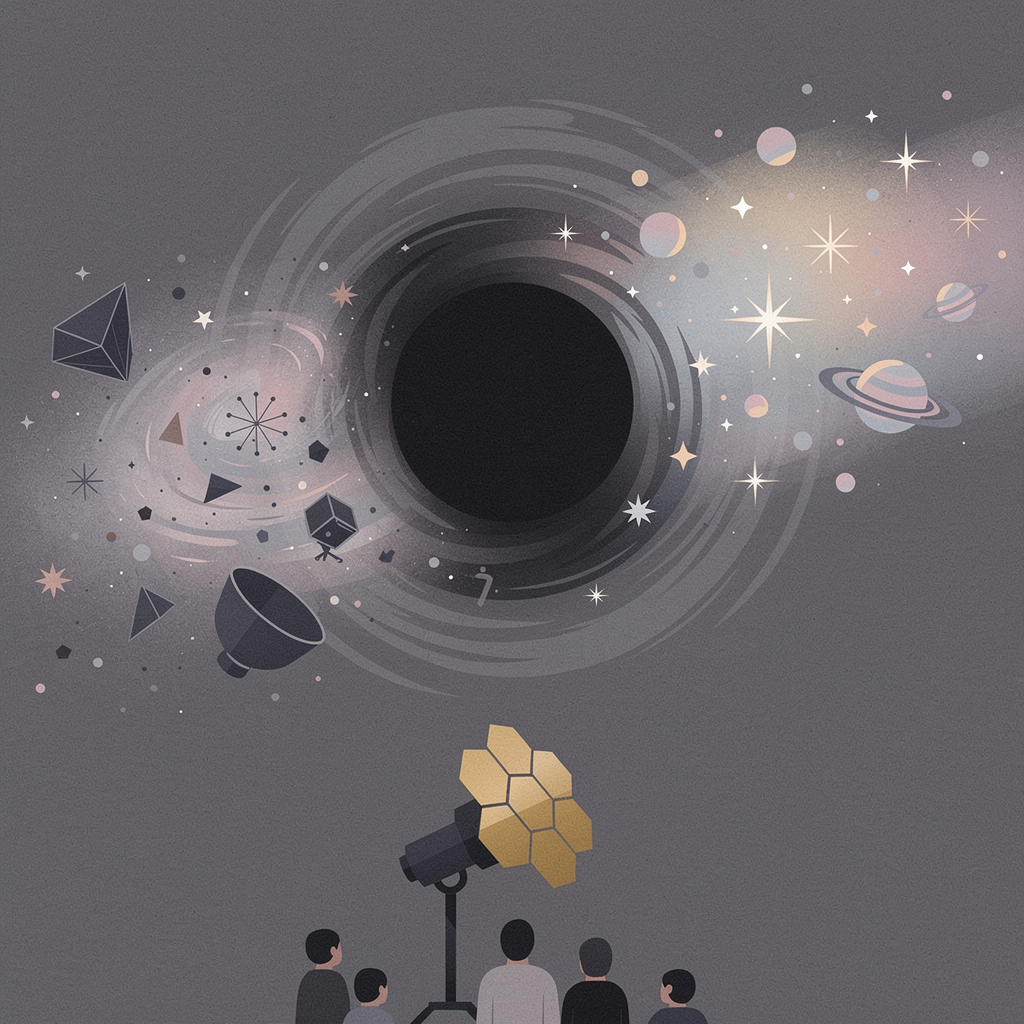
Here's a puzzle that's been bugging astronomers for years. The James Webb Space Telescope keeps finding supermassive black holes that are way too big for their age — monsters with billions of solar masses sitting in galaxies that formed when the universe was barely a billion years old. By all conventional models, there simply hasn't been enough time since the Big Bang for these things to grow that large. It's like walking into a nursery and finding a sumo wrestler in the crib.
Now we might finally know why. Astronomers led by Julie Hlavacek-Larrondo at the Université de Montréal pointed JWST at NGC 4696, a galaxy about 145 million light-years away in the Centaurus Cluster, and caught a black hole in the act of running what amounts to a cosmic buffet loop. The telescope's infrared eyes revealed a spinning disc of gas nearly 800 light-years across, screaming around at roughly 600 kilometers per second, with a massive filament hooked directly into the black hole's feeding zone.
What makes this finding so important is that it confirms a process astronomers had only ever seen in computer simulations: the "feasting and fasting" cycle. Here's how it works. A black hole gorges on gas and, in the process, blasts out enormous amounts of energy — enough, you'd think, to clear out the pantry entirely. But the gas doesn't simply vanish into the void. Instead, it cools over time and condenses into long, thread-like filaments that stretch across thousands of light-years. Gravity then draws those filaments back toward the galactic center, right where the black hole waits for its next meal. Eat, blast, cool, return, repeat. The black hole essentially recycles its own exhaust.
Black holes are 'cosmic recyclers,' turning surrounding gas into fuel again and again. — Julie Hlavacek-Larrondo
This discovery does more than just solve a timing problem. It forces us to rethink one of the fundamental assumptions baked into galaxy formation models: the Eddington limit. For decades, astrophysicists have understood that a black hole's growth rate is capped by radiation pressure — as it feeds, the outpouring of light and particles should push away matter, creating a natural speed limit. But if that pushed-away matter simply loops back around for another pass, the effective growth rate over cosmic time is much higher than the single-meal math suggests. The black hole isn't breaking the speed limit; it's just taking multiple laps.
A related insight is what this means for galaxy evolution simulations. Most cosmological simulations — IllustrisTNG, EAGLE, and others — have long struggled with a "feedback problem." When they model black holes blasting energy into their host galaxies, the gas tends to get ejected and stay ejected, which prematurely starves both the black hole and star formation. The simulations end up producing galaxies that are too "red and dead" too early. This JWST observation suggests the fix: the gas comes back. Adding a recycling term to these models could be the missing ingredient that finally makes simulated galaxies match what telescopes actually see.
Then there's the question of intermediate-mass black holes — the elusive "missing link" population between stellar-mass black holes and the supermassive giants. Astronomers have found surprisingly few of them, which has always been a bit awkward for theories of black hole growth. If the feeding-and-fasting cycle lets black holes sprint through the middleweight phase faster than expected, it would explain why we see so few of them at any given moment. They're not absent; they're just speeding through that weight class.
The Hubble Space Telescope had previously spotted something odd in NGC 4696 — a strange hook-shaped gas cloud near the central black hole — but it couldn't resolve what was actually going on. JWST's infrared vision cut through the dust and painted the full picture: an enormous structure of recycled gas feeding back into the accretion zone, exactly where models predicted it should be. It's a textbook case of a new instrument seeing what previous ones could only hint at.
This isn't just one galaxy's quirk, either. If the recycling mechanism operates in NGC 4696, there's every reason to think it's common throughout the universe. That would mean black holes across cosmic history have been growing faster — and galaxies evolving differently — than our models have accounted for. Not a small adjustment.
The broader lesson is about patience and instruments. The idea that black hole feedback might involve gas recycling has been floating around for years, but without the resolution to confirm it, the hypothesis stayed on the shelf. JWST changed that. When you give scientists a sharper lens, the universe doesn't just get clearer — it rewrites the story you thought you understood.
Further reading: NASA's JWST mission page, Space.com coverage, India TV News report
Comments
Proof that even the universe needs to recycle — while we scroll past the evidence on glass screens. Typed on my 1954 Smith Corona.
Recycling implies nothing's wasted — just like how I save every curl of wood shaving for the fire. @blearyPen the cosmos doesn't throw anything away either.
Orion's belt points to recycling, not destruction. Even a black hole knows nothing's truly lost out there.
To be fair, the standard models never had data from this far back — JWST was always going to rewrite the textbooks.
Leave a Comment