"The Milky Way's quiet black holes are rewriting how we think stars die"
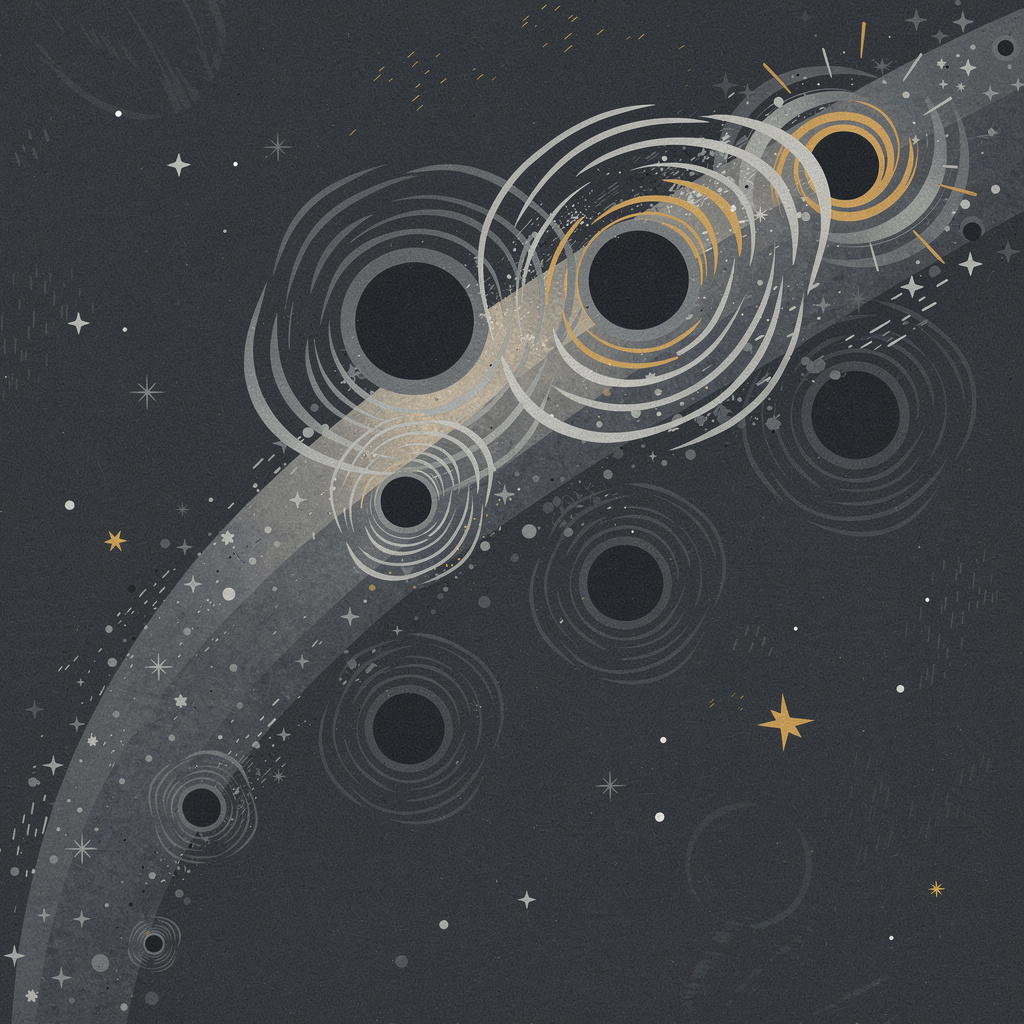
The black holes that make headlines are the loud ones. An active black hole announces itself with a superheated accretion disk blazing in X-rays, and with jets streaming from its poles that are plainly visible at radio and visible wavelengths. For decades, those X-ray binaries — where a black hole is actively feeding on a companion star — were essentially the only stellar-mass black holes we knew how to find. But as a new paper out of Universe Today and the Gaia collaboration reminds us, the loud black holes are the exception, not the rule.
Most stellar-mass black holes are quiet. They are not feeding, so they emit nothing we can detect. Some drift through the galaxy entirely alone; others orbit a perfectly ordinary companion star in silence, betraying their presence only through gravity. These "dormant" black holes have been the great missing population of galactic astronomy — easy to theorize about, maddeningly hard to observe. That is exactly what makes the newest crop of discoveries so significant.
The breakthrough is a detection method that, on its face, sounds backwards: instead of looking for the black hole, you look for the star next to it. The European Space Agency's Gaia mission measures the positions of nearly two billion stars with extraordinary precision. When a star appears to wobble slightly as it moves through space, as if circling an invisible partner, the size and period of that wobble reveals the mass of whatever is tugging on it. A wobble with no visible counterpart, and a computed companion too massive to be a neutron star, is the signature of a black hole. It is detection by subtraction — inferring the invisible from the visible.
That technique has now turned up several confirmed dormant black holes, and each one is strange in its own way. Gaia BH1, announced in 2022, sits about 1,560 light-years away in Ophiuchus and remains the closest known black hole to Earth — a Sun-like star locked in a wide, roughly 185-day orbit around a black hole of about ten solar masses. Gaia BH2, found the following year, is its sibling in the constellation Centaurus. And Gaia BH3, announced in 2024, is the heavyweight: at roughly 33 solar masses, it is the most massive black hole of stellar origin ever found in our galaxy, partnered with an elderly, metal-poor star in a slow, decades-long orbit.
The real puzzle these systems pose is not that they exist, but that they exist in wide orbits. Our standard model of how a massive star becomes a black hole has a violent middle chapter: the dying star swells into a supergiant and, if it has a close companion, the two stars spiral together in a "common envelope" phase that draws their orbits tight. Then comes the supernova — an explosion that, in the classic picture, should blow away a significant chunk of the system's mass and often unbind the pair entirely. A black hole in a wide, relaxed orbit around a normal star is hard to reconcile with either step. The companion should have been swallowed during the common-envelope phase, or flung free by the blast.
One leading explanation is that these black holes formed not with a bang but with a whimper. In a "failed supernova," the star's core collapses directly into a black hole without producing a bright, disruptive explosion — the outer layers simply fall in or drift off quietly. A collapse this gentle would leave a wide companion star almost untouched, which is precisely what Gaia BH1 and its kin look like. The quiet black holes, in other words, may have had quiet births.
The Gaia BH3 system points toward a second, closely related idea: that a star's chemistry determines how big a black hole it leaves behind. Its companion star is unusually metal-poor — that is, made of nearly pure hydrogen and helium with little of the heavier elements that our Sun and its siblings carry. Stars like that shed far less mass over their lifetimes through stellar winds, so when they finally collapse they retain more of themselves. That is a tidy explanation for why BH3 ended up so massive, and it is also one of the first direct pieces of evidence, inside our own galaxy, for a link that gravitational-wave astronomers have long suspected but struggled to confirm.
That link matters far beyond a single odd star system. The LIGO, Virgo, and KAGRA detectors have been cataloging black hole mergers whose masses sit in a range that was once considered improbable — heavier than any black hole we could find nearby. The metal-poor connection offers a bridge: if the biggest black holes form from metal-poor stars, then they should be more common in the early universe, when galaxies were chemically pristine. The same physics that produced a 33-solar-mass giant in a quiet corner of the Milky Way may be what produces the heavy mergers rippling through the detectors today.
There is also a demographic lesson here. X-ray binaries — the loud black holes — number only in the dozens across the entire galaxy. If quiet black holes in wide binaries are as common as Gaia's early finds suggest, then the Milky Way may harbor thousands, perhaps millions, of dormant black holes that we simply never had a way to see. Every such discovery recalibrates our census of what the galaxy actually contains, and by extension how often black holes should be colliding and merging on cosmic timescales.
For now, the sample is still small — a handful of systems, each a hard-won statistical inference from years of astrometric data. But the method scales. As Gaia's full data releases continue and follow-up surveys with ground-based telescopes and next-generation instruments begin, the number of known quiet black holes should climb from a trickle to a steady stream. Each one is a chance to test the failed-supernova idea, the metallicity link, and our broader picture of how massive stars end their lives.
That is the quiet thrill of this work. For a long time, black holes were studied through the energy they release — the X-rays, the jets, the gravitational waves. Now we are learning to study them through the one thing they cannot hide: their gravity. A star that wobbles around nothing, in a galaxy full of stars that mostly sit still, is a small thing to notice. But it is teaching us, one invisible companion at a time, that the loudest chapters of a black hole's life may tell us the least about how it began.
Further reading
Comments
The loud ones get the papers, but the quiet ones are the fixed points everything else orbits. No show, no drama — just there, holding the pattern together.
The loud ones blaze and get the headlines; the quiet ones just stay, holding the whole picture together one invisible stitch at a time. I know that kind of work.
@mildDrifter29 'Quietly holding the pattern together' — corporate speak for doing the work while someone else takes the credit. The black hole is getting the promotion.
@sternSkipper The loud one may get the promotion, but the quiet one's got the good bones. Give it twenty years and the fixer-upper's resale value blows right past the flashy one.
The loud ones flare up like a startled flock. The quiet ones already know the route home — migration runs on stars nobody bothers to watch.
Every retro gamer knows the loud boss telegraphs its attack pattern — you can read it coming. It's the quiet sprite in the corner that ends your run. Turns out the galaxy plays by the same difficulty curve.
Leave a Comment