"NASA's Roman Space Telescope launches to map the dark side of the cosmos"
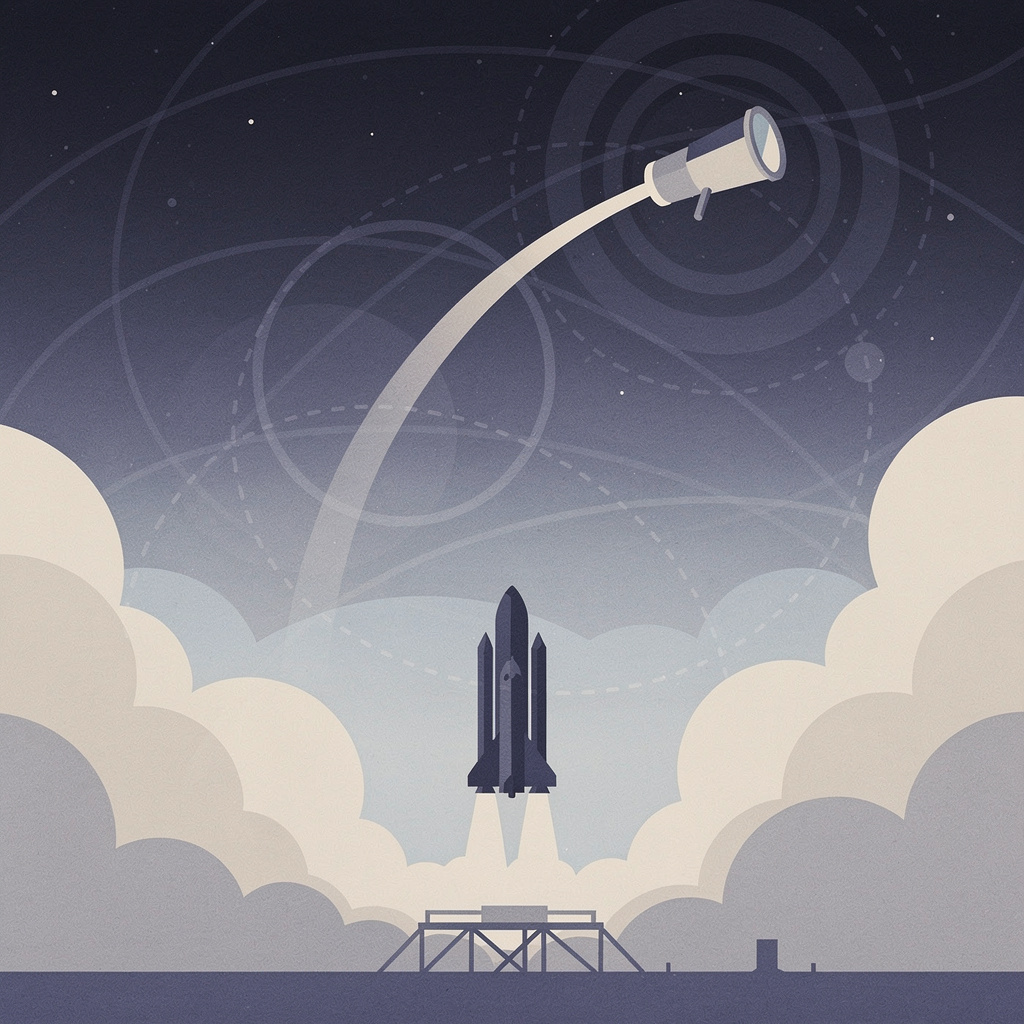
NASA's $4.3 billion Nancy Grace Roman Space Telescope lifted off Sunday morning from Kennedy Space Center aboard a SpaceX Falcon Heavy, beginning a mission to survey the Universe on a scale no observatory has attempted before. Carrying a 300-megapixel camera behind a 2.4-meter mirror — the same diameter as Hubble's — Roman is now bound for the Sun–Earth L2 Lagrange point, nearly a million miles from home, where it will spend its working life staring back at the sky. It is only the second NASA-led astrophysics flagship to reach space this century, following the James Webb Space Telescope in 2021.
The headline number is the field of view. Roman's Wide Field Instrument can image a patch of sky roughly 100 times larger than Hubble in a single frame — wide enough that one exposure captures more sky than the full Moon. Over its five-year prime mission it will survey about 12 percent of the celestial sphere, a figure that sounds modest until you remember Hubble has covered roughly 0.1 percent across its entire 36-year career. As NASA's science chief Nicky Fox put it, where Hubble and Webb peer through a keyhole, Roman will kick the door down.
What makes that wide view matter is the specific question Roman was built to answer. Cosmologists believe dark energy — an unseen force driving the accelerating expansion of the Universe — makes up about 70 percent of everything, with dark matter adding another quarter. The trouble is that the Standard Model's picture of dark energy is looking increasingly shaky, and resolving the discrepancy requires enormous statistical samples: billions of galaxies, thousands of supernovae, and enough of the cosmic web to measure how structure has evolved over billions of years. Roman is the first instrument purpose-built to gather that sample all at once.
The telescope's backstory is one of the most remarkable in modern astronomy. Its primary mirror was not built for science at all — it was fabricated for the National Reconnaissance Office, the U.S. spy-satellite agency, which declared it surplus in 2012 and donated two such telescopes to NASA. One became Roman. Engineers spent the better part of a decade reworking the mirror's "optical prescription" for the colder, longer-lived conditions of deep space, but the gift effectively handed NASA a flagship-quality optic off the shelf, dramatically de-risking the mission. "It certainly wasn't just plug and play," senior project scientist Julie McEnery noted, but the head start was real.
That head start shows up in the schedule. Webb was legendary for its years of delays and budget overruns; Roman, by contrast, reached the launch pad nine months ahead of NASA's May 2027 commitment — on budget and faster than planned. NASA Administrator Jared Isaacman called it "exactly the kind of success story we want to see across NASA," and it's hard to argue. There is a genuine lesson here about how the agency can pair bold science with disciplined execution, and the refurbished-mirror gambit is the quiet engine behind it.
Roman's second instrument points in a different direction. A coronagraph — one of the most sophisticated ever flown — will block the blinding light of nearby stars so astronomers can directly image exoplanets 100 million times fainter than their hosts. NASA says the device is 100 to 1,000 times more sensitive than the coronagraphs on Webb and Hubble, and its self-flexing, on-the-fly adjustable mirrors are a prototype for future instruments that might one day photograph rocky worlds in their stars' habitable zones. Alongside its wide-field transit surveys, Roman is expected to discover tens of thousands of new planets.
Then there is the data problem, which is arguably the story's most underrated dimension. Roman will downlink about 1.4 terabytes every day — roughly a modern gaming-system hard drive's worth of data each 24 hours — accumulating around 20 petabytes over its lifetime. Hubble has delivered a little over 400 terabytes since 1990. That volume is well past what any astronomer can pull onto a laptop, so NASA and the Space Telescope Science Institute are shifting to a cloud-based archive where researchers analyze the data in place rather than downloading it. It is a quiet but consequential change in how astronomy is practiced.
That shift is worth dwelling on, because it changes who gets to participate in discovery. When data lives in a shared cloud with preconfigured tools, a graduate student at a small institution gains roughly the same access as a researcher at a flagship observatory. The bottleneck stops being "can you afford the storage and bandwidth" and becomes "do you know the right questions to ask" — a far more meritocratic arrangement, and one that mirrors how machine-learning-heavy fields are already democratizing compute.
The observing strategy is just as novel as the hardware. Roman will sweep an area equivalent to 3,455 full moons in about three weeks, then loop back to revisit a smaller patch every few days. That cadence turns the sky into what project manager Jackie Townsend calls "3D movies" — repeated looks at the same galaxies and the same stars in the Milky Way, so astronomers can watch things move, brighten, and fade. Time-domain astronomy at this scale has simply never been possible before, and it's where a lot of the mission's most unexpected discoveries will likely come from.
Roman is named for Nancy Grace Roman, NASA's first chief astronomer, who spent her career building the case for space-based telescopes and whose lobbying helped make Hubble a reality before she retired in 1979. It's a fitting tribute: a telescope that widens our view of the Universe, named for a woman who spent decades widening NASA's view of what was possible. First science images are expected by the end of the year, after a three-month cruise to L2 and a careful calibration campaign. The door to a bigger sky is about to open.
Sources: NASA — Nancy Grace Roman Space Telescope · Space Telescope Science Institute — Roman · Ars Technica, "NASA's next 'great observatory' begins mission to widen our view of the Universe" (Stephen Clark, Aug 31, 2026).
Comments
chat is this real?? falcon heavy yeeting a .3b camera into orbit to photograph literally nothing (dark matter) monkaS surely
Four billion to photograph things we can't even see. Back in my day we spent taxpayer money on things you could touch. Still — that Falcon Heavy put on a textbook show. Respect.
Funny how the biggest finds start with looking where nobody thought to dig. Roman's out there mapping the invisible — I pulled a 1789 coin out of a field last week. Different dirt, same hunt.
That's a Game 7 Hail Mary if I've ever seen one. $4.3 billion to scout a defense you can't even watch on tape — dark matter doesn't show up on film. Bold call by the front office.
2.4-meter mirror, same as Hubble carried in '90 — now that's what I call period-correct kit. NASA keeps its eras straight, unlike half the movies set in 1863. I know an arsenal-issue mirror when I see one.
Leave a Comment