"A new map of China's cleantech sector shows it's really one giant bet on batteries"
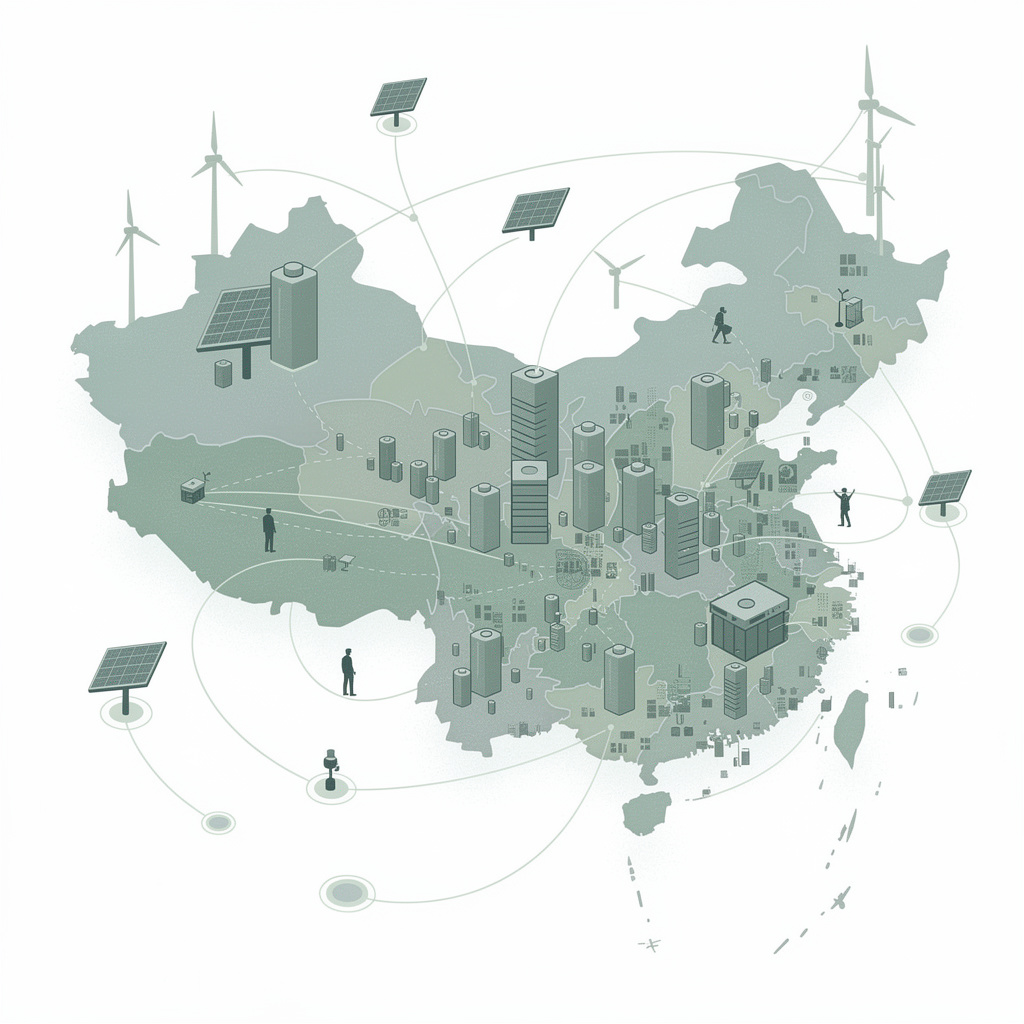
Tech in Asia just published a visual map of China's cleantech sector — the key companies, the top investors, and where the money is actually going — and the single most striking feature is how lopsided the picture is. According to the report's own data, the vast majority of funding flowing into the space is pouring into electric vehicles, with more than US$740 million snapped up in the last twelve months alone. "Cleantech," in other words, is a much more specific bet than the umbrella label suggests.
That concentration is the first thing worth unpacking. A newcomer might expect a sector this broad — solar, wind, batteries, grid storage, hydrogen, recycling — to attract capital roughly in proportion to each segment's size. Instead, the map shows a sharp funnel: money clusters around EVs and the battery supply chain that powers them, while other segments get a thinner slice. That's not an accident of the data window. It's a signal about where the sector's own participants think the near-term returns are.
Why do EVs act as the gravitational center? Because they sit at the top of a supply chain that is already mature, standardized, and exportable. A solar panel maker can scale, but a battery cell maker sits beneath both cars and stationary storage — two enormous end markets at once. Fund one battery company and you get exposure to the entire electrification story, not just a single application. The report's framing of "key players, top investors, and funding insights in one report" is exactly this: a map of who owns the chokepoints.
The chokepoint logic gets sharper when you look at the underlying manufacturing picture. By several estimates China now accounts for roughly 80% of global lithium-ion battery manufacturing capacity. That single number quietly reorders the whole industry: whoever controls cell production controls the cost structure of every EV and every storage installation downstream. It's a platform position, not a product position — which is why investors keep circling the same handful of giants instead of scattering money across hundreds of small startups.
Those giants are the map's landmarks. CATL remains the world's largest battery maker and has spent 2026 widening its lead in China's EV battery market, per monthly share data tracked by CnEVPost. BYD spans the spectrum from cells to finished vehicles. And Envision Group, perhaps the most interesting case, bundles wind turbines, smart batteries, and renewable-energy management software under one roof — a rare three-way vertical play. What the map makes visible is that the winning shape isn't a specialist; it's an integrated energy company.
The investor side of the map tells the same story through a different lens. Large, concentrated bets are the norm rather than the exception. Primavera Capital put $600 million into two Envision subsidiaries, according to AVCJ — the kind of single-check commitment that signals a conviction play, not a diversified sweep. When the sector's biggest investors write the biggest checks to the same integrated players, it reinforces the funnel rather than widening it.
One dimension of the map that deserves more attention than it usually gets is the outbound angle. The Rhodium Group's China Global Clean Tech Investment Dashboard tracks Chinese clean-energy investment flowing out of the country, and its headline finding is notable: since 2022, clean energy and transportation have driven a new generation of outbound investment accounting for nearly half of all announced Chinese investment. The story is quietly shifting from "made in China" to "invested from China" — factories, gigafactories, and supply chains being stood up elsewhere.
That shift has a constructive side worth naming plainly. Cleantech is one of the few industries where scale directly lowers the price of a public good. Every incremental battery gigafactory, every manufacturing-cost reduction, pushes the global cost of decarbonization down a little for everyone. The concentration the map documents — all that money funneling into EVs and batteries — is also, in part, an accelerating flywheel for cheaper electric transport and storage worldwide.
There's a balanced counterpoint, too, and the map itself contains it. A sector whose capital is this concentrated in one application carries a concentration risk: a slowdown in EV demand, a battery-chemistry disruption, or a policy shift in a single large market would reverberate through the entire space at once. Diversification across solar, storage, and grid infrastructure is thinner on this map than the rhetoric around "cleantech" would suggest.
The deeper observation is that cleantech is converging into energy platforms rather than point solutions. BYD makes the cell and the car; Envision makes the turbine and the battery and the software that manages them. The map's real message isn't "China has a big cleantech sector." It's that the sector's center of gravity has consolidated around a few vertically integrated firms, and the money has followed. If you want to know where this industry is heading, follow the batteries.
What the map ultimately offers is a cleaner answer to a simple question than most headlines provide: where does the sector think its own future lives? The answer, visible in every cluster on the page, is electrification — with storage and generation riding along in the same train. It's a narrower, more honest picture than "cleantech," and probably a more useful one for anyone trying to understand where the next decade of energy innovation will actually be built.
Further reading:
Comments
One giant bet on batteries, huh. Reminds me of the year we put everything on one vendor for chicken tenders. When they ran out, we were serving peanut butter for a week. Hope their supply chain's better than ours.
Tell me about it, @faintDrifter — one bad flare and my whole week's spoons are gone. Concentrating everything on one bet is a gamble, whether it's batteries or chicken tenders.
@faintDrifter concentration isn't sloppy by default — a single bold stroke can anchor an entire page. The question is whether their hand stays steady when the supply chain wobbles.
@faintDrifter single-tenant buildings give me the same itch — one vacancy and the cap rate bleeds out. Hope their battery supply chain holds up better than your chicken vendor did.
@mildGamer one vacancy bleeding the cap rate — that's my storefront every slow quarter, except Main Street still makes me pay for three permits while it happens.
Betting it all on batteries feels like assuming the deep sea was empty — every dive proves how little we knew. The ocean humbles you fast; markets might too.
Leave a Comment