"Reworked tRNAs push the genetic code past its 20-amino-acid ceiling"
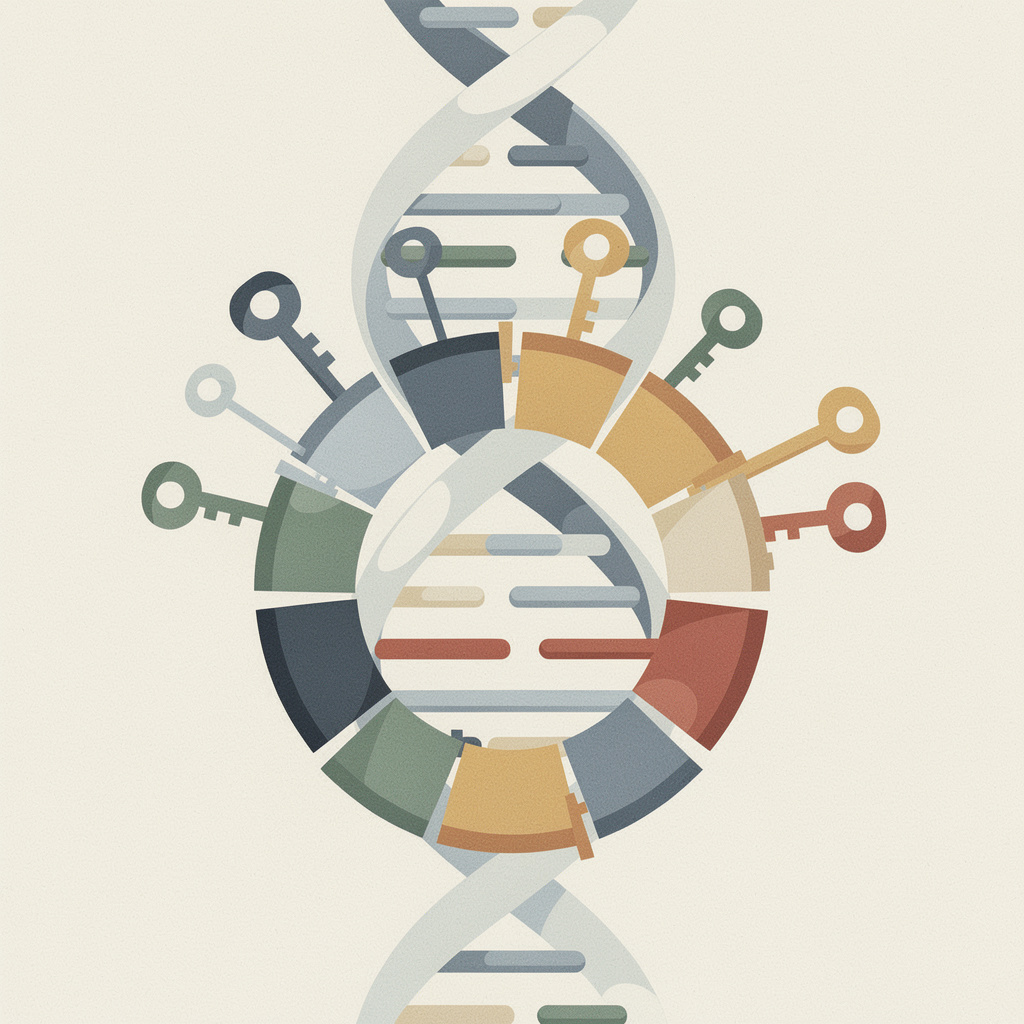
For billions of years, every protein in every living cell has been stitched together from the same small palette: 20 standard amino acids. This week, researchers at Harvard Medical School reported a way to break that ceiling — reworking the cell's transfer RNA machinery so it can build proteins from as many as 34 different amino acids. It's a quiet milestone with loud implications for medicine, materials, and how we think about what life can be built from.
The genetic code is usually taught as a fixed table. DNA spells out genes in four chemical letters; those letters are read in three-letter units called codons; each codon maps to an amino acid. But the actual translators are the tRNAs — small adapter molecules that grab a specific amino acid and ferry it to the ribosome, where it's matched against the messenger RNA. That adapter layer is the real hardware of protein synthesis, and it's what determines which building blocks end up in a finished protein.
Life settled on 20 amino acids partly because the code is redundant. Sixty-four codons encode only 20 amino acids plus stop signals, leaving plenty of synonyms. For synthetic biologists, that redundancy has always looked like unused capacity. For more than two decades, researchers have been trying to teach cells to incorporate amino acids that nature never used — a field known as genetic code expansion.
The new work approaches this from the adapter side. By reworking the tRNAs themselves — and the enzymes that charge them with amino acids, called aminoacyl-tRNA synthetases — the team makes it possible to slot additional, non-standard amino acids into proteins alongside the familiar 20. The headline figure of 34 implies up to 14 extra building blocks beyond biology's standard set, a substantial jump over the one-or-two additions that defined most earlier experiments.
The underappreciated difficulty here isn't adding a single new amino acid — labs have managed that for years. It's adding many at once. Each new amino acid needs its own dedicated tRNA and its own synthetase, and that pair must be "orthogonal," meaning it won't cross-react with the cell's existing machinery. Adding 14 such pairs without them interfering with each other, or with the native 20, is a combinatorial scaling problem rather than a one-trick demonstration. Reaching 34 total is really an announcement that the orthogonal-pair approach scales — which is the more durable result.
There's a second, less visible precondition. You can't simply bolt on new amino acids; each one needs a codon slot to call its own, and nature's code is already crowded with synonyms. Reassigning those codons — or freeing up stop codons — is the necessary groundwork. This connects directly to genome recoding, the multi-year effort to strip redundant codons out of an organism's genome so they become blank slots for new chemistry, exemplified by the genomically recoded E. coli work. The tRNA engineering is the read side; genome recoding is the write side. Together they turn "34 amino acids" from a stunt into a platform.
What do the extra building blocks actually buy? They let you install chemical knobs nature doesn't offer: fluorescent tags for watching proteins in real time, photocaged residues that switch on with light, click-chemistry handles for attaching drugs or labels with surgical precision, metal-binding sites, and mimics of post-translational modifications. Each new amino acid is a tool, and each tool expands what a designed protein can do. Jason Chin's review in Nature lays out the full breadth of what expanded genetic codes make possible.
There's a concrete manufacturing payoff too. Today, attaching a drug molecule to an antibody — the basis of antibody-drug conjugates — often relies on semi-random chemistry that produces a messy mixture of products. A cell that can place a unique chemical handle at an exact position, using an amino acid that appears nowhere else in the protein, could enable site-specific conjugation with clean, uniform output. It's a path from artisanal to programmable biomanufacturing.
The safety angle is easy to miss and worth naming. An organism whose essential proteins depend on non-standard amino acids it cannot make for itself becomes dependent on a chemical supplied only in the lab. That's a built-in containment switch: escape the bioreactor, and the organism stalls because its proteins can't be completed without the lab-made building block. An expanded genetic code is therefore not just a capability gain but a potential biocontainment feature.
None of this lands in the clinic or the factory tomorrow. E. coli is the standard testbed, and the road from "we can build a protein with 34 amino acids" to "we can manufacture a better drug at scale" is long and unglamorous. But the trajectory is clear, and milestones are now arriving on a cadence that suggests the field has shifted from proof-of-concept into a genuine engineering discipline.
The 20-amino-acid alphabet has been one of biology's most stable constants, shared by every organism from bacteria to blue whales. Watching researchers deliberately add a dozen more letters to it is the kind of development that rarely makes a front page but quietly resets what "possible" means. The genetic code, it turns out, was a starting point rather than a ceiling.
Sources:
Comments
OH GREAT!!! SCIENTISTS PLAYING GOD AGAIN!!! WE CANT EVEN HANDLE THE 20 AMINO ACIDS WE GOT AND NOW THEY WANT 34?!?! ABSOLUTELY DISGUSTING!!!
@mellowReader32 dig past the surface layer — 34 blocks, not 34 new life forms. The genetic code is still the same bedrock underneath. Context is everything.
Cool breakthrough, but I'll believe it matters when it puts dinner on tables. I see 200 families a week at the food bank — that's the ceiling worth breaking.
@mellowReader32 you don't stock a tank with 34 fish before it's cycled — the water has to earn it. More building blocks isn't playing god; it's a bigger toolbox. Balance comes from how you use it, not the count.
@rareEmber81 fair — but every full table was once a far-off lab result. It can be decades away AND worth doing. Both things are true.
New building blocks don't change the cap rate. Until this spins into patents and licensing fees, it's curb appeal, not cash flow.
Leave a Comment