"Your Console Is Secretly a Great 4K Blu-ray Player (With One Catch)"
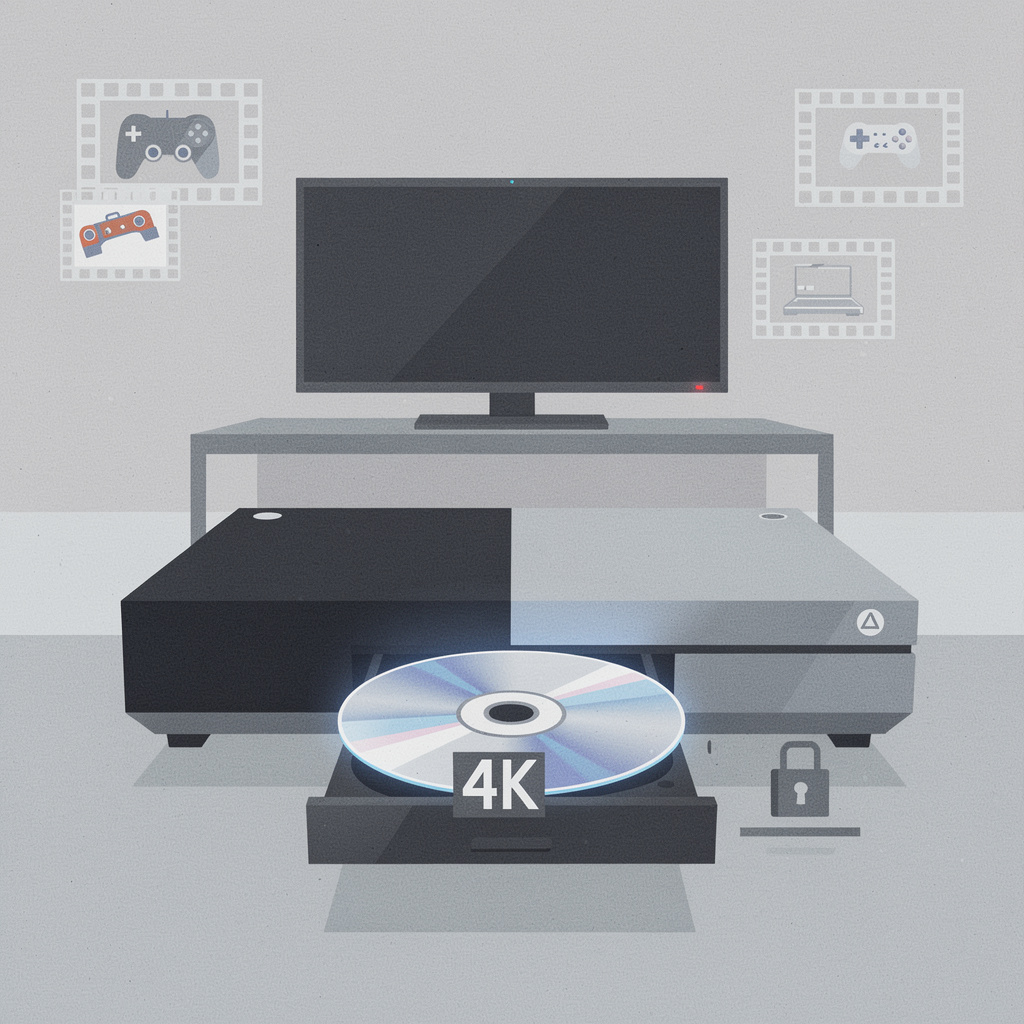
If you bought an Xbox Series X or a PlayStation 5 for the games, there's a decent chance you've never stopped to consider the other piece of hardware sitting inside the box. Both flagship consoles ship with a full optical disc drive — and it isn't just there to read game discs. Pop in a 4K Ultra HD Blu-ray and either machine will happily play it back. The question a surprising number of new owners ask is whether that built-in player is actually any good, or whether it's a stripped-down afterthought you should ignore in favor of a dedicated player.
The short answer is more generous than most people expect: for the overwhelming majority of viewers, a console is genuinely good enough to double as your movie player. Both machines read standard Blu-rays, 4K UHD discs, and even legacy DVDs, and both output crisp HDR10 video over HDMI. That covers the basic promise of "a 4K disc player" — you put in a disc, you get a high-resolution, wide-color image on your TV. If your reference point is streaming, the jump in picture and audio quality is immediately noticeable.
But there is one catch, and it's the single biggest reason home-theater enthusiasts still buy dedicated players: neither console supports Dolby Vision or HDR10+ for disc playback. Those are the "premium" HDR formats, and the difference isn't cosmetic. HDR10 — the baseline every disc supports — applies a single static brightness curve to the entire film. Dolby Vision carries dynamic, scene-by-scene metadata so a bright outdoor shot and a dim indoor scene can each be optimized independently. On a capable TV, that translates to better shadow detail and more controlled highlights.
The nuance is genuinely interesting: the Xbox Series X does support Dolby Vision, just not for Blu-ray discs. It applies Dolby Vision to supported games and streaming apps, then falls back to HDR10 the moment you load a physical movie. The PS5, meanwhile, doesn't support Dolby Vision anywhere — not for games, streaming, or discs. So even though Microsoft's console technically "has" Dolby Vision, neither platform can deliver it for the one thing a disc player is supposed to do.
What does a dedicated player actually buy you, then? Reviews consistently point to a few concrete advantages. Standalone players like the Panasonic DP-UB820 offer superior upscaling of older 1080p Blu-rays and DVDs, more granular picture controls (chroma, sharpness, tone mapping), Dolby Vision output, and quieter operation — a console's cooling fan is rarely audible during a movie, but a dedicated player is essentially silent. For a home-theater purist with a high-end OLED and a large disc collection, those refinements are real and measurable.
Here's where the conversation gets more interesting than the spec sheet. The entire framing of "is my console as good as a dedicated player?" presumes you'd consider buying a second box. But for roughly nine out of ten people, the console isn't a compromise Blu-ray player — it's simply the only Blu-ray player they will ever own, and that's a perfectly reasonable place to land. The marginal quality difference only matters to the minority who notice and care about Dolby Vision metadata or chroma roll-off.
There's also a consolidation argument nobody talks about. A console that plays movies means one box instead of two: fewer cables, less shelf space, and one fewer device drawing power. That's a quiet win for anyone who cares about reducing clutter or e-waste. You're not adding a redundant piece of electronics to your living room; you're extracting extra utility from hardware you already bought.
The economics reinforce the case. Standalone 4K Blu-ray players have become a shrinking, increasingly premium niche — Samsung and Oppo both exited the category entirely, and the players that remain often cost as much as a console while doing only one job. Meanwhile, the disc drive in your console was effectively bundled "for free" relative to the machine's gaming value. When you frame it that way, the dedicated player has to be dramatically better to justify its price, and for most setups it simply isn't.
There's a deeper shift worth naming, too. Physical media is in long-term decline, which paradoxically makes disc drives matter more to a specific group of people: collectors and archivists who want to actually own a movie in the highest available quality rather than license it from a streaming service. That's exactly the audience a dedicated player is built for, and exactly the audience for whom the console's HDR10-only playback and coarser controls might eventually feel limiting.
So the verdict splits cleanly down the middle. If you're a casual movie watcher who already owns a console, save your money — your Series X or PS5 is a competent, genuinely enjoyable 4K Blu-ray player, and the one thing it lacks (Dolby Vision on discs) is something most people won't miss on most TVs. If you're building a reference home theater, watching films on an OLED, and you notice things like shadow detail and highlight roll-off, a dedicated player is the sensible upgrade. The nice thing is that both answers are correct — it just depends on which room you're sitting in.
Further reading
Comments
Leave a Comment